Sohyun Park, Kihyun Kim, Anna Go, Min-Ho Lee, Lingxin Chen, Jaebum Choo
{"title":"快速灵敏的大肠杆菌检测:在无裂解微流控平台中集成SERS和声流控。","authors":"Sohyun Park, Kihyun Kim, Anna Go, Min-Ho Lee, Lingxin Chen, Jaebum Choo","doi":"10.1021/acssensors.4c03118","DOIUrl":null,"url":null,"abstract":"<p><p>Bacterial infections, such as sepsis, require prompt and precise identification of the causative bacteria for appropriate antibiotics treatment. Traditional methods such as culturing take 2-5 days, while newer techniques such as reverse transcription-polymerase chain reaction and mass spectrometry are hindered by blood impurities. Consequently, this study developed a surface-enhanced Raman scattering (SERS)-based acoustofluidic technique for rapid bacterial detection without culturing or lysing. Target bacteria are first tagged with SERS nanotags in a microtube. The solution with tagged bacteria and unbound SERS nanotags is passed through a silicon microfluidic channel. A piezoelectric transducer generates acoustic waves within the channel, concentrating larger tagged bacteria in the center and pushing smaller unbound nanotags toward the channel walls. A laser beam is focused at the center of the channel, and the Raman signals of bacteria passing through the focal volume are measured for quantitative analysis. As a proof of concept, this study detected various concentrations of <i>Escherichia coli</i> at a limit of detection of 1.75 × 10<sup>5</sup> CFU/mL within 1 h. This method offers significant clinical potential, enabling rapid and accurate bacterial identification without genetic material extraction, cultivation, or lysis.</p>","PeriodicalId":24,"journal":{"name":"ACS Sensors","volume":" ","pages":"1217-1227"},"PeriodicalIF":9.1000,"publicationDate":"2025-02-28","publicationTypes":"Journal Article","fieldsOfStudy":null,"isOpenAccess":false,"openAccessPdf":"","citationCount":"0","resultStr":"{\"title\":\"Rapid and Sensitive <i>Escherichia coli</i> Detection: Integration of SERS and Acoustofluidics in a Lysis-Free Microfluidic Platform.\",\"authors\":\"Sohyun Park, Kihyun Kim, Anna Go, Min-Ho Lee, Lingxin Chen, Jaebum Choo\",\"doi\":\"10.1021/acssensors.4c03118\",\"DOIUrl\":null,\"url\":null,\"abstract\":\"<p><p>Bacterial infections, such as sepsis, require prompt and precise identification of the causative bacteria for appropriate antibiotics treatment. Traditional methods such as culturing take 2-5 days, while newer techniques such as reverse transcription-polymerase chain reaction and mass spectrometry are hindered by blood impurities. Consequently, this study developed a surface-enhanced Raman scattering (SERS)-based acoustofluidic technique for rapid bacterial detection without culturing or lysing. Target bacteria are first tagged with SERS nanotags in a microtube. The solution with tagged bacteria and unbound SERS nanotags is passed through a silicon microfluidic channel. A piezoelectric transducer generates acoustic waves within the channel, concentrating larger tagged bacteria in the center and pushing smaller unbound nanotags toward the channel walls. A laser beam is focused at the center of the channel, and the Raman signals of bacteria passing through the focal volume are measured for quantitative analysis. As a proof of concept, this study detected various concentrations of <i>Escherichia coli</i> at a limit of detection of 1.75 × 10<sup>5</sup> CFU/mL within 1 h. This method offers significant clinical potential, enabling rapid and accurate bacterial identification without genetic material extraction, cultivation, or lysis.</p>\",\"PeriodicalId\":24,\"journal\":{\"name\":\"ACS Sensors\",\"volume\":\" \",\"pages\":\"1217-1227\"},\"PeriodicalIF\":9.1000,\"publicationDate\":\"2025-02-28\",\"publicationTypes\":\"Journal Article\",\"fieldsOfStudy\":null,\"isOpenAccess\":false,\"openAccessPdf\":\"\",\"citationCount\":\"0\",\"resultStr\":null,\"platform\":\"Semanticscholar\",\"paperid\":null,\"PeriodicalName\":\"ACS Sensors\",\"FirstCategoryId\":\"92\",\"ListUrlMain\":\"https://doi.org/10.1021/acssensors.4c03118\",\"RegionNum\":1,\"RegionCategory\":\"化学\",\"ArticlePicture\":[],\"TitleCN\":null,\"AbstractTextCN\":null,\"PMCID\":null,\"EPubDate\":\"2025/1/30 0:00:00\",\"PubModel\":\"Epub\",\"JCR\":\"Q1\",\"JCRName\":\"CHEMISTRY, ANALYTICAL\",\"Score\":null,\"Total\":0}","platform":"Semanticscholar","paperid":null,"PeriodicalName":"ACS Sensors","FirstCategoryId":"92","ListUrlMain":"https://doi.org/10.1021/acssensors.4c03118","RegionNum":1,"RegionCategory":"化学","ArticlePicture":[],"TitleCN":null,"AbstractTextCN":null,"PMCID":null,"EPubDate":"2025/1/30 0:00:00","PubModel":"Epub","JCR":"Q1","JCRName":"CHEMISTRY, ANALYTICAL","Score":null,"Total":0}
Rapid and Sensitive Escherichia coli Detection: Integration of SERS and Acoustofluidics in a Lysis-Free Microfluidic Platform.
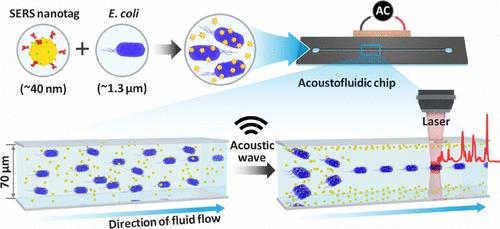
Bacterial infections, such as sepsis, require prompt and precise identification of the causative bacteria for appropriate antibiotics treatment. Traditional methods such as culturing take 2-5 days, while newer techniques such as reverse transcription-polymerase chain reaction and mass spectrometry are hindered by blood impurities. Consequently, this study developed a surface-enhanced Raman scattering (SERS)-based acoustofluidic technique for rapid bacterial detection without culturing or lysing. Target bacteria are first tagged with SERS nanotags in a microtube. The solution with tagged bacteria and unbound SERS nanotags is passed through a silicon microfluidic channel. A piezoelectric transducer generates acoustic waves within the channel, concentrating larger tagged bacteria in the center and pushing smaller unbound nanotags toward the channel walls. A laser beam is focused at the center of the channel, and the Raman signals of bacteria passing through the focal volume are measured for quantitative analysis. As a proof of concept, this study detected various concentrations of Escherichia coli at a limit of detection of 1.75 × 10⁵ CFU/mL within 1 h. This method offers significant clinical potential, enabling rapid and accurate bacterial identification without genetic material extraction, cultivation, or lysis.
期刊介绍:
ACS Sensors is a peer-reviewed research journal that focuses on the dissemination of new and original knowledge in the field of sensor science, particularly those that selectively sense chemical or biological species or processes. The journal covers a broad range of topics, including but not limited to biosensors, chemical sensors, gas sensors, intracellular sensors, single molecule sensors, cell chips, and microfluidic devices. It aims to publish articles that address conceptual advances in sensing technology applicable to various types of analytes or application papers that report on the use of existing sensing concepts in new ways or for new analytes.




 京公网安备 11010802042870号
京ICP备2023020795号-1
京公网安备 11010802042870号
京ICP备2023020795号-1

 分享
分享
 求助内容:
求助内容: 应助结果提醒方式:
 扫码关注我们
