{"title":"阻塞性睡眠呼吸暂停和偏头痛之间的因果关系:一项双向孟德尔随机研究。","authors":"Yu-Pei Wang, Hui-Xia Wei, Yuan-Yuan Hu, Chao Zhang, Yu-Ming Niu","doi":"10.2147/NSS.S492630","DOIUrl":null,"url":null,"abstract":"<p><strong>Objective: </strong>Patients with obstructive sleep apnea (OSA) frequently suffer from migraine, however the causal relationship between OSA and migraine is unknown. Investigating the causation will assist in understanding the etiology of OSA and migraine.</p><p><strong>Methods: </strong>Bidirectional two-sample Mendelian randomization (MR) and multivariable MR (MVMR) approaches were carried out to investigate the causal link between OSA and migraine. The public genome-wide association study (GWAS) data for OSA, migraine, and subtypes were obtained from the IUE open GWAS project and the FinnGen consortium. To investigate the causal links between OSA and migraine, inverse variance weighted (IVW) analysis was used in conjunction with four additional statistical approaches. Furthermore, sensitivity studies were performed using heterogeneity and pleiotropy tests to assess the estimation's robustness.</p><p><strong>Results: </strong>In general, our findings suggested that the OSA is causally associated with migraine with aura (MA, IVW: OR = 1.147; 95% CI = 1.016-1.295; P = 0.026), which was confirmed with the MVMR analysis further (OR = 1.184, 95% CI = 1.028-1.364, P = 0.020). In addition, increased risk of migraine and migraine without aura on OSA occurrence were identified in the reverse analysis, but these results were subsequently negated with MVMR analysis.</p><p><strong>Conclusion: </strong>According to the current findings, there was a preliminary causal effect of OSA on MA among European descendants.</p><p><strong>Clinical relevance: </strong>These findings suggest a potential causal effect of OSA on migraine and provide new insights to prevent and manage the two disorders.</p>","PeriodicalId":18896,"journal":{"name":"Nature and Science of Sleep","volume":"17 ","pages":"183-194"},"PeriodicalIF":3.4000,"publicationDate":"2025-01-25","publicationTypes":"Journal Article","fieldsOfStudy":null,"isOpenAccess":false,"openAccessPdf":"https://www.ncbi.nlm.nih.gov/pmc/articles/PMC11776924/pdf/","citationCount":"0","resultStr":"{\"title\":\"Causal Association Between Obstructive Sleep Apnea and Migraine: A Bidirectional Mendelian Randomization Study.\",\"authors\":\"Yu-Pei Wang, Hui-Xia Wei, Yuan-Yuan Hu, Chao Zhang, Yu-Ming Niu\",\"doi\":\"10.2147/NSS.S492630\",\"DOIUrl\":null,\"url\":null,\"abstract\":\"<p><strong>Objective: </strong>Patients with obstructive sleep apnea (OSA) frequently suffer from migraine, however the causal relationship between OSA and migraine is unknown. Investigating the causation will assist in understanding the etiology of OSA and migraine.</p><p><strong>Methods: </strong>Bidirectional two-sample Mendelian randomization (MR) and multivariable MR (MVMR) approaches were carried out to investigate the causal link between OSA and migraine. The public genome-wide association study (GWAS) data for OSA, migraine, and subtypes were obtained from the IUE open GWAS project and the FinnGen consortium. To investigate the causal links between OSA and migraine, inverse variance weighted (IVW) analysis was used in conjunction with four additional statistical approaches. Furthermore, sensitivity studies were performed using heterogeneity and pleiotropy tests to assess the estimation's robustness.</p><p><strong>Results: </strong>In general, our findings suggested that the OSA is causally associated with migraine with aura (MA, IVW: OR = 1.147; 95% CI = 1.016-1.295; P = 0.026), which was confirmed with the MVMR analysis further (OR = 1.184, 95% CI = 1.028-1.364, P = 0.020). In addition, increased risk of migraine and migraine without aura on OSA occurrence were identified in the reverse analysis, but these results were subsequently negated with MVMR analysis.</p><p><strong>Conclusion: </strong>According to the current findings, there was a preliminary causal effect of OSA on MA among European descendants.</p><p><strong>Clinical relevance: </strong>These findings suggest a potential causal effect of OSA on migraine and provide new insights to prevent and manage the two disorders.</p>\",\"PeriodicalId\":18896,\"journal\":{\"name\":\"Nature and Science of Sleep\",\"volume\":\"17 \",\"pages\":\"183-194\"},\"PeriodicalIF\":3.4000,\"publicationDate\":\"2025-01-25\",\"publicationTypes\":\"Journal Article\",\"fieldsOfStudy\":null,\"isOpenAccess\":false,\"openAccessPdf\":\"https://www.ncbi.nlm.nih.gov/pmc/articles/PMC11776924/pdf/\",\"citationCount\":\"0\",\"resultStr\":null,\"platform\":\"Semanticscholar\",\"paperid\":null,\"PeriodicalName\":\"Nature and Science of Sleep\",\"FirstCategoryId\":\"3\",\"ListUrlMain\":\"https://doi.org/10.2147/NSS.S492630\",\"RegionNum\":2,\"RegionCategory\":\"医学\",\"ArticlePicture\":[],\"TitleCN\":null,\"AbstractTextCN\":null,\"PMCID\":null,\"EPubDate\":\"2025/1/1 0:00:00\",\"PubModel\":\"eCollection\",\"JCR\":\"Q2\",\"JCRName\":\"CLINICAL NEUROLOGY\",\"Score\":null,\"Total\":0}","platform":"Semanticscholar","paperid":null,"PeriodicalName":"Nature and Science of Sleep","FirstCategoryId":"3","ListUrlMain":"https://doi.org/10.2147/NSS.S492630","RegionNum":2,"RegionCategory":"医学","ArticlePicture":[],"TitleCN":null,"AbstractTextCN":null,"PMCID":null,"EPubDate":"2025/1/1 0:00:00","PubModel":"eCollection","JCR":"Q2","JCRName":"CLINICAL NEUROLOGY","Score":null,"Total":0}
引用次数: 0
摘要
目的:阻塞性睡眠呼吸暂停(OSA)患者常伴有偏头痛,但其与偏头痛的因果关系尚不清楚。研究其病因将有助于了解阻塞性睡眠呼吸暂停和偏头痛的病因学。方法:采用双向双样本孟德尔随机化(MR)和多变量随机化(MVMR)方法研究OSA与偏头痛之间的因果关系。OSA、偏头痛和亚型的公共全基因组关联研究(GWAS)数据来自IUE开放GWAS项目和FinnGen联盟。为了研究阻塞性睡眠呼吸暂停和偏头痛之间的因果关系,研究人员将逆方差加权(IVW)分析与另外四种统计方法结合使用。此外,使用异质性和多效性检验进行敏感性研究,以评估估计的稳健性。结果:总的来说,我们的研究结果表明,OSA与先兆偏头痛有因果关系(MA, IVW: OR = 1.147;95% ci = 1.016-1.295;P = 0.026),进一步的MVMR分析证实了这一点(OR = 1.184, 95% CI = 1.028 ~ 1.364, P = 0.020)。此外,在反向分析中发现偏头痛和无先兆偏头痛对OSA发生的风险增加,但随后用MVMR分析否定了这些结果。结论:根据目前的研究结果,OSA对欧洲人后裔的MA有初步的因果影响。临床意义:这些发现提示了阻塞性睡眠呼吸暂停与偏头痛的潜在因果关系,并为预防和治疗这两种疾病提供了新的见解。
Causal Association Between Obstructive Sleep Apnea and Migraine: A Bidirectional Mendelian Randomization Study.
Objective: Patients with obstructive sleep apnea (OSA) frequently suffer from migraine, however the causal relationship between OSA and migraine is unknown. Investigating the causation will assist in understanding the etiology of OSA and migraine.
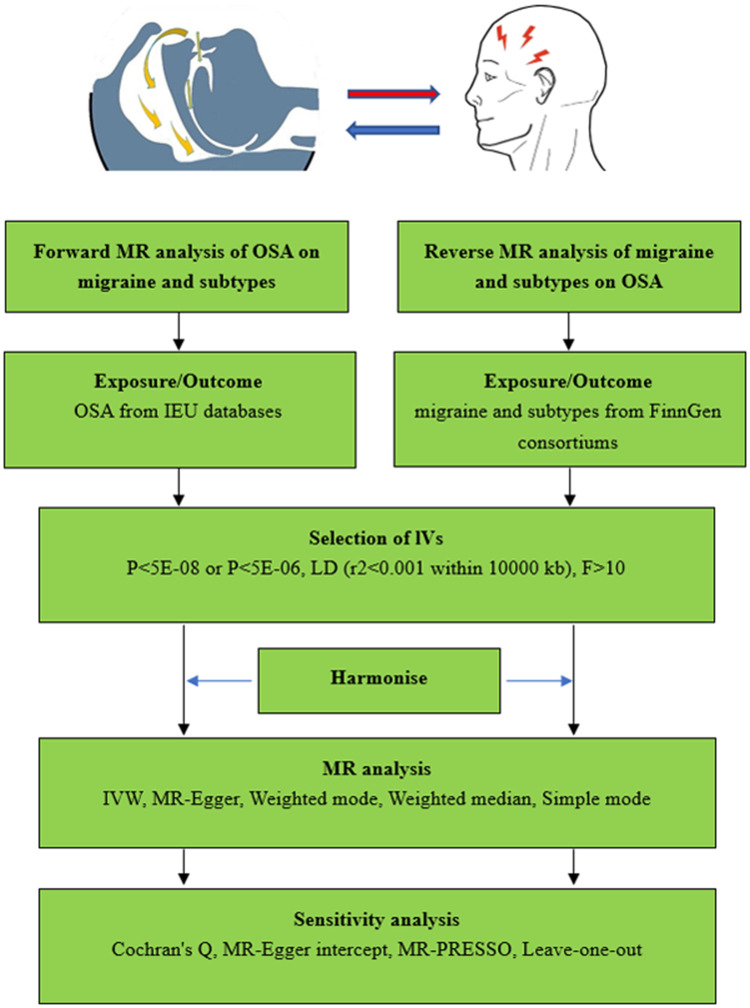
Methods: Bidirectional two-sample Mendelian randomization (MR) and multivariable MR (MVMR) approaches were carried out to investigate the causal link between OSA and migraine. The public genome-wide association study (GWAS) data for OSA, migraine, and subtypes were obtained from the IUE open GWAS project and the FinnGen consortium. To investigate the causal links between OSA and migraine, inverse variance weighted (IVW) analysis was used in conjunction with four additional statistical approaches. Furthermore, sensitivity studies were performed using heterogeneity and pleiotropy tests to assess the estimation's robustness.
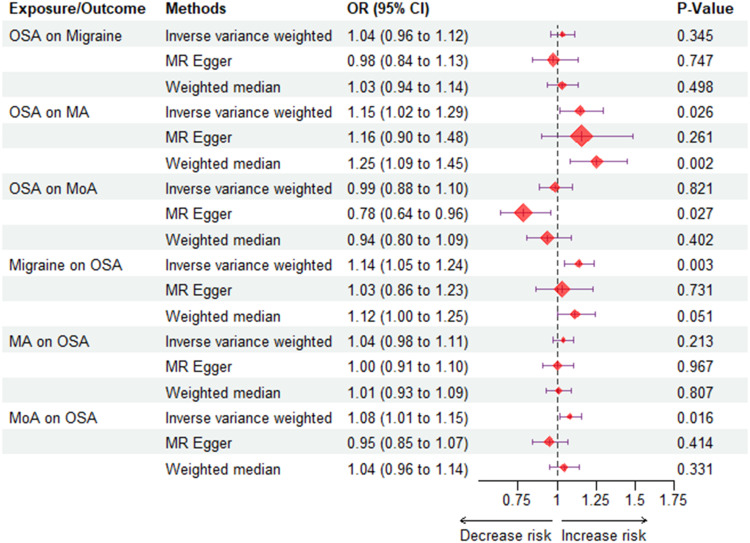
Results: In general, our findings suggested that the OSA is causally associated with migraine with aura (MA, IVW: OR = 1.147; 95% CI = 1.016-1.295; P = 0.026), which was confirmed with the MVMR analysis further (OR = 1.184, 95% CI = 1.028-1.364, P = 0.020). In addition, increased risk of migraine and migraine without aura on OSA occurrence were identified in the reverse analysis, but these results were subsequently negated with MVMR analysis.
Conclusion: According to the current findings, there was a preliminary causal effect of OSA on MA among European descendants.
Clinical relevance: These findings suggest a potential causal effect of OSA on migraine and provide new insights to prevent and manage the two disorders.
期刊介绍:
Nature and Science of Sleep is an international, peer-reviewed, open access journal covering all aspects of sleep science and sleep medicine, including the neurophysiology and functions of sleep, the genetics of sleep, sleep and society, biological rhythms, dreaming, sleep disorders and therapy, and strategies to optimize healthy sleep.
Specific topics covered in the journal include:
The functions of sleep in humans and other animals
Physiological and neurophysiological changes with sleep
The genetics of sleep and sleep differences
The neurotransmitters, receptors and pathways involved in controlling both sleep and wakefulness
Behavioral and pharmacological interventions aimed at improving sleep, and improving wakefulness
Sleep changes with development and with age
Sleep and reproduction (e.g., changes across the menstrual cycle, with pregnancy and menopause)
The science and nature of dreams
Sleep disorders
Impact of sleep and sleep disorders on health, daytime function and quality of life
Sleep problems secondary to clinical disorders
Interaction of society with sleep (e.g., consequences of shift work, occupational health, public health)
The microbiome and sleep
Chronotherapy
Impact of circadian rhythms on sleep, physiology, cognition and health
Mechanisms controlling circadian rhythms, centrally and peripherally
Impact of circadian rhythm disruptions (including night shift work, jet lag and social jet lag) on sleep, physiology, cognition and health
Behavioral and pharmacological interventions aimed at reducing adverse effects of circadian-related sleep disruption
Assessment of technologies and biomarkers for measuring sleep and/or circadian rhythms
Epigenetic markers of sleep or circadian disruption.






 京公网安备 11010802042870号
京ICP备2023020795号-1
京公网安备 11010802042870号
京ICP备2023020795号-1

 分享
分享
 求助内容:
求助内容: 应助结果提醒方式:
 扫码关注我们
