Assel Baibek, Zuzanna Konieczna, Muhammed Üçüncü, Zainab S Alghamdi, Richa Sharma, Mathew H Horrocks, Mark Bradley
{"title":"一种用于标记革兰氏阴性菌的长荧光寿命探针。","authors":"Assel Baibek, Zuzanna Konieczna, Muhammed Üçüncü, Zainab S Alghamdi, Richa Sharma, Mathew H Horrocks, Mark Bradley","doi":"10.1021/cbmi.4c00066","DOIUrl":null,"url":null,"abstract":"<p><p>Bacterial resistance, primarily stemming from misdiagnosis, misuse, and overuse of antibacterial medications in humans and animals, is a pressing issue. To address this, we focused on developing a fluorescent probe for the detection of bacteria, with a unique feature-an exceptionally long fluorescence lifetime, to overcome autofluorescence limitations in biological samples. The polymyxin-based probe (ADOTA-PMX) selectively targets Gram-negative bacteria and used the red-emitting fluorophore azadioxatriangulenium (with a reported fluorescence lifetime of 19.5 ns). Evaluation of ADOTA-PMX's bacterial labeling efficacy revealed strong specificity for Gram-negative bacteria, and full spectral fluorescence lifetime imaging microscopy demonstrated the potential of ADOTA-PMX for bacterial imaging applications. The probe exhibited a lifetime of 4.5 ns when bound to bacteria, possibly indicating interactions with the bacterial outer membrane. Furthermore, the fluorescence lifetime measurements of ADOTA-PMX labeled bacteria could be performed using a benchtop fluorimeter without the need of sophisticated microscopes. This study represents the first targeted probe for fluorescence lifetime imaging, offering sensitivity for detecting Gram-negative bacteria and enabling multiplexing via fluorescence lifetime imaging.</p>","PeriodicalId":53181,"journal":{"name":"Chemical & Biomedical Imaging","volume":"3 1","pages":"45-50"},"PeriodicalIF":6.7000,"publicationDate":"2024-12-05","publicationTypes":"Journal Article","fieldsOfStudy":null,"isOpenAccess":false,"openAccessPdf":"https://www.ncbi.nlm.nih.gov/pmc/articles/PMC11775855/pdf/","citationCount":"0","resultStr":"{\"title\":\"A Long Fluorescence Lifetime Probe for Labeling of Gram-Negative Bacteria.\",\"authors\":\"Assel Baibek, Zuzanna Konieczna, Muhammed Üçüncü, Zainab S Alghamdi, Richa Sharma, Mathew H Horrocks, Mark Bradley\",\"doi\":\"10.1021/cbmi.4c00066\",\"DOIUrl\":null,\"url\":null,\"abstract\":\"<p><p>Bacterial resistance, primarily stemming from misdiagnosis, misuse, and overuse of antibacterial medications in humans and animals, is a pressing issue. To address this, we focused on developing a fluorescent probe for the detection of bacteria, with a unique feature-an exceptionally long fluorescence lifetime, to overcome autofluorescence limitations in biological samples. The polymyxin-based probe (ADOTA-PMX) selectively targets Gram-negative bacteria and used the red-emitting fluorophore azadioxatriangulenium (with a reported fluorescence lifetime of 19.5 ns). Evaluation of ADOTA-PMX's bacterial labeling efficacy revealed strong specificity for Gram-negative bacteria, and full spectral fluorescence lifetime imaging microscopy demonstrated the potential of ADOTA-PMX for bacterial imaging applications. The probe exhibited a lifetime of 4.5 ns when bound to bacteria, possibly indicating interactions with the bacterial outer membrane. Furthermore, the fluorescence lifetime measurements of ADOTA-PMX labeled bacteria could be performed using a benchtop fluorimeter without the need of sophisticated microscopes. This study represents the first targeted probe for fluorescence lifetime imaging, offering sensitivity for detecting Gram-negative bacteria and enabling multiplexing via fluorescence lifetime imaging.</p>\",\"PeriodicalId\":53181,\"journal\":{\"name\":\"Chemical & Biomedical Imaging\",\"volume\":\"3 1\",\"pages\":\"45-50\"},\"PeriodicalIF\":6.7000,\"publicationDate\":\"2024-12-05\",\"publicationTypes\":\"Journal Article\",\"fieldsOfStudy\":null,\"isOpenAccess\":false,\"openAccessPdf\":\"https://www.ncbi.nlm.nih.gov/pmc/articles/PMC11775855/pdf/\",\"citationCount\":\"0\",\"resultStr\":null,\"platform\":\"Semanticscholar\",\"paperid\":null,\"PeriodicalName\":\"Chemical & Biomedical Imaging\",\"FirstCategoryId\":\"1085\",\"ListUrlMain\":\"https://doi.org/10.1021/cbmi.4c00066\",\"RegionNum\":0,\"RegionCategory\":null,\"ArticlePicture\":[],\"TitleCN\":null,\"AbstractTextCN\":null,\"PMCID\":null,\"EPubDate\":\"2025/1/27 0:00:00\",\"PubModel\":\"eCollection\",\"JCR\":\"\",\"JCRName\":\"\",\"Score\":null,\"Total\":0}","platform":"Semanticscholar","paperid":null,"PeriodicalName":"Chemical & Biomedical Imaging","FirstCategoryId":"1085","ListUrlMain":"https://doi.org/10.1021/cbmi.4c00066","RegionNum":0,"RegionCategory":null,"ArticlePicture":[],"TitleCN":null,"AbstractTextCN":null,"PMCID":null,"EPubDate":"2025/1/27 0:00:00","PubModel":"eCollection","JCR":"","JCRName":"","Score":null,"Total":0}
A Long Fluorescence Lifetime Probe for Labeling of Gram-Negative Bacteria.
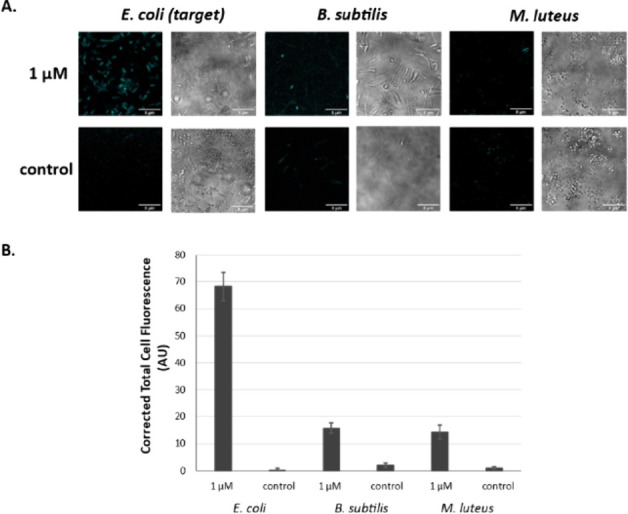
Bacterial resistance, primarily stemming from misdiagnosis, misuse, and overuse of antibacterial medications in humans and animals, is a pressing issue. To address this, we focused on developing a fluorescent probe for the detection of bacteria, with a unique feature-an exceptionally long fluorescence lifetime, to overcome autofluorescence limitations in biological samples. The polymyxin-based probe (ADOTA-PMX) selectively targets Gram-negative bacteria and used the red-emitting fluorophore azadioxatriangulenium (with a reported fluorescence lifetime of 19.5 ns). Evaluation of ADOTA-PMX's bacterial labeling efficacy revealed strong specificity for Gram-negative bacteria, and full spectral fluorescence lifetime imaging microscopy demonstrated the potential of ADOTA-PMX for bacterial imaging applications. The probe exhibited a lifetime of 4.5 ns when bound to bacteria, possibly indicating interactions with the bacterial outer membrane. Furthermore, the fluorescence lifetime measurements of ADOTA-PMX labeled bacteria could be performed using a benchtop fluorimeter without the need of sophisticated microscopes. This study represents the first targeted probe for fluorescence lifetime imaging, offering sensitivity for detecting Gram-negative bacteria and enabling multiplexing via fluorescence lifetime imaging.
期刊介绍:
Chemical & Biomedical Imaging is a peer-reviewed open access journal devoted to the publication of cutting-edge research papers on all aspects of chemical and biomedical imaging. This interdisciplinary field sits at the intersection of chemistry physics biology materials engineering and medicine. The journal aims to bring together researchers from across these disciplines to address cutting-edge challenges of fundamental research and applications.Topics of particular interest include but are not limited to:Imaging of processes and reactionsImaging of nanoscale microscale and mesoscale materialsImaging of biological interactions and interfacesSingle-molecule and cellular imagingWhole-organ and whole-body imagingMolecular imaging probes and contrast agentsBioluminescence chemiluminescence and electrochemiluminescence imagingNanophotonics and imagingChemical tools for new imaging modalitiesChemical and imaging techniques in diagnosis and therapyImaging-guided drug deliveryAI and machine learning assisted imaging






 京公网安备 11010802042870号
京ICP备2023020795号-1
京公网安备 11010802042870号
京ICP备2023020795号-1

 分享
分享
 求助内容:
求助内容: 应助结果提醒方式:
 扫码关注我们
