Yong Chen , Yong Liu , Xiaobo Gong , Jianlong Wang
{"title":"利用新型自驾车光催化燃料电池从富含硫的废水中回收硫、发电和过氧化氢","authors":"Yong Chen , Yong Liu , Xiaobo Gong , Jianlong Wang","doi":"10.1016/j.watres.2025.123232","DOIUrl":null,"url":null,"abstract":"<div><div>A novel photocatalytic fuel cell (PFC) with a sandwich-structure photoanode (ZnS@ZnO/ITO) was fabricated through electrodeposition-calcination to modulate the behavior of charge carriers and improve S<sup>2-</sup> oxidation performance, which can effectively recover sulfur and generate electricity and hydrogen peroxide (H<sub>2</sub>O<sub>2</sub>) from sulfion-rich wastewater. ZnO was locate between ZnS and ITO in ZnS@ZnO/ITO to promote the separation of charge carriers and electron transfer, which can function as an electron transport bridge by forming a type-II heterostructure and acting as an electron transport layer. The PFC system was assembled by integrating ZnS@ZnO/ITO as the photoanode for S<sup>2-</sup> oxidation, and graphite (Gr) as the cathode for oxygen reduction, given that Gr exhibits excellent catalytic activity for H<sub>2</sub>O<sub>2</sub> generation. In the PFC, the removal efficiency of S<sup>2-</sup>, H<sub>2</sub>O<sub>2</sub> production, and the maximum power density were 93.4 %, 2.1 mmol/L, and 260 mW/m<sup>2</sup>, respectively. After 24 cycles, the removal efficiency of S<sup>2-</sup> and H<sub>2</sub>O<sub>2</sub> production maintained 80.0 % and 1.6 mmol/L, respectively. The mechanism for sulfur recovery along with electricity generation and H<sub>2</sub>O<sub>2</sub> production was proposed. Moreover, this PFC can effectively treat the actual shale gas wastewater and tannery wastewater, achieving the dual roles of wastewater treatment and resource recovery. This work opens up a brand-new avenue on PFC for purifying wastewater, meanwhile generating electricity and producing H<sub>2</sub>O<sub>2</sub>.</div></div>","PeriodicalId":443,"journal":{"name":"Water Research","volume":"275 ","pages":"Article 123232"},"PeriodicalIF":12.4000,"publicationDate":"2025-05-01","publicationTypes":"Journal Article","fieldsOfStudy":null,"isOpenAccess":false,"openAccessPdf":"","citationCount":"0","resultStr":"{\"title\":\"Recovery of sulfur, generation of electricity and hydrogen peroxide from sulfion-rich wastewater using a novel self-driving photocatalytic fuel cell\",\"authors\":\"Yong Chen , Yong Liu , Xiaobo Gong , Jianlong Wang\",\"doi\":\"10.1016/j.watres.2025.123232\",\"DOIUrl\":null,\"url\":null,\"abstract\":\"<div><div>A novel photocatalytic fuel cell (PFC) with a sandwich-structure photoanode (ZnS@ZnO/ITO) was fabricated through electrodeposition-calcination to modulate the behavior of charge carriers and improve S<sup>2-</sup> oxidation performance, which can effectively recover sulfur and generate electricity and hydrogen peroxide (H<sub>2</sub>O<sub>2</sub>) from sulfion-rich wastewater. ZnO was locate between ZnS and ITO in ZnS@ZnO/ITO to promote the separation of charge carriers and electron transfer, which can function as an electron transport bridge by forming a type-II heterostructure and acting as an electron transport layer. The PFC system was assembled by integrating ZnS@ZnO/ITO as the photoanode for S<sup>2-</sup> oxidation, and graphite (Gr) as the cathode for oxygen reduction, given that Gr exhibits excellent catalytic activity for H<sub>2</sub>O<sub>2</sub> generation. In the PFC, the removal efficiency of S<sup>2-</sup>, H<sub>2</sub>O<sub>2</sub> production, and the maximum power density were 93.4 %, 2.1 mmol/L, and 260 mW/m<sup>2</sup>, respectively. After 24 cycles, the removal efficiency of S<sup>2-</sup> and H<sub>2</sub>O<sub>2</sub> production maintained 80.0 % and 1.6 mmol/L, respectively. The mechanism for sulfur recovery along with electricity generation and H<sub>2</sub>O<sub>2</sub> production was proposed. Moreover, this PFC can effectively treat the actual shale gas wastewater and tannery wastewater, achieving the dual roles of wastewater treatment and resource recovery. This work opens up a brand-new avenue on PFC for purifying wastewater, meanwhile generating electricity and producing H<sub>2</sub>O<sub>2</sub>.</div></div>\",\"PeriodicalId\":443,\"journal\":{\"name\":\"Water Research\",\"volume\":\"275 \",\"pages\":\"Article 123232\"},\"PeriodicalIF\":12.4000,\"publicationDate\":\"2025-05-01\",\"publicationTypes\":\"Journal Article\",\"fieldsOfStudy\":null,\"isOpenAccess\":false,\"openAccessPdf\":\"\",\"citationCount\":\"0\",\"resultStr\":null,\"platform\":\"Semanticscholar\",\"paperid\":null,\"PeriodicalName\":\"Water Research\",\"FirstCategoryId\":\"93\",\"ListUrlMain\":\"https://www.sciencedirect.com/science/article/pii/S0043135425001460\",\"RegionNum\":1,\"RegionCategory\":\"环境科学与生态学\",\"ArticlePicture\":[],\"TitleCN\":null,\"AbstractTextCN\":null,\"PMCID\":null,\"EPubDate\":\"2025/2/1 0:00:00\",\"PubModel\":\"Epub\",\"JCR\":\"Q1\",\"JCRName\":\"ENGINEERING, ENVIRONMENTAL\",\"Score\":null,\"Total\":0}","platform":"Semanticscholar","paperid":null,"PeriodicalName":"Water Research","FirstCategoryId":"93","ListUrlMain":"https://www.sciencedirect.com/science/article/pii/S0043135425001460","RegionNum":1,"RegionCategory":"环境科学与生态学","ArticlePicture":[],"TitleCN":null,"AbstractTextCN":null,"PMCID":null,"EPubDate":"2025/2/1 0:00:00","PubModel":"Epub","JCR":"Q1","JCRName":"ENGINEERING, ENVIRONMENTAL","Score":null,"Total":0}
Recovery of sulfur, generation of electricity and hydrogen peroxide from sulfion-rich wastewater using a novel self-driving photocatalytic fuel cell
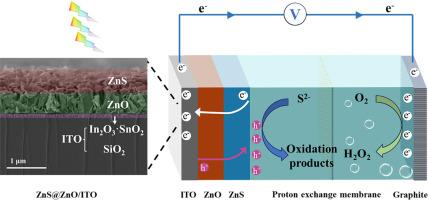
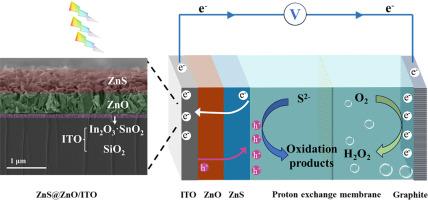
A novel photocatalytic fuel cell (PFC) with a sandwich-structure photoanode (ZnS@ZnO/ITO) was fabricated through electrodeposition-calcination to modulate the behavior of charge carriers and improve S2- oxidation performance, which can effectively recover sulfur and generate electricity and hydrogen peroxide (H2O2) from sulfion-rich wastewater. ZnO was locate between ZnS and ITO in ZnS@ZnO/ITO to promote the separation of charge carriers and electron transfer, which can function as an electron transport bridge by forming a type-II heterostructure and acting as an electron transport layer. The PFC system was assembled by integrating ZnS@ZnO/ITO as the photoanode for S2- oxidation, and graphite (Gr) as the cathode for oxygen reduction, given that Gr exhibits excellent catalytic activity for H2O2 generation. In the PFC, the removal efficiency of S2-, H2O2 production, and the maximum power density were 93.4 %, 2.1 mmol/L, and 260 mW/m2, respectively. After 24 cycles, the removal efficiency of S2- and H2O2 production maintained 80.0 % and 1.6 mmol/L, respectively. The mechanism for sulfur recovery along with electricity generation and H2O2 production was proposed. Moreover, this PFC can effectively treat the actual shale gas wastewater and tannery wastewater, achieving the dual roles of wastewater treatment and resource recovery. This work opens up a brand-new avenue on PFC for purifying wastewater, meanwhile generating electricity and producing H2O2.
期刊介绍:
Water Research, along with its open access companion journal Water Research X, serves as a platform for publishing original research papers covering various aspects of the science and technology related to the anthropogenic water cycle, water quality, and its management worldwide. The audience targeted by the journal comprises biologists, chemical engineers, chemists, civil engineers, environmental engineers, limnologists, and microbiologists. The scope of the journal include:
•Treatment processes for water and wastewaters (municipal, agricultural, industrial, and on-site treatment), including resource recovery and residuals management;
•Urban hydrology including sewer systems, stormwater management, and green infrastructure;
•Drinking water treatment and distribution;
•Potable and non-potable water reuse;
•Sanitation, public health, and risk assessment;
•Anaerobic digestion, solid and hazardous waste management, including source characterization and the effects and control of leachates and gaseous emissions;
•Contaminants (chemical, microbial, anthropogenic particles such as nanoparticles or microplastics) and related water quality sensing, monitoring, fate, and assessment;
•Anthropogenic impacts on inland, tidal, coastal and urban waters, focusing on surface and ground waters, and point and non-point sources of pollution;
•Environmental restoration, linked to surface water, groundwater and groundwater remediation;
•Analysis of the interfaces between sediments and water, and between water and atmosphere, focusing specifically on anthropogenic impacts;
•Mathematical modelling, systems analysis, machine learning, and beneficial use of big data related to the anthropogenic water cycle;
•Socio-economic, policy, and regulations studies.




 京公网安备 11010802042870号
京ICP备2023020795号-1
京公网安备 11010802042870号
京ICP备2023020795号-1

 分享
分享
 求助内容:
求助内容: 应助结果提醒方式:
 扫码关注我们
