{"title":"设计激子极化子手性的一般模型","authors":"Ping Bai, Siying Peng","doi":"10.1515/nanoph-2024-0662","DOIUrl":null,"url":null,"abstract":"Chirality of exciton-polaritons can be tuned by the chirality of photons, excitons, and their coupling strength. In this work, we propose a general analytical model based on coupled harmonic oscillators to describe the chirality of exciton-polaritons. Our model predicts the degree of circular polarization (DCP) of exciton-polaritons, which is determined by the DCPs and weight fractions of the constituent excitons and photons. At the anticrossing point, the DCP of exciton-polaritons is equally contributed from both constituents. Away from the anticrossing point, the DCP of exciton-polaritons relaxes toward the DCP of the dominant constituent, with the relaxation rate decreasing as the coupling strength increases. We validate our model through simulations of strongly coupled topological edge states and excitons, showing good agreement with model predictions. Our model provides a valuable tool for designing the chirality of strong coupling systems and offers a framework for the inverse design of exciton-polaritons with tailored chirality.","PeriodicalId":19027,"journal":{"name":"Nanophotonics","volume":"79 1","pages":""},"PeriodicalIF":6.6000,"publicationDate":"2025-01-31","publicationTypes":"Journal Article","fieldsOfStudy":null,"isOpenAccess":false,"openAccessPdf":"","citationCount":"0","resultStr":"{\"title\":\"A general model for designing the chirality of exciton-polaritons\",\"authors\":\"Ping Bai, Siying Peng\",\"doi\":\"10.1515/nanoph-2024-0662\",\"DOIUrl\":null,\"url\":null,\"abstract\":\"Chirality of exciton-polaritons can be tuned by the chirality of photons, excitons, and their coupling strength. In this work, we propose a general analytical model based on coupled harmonic oscillators to describe the chirality of exciton-polaritons. Our model predicts the degree of circular polarization (DCP) of exciton-polaritons, which is determined by the DCPs and weight fractions of the constituent excitons and photons. At the anticrossing point, the DCP of exciton-polaritons is equally contributed from both constituents. Away from the anticrossing point, the DCP of exciton-polaritons relaxes toward the DCP of the dominant constituent, with the relaxation rate decreasing as the coupling strength increases. We validate our model through simulations of strongly coupled topological edge states and excitons, showing good agreement with model predictions. Our model provides a valuable tool for designing the chirality of strong coupling systems and offers a framework for the inverse design of exciton-polaritons with tailored chirality.\",\"PeriodicalId\":19027,\"journal\":{\"name\":\"Nanophotonics\",\"volume\":\"79 1\",\"pages\":\"\"},\"PeriodicalIF\":6.6000,\"publicationDate\":\"2025-01-31\",\"publicationTypes\":\"Journal Article\",\"fieldsOfStudy\":null,\"isOpenAccess\":false,\"openAccessPdf\":\"\",\"citationCount\":\"0\",\"resultStr\":null,\"platform\":\"Semanticscholar\",\"paperid\":null,\"PeriodicalName\":\"Nanophotonics\",\"FirstCategoryId\":\"101\",\"ListUrlMain\":\"https://doi.org/10.1515/nanoph-2024-0662\",\"RegionNum\":2,\"RegionCategory\":\"物理与天体物理\",\"ArticlePicture\":[],\"TitleCN\":null,\"AbstractTextCN\":null,\"PMCID\":null,\"EPubDate\":\"\",\"PubModel\":\"\",\"JCR\":\"Q1\",\"JCRName\":\"MATERIALS SCIENCE, MULTIDISCIPLINARY\",\"Score\":null,\"Total\":0}","platform":"Semanticscholar","paperid":null,"PeriodicalName":"Nanophotonics","FirstCategoryId":"101","ListUrlMain":"https://doi.org/10.1515/nanoph-2024-0662","RegionNum":2,"RegionCategory":"物理与天体物理","ArticlePicture":[],"TitleCN":null,"AbstractTextCN":null,"PMCID":null,"EPubDate":"","PubModel":"","JCR":"Q1","JCRName":"MATERIALS SCIENCE, MULTIDISCIPLINARY","Score":null,"Total":0}
A general model for designing the chirality of exciton-polaritons
Chirality of exciton-polaritons can be tuned by the chirality of photons, excitons, and their coupling strength. In this work, we propose a general analytical model based on coupled harmonic oscillators to describe the chirality of exciton-polaritons. Our model predicts the degree of circular polarization (DCP) of exciton-polaritons, which is determined by the DCPs and weight fractions of the constituent excitons and photons. At the anticrossing point, the DCP of exciton-polaritons is equally contributed from both constituents. Away from the anticrossing point, the DCP of exciton-polaritons relaxes toward the DCP of the dominant constituent, with the relaxation rate decreasing as the coupling strength increases. We validate our model through simulations of strongly coupled topological edge states and excitons, showing good agreement with model predictions. Our model provides a valuable tool for designing the chirality of strong coupling systems and offers a framework for the inverse design of exciton-polaritons with tailored chirality.
期刊介绍:
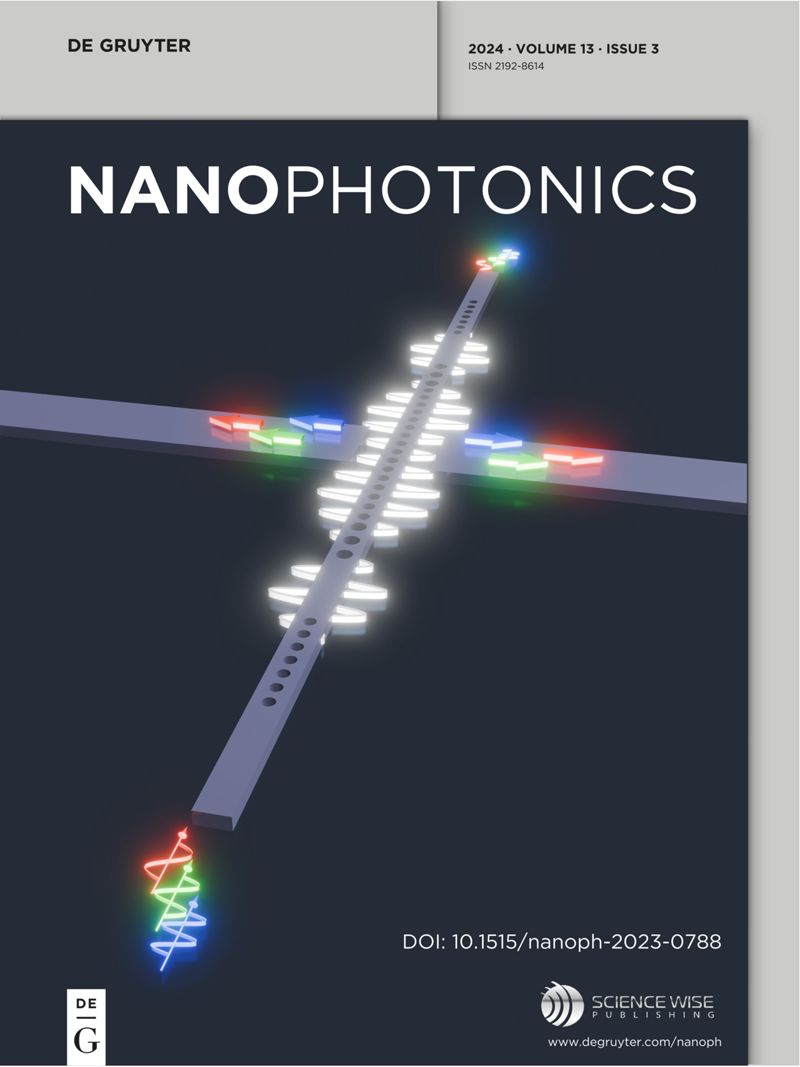
Nanophotonics, published in collaboration with Sciencewise, is a prestigious journal that showcases recent international research results, notable advancements in the field, and innovative applications. It is regarded as one of the leading publications in the realm of nanophotonics and encompasses a range of article types including research articles, selectively invited reviews, letters, and perspectives.
The journal specifically delves into the study of photon interaction with nano-structures, such as carbon nano-tubes, nano metal particles, nano crystals, semiconductor nano dots, photonic crystals, tissue, and DNA. It offers comprehensive coverage of the most up-to-date discoveries, making it an essential resource for physicists, engineers, and material scientists.




 京公网安备 11010802042870号
京ICP备2023020795号-1
京公网安备 11010802042870号
京ICP备2023020795号-1

 分享
分享
 求助内容:
求助内容: 应助结果提醒方式:
 扫码关注我们
