Liu Wang, Jiahao Xie, Chong Zhang, Jian Zou, Zirui Huang, Sitong Shang, Xingyu Chen, Yang Yang, Jianquan Liu, Haohao Dong, Dingming Huang, Zhaoming Su
{"title":"环状排列II族内含子自剪接的结构基础","authors":"Liu Wang, Jiahao Xie, Chong Zhang, Jian Zou, Zirui Huang, Sitong Shang, Xingyu Chen, Yang Yang, Jianquan Liu, Haohao Dong, Dingming Huang, Zhaoming Su","doi":"10.1038/s41594-025-01484-x","DOIUrl":null,"url":null,"abstract":"Circularly permuted group II introns (CP introns) consist of rearranged structural domains separated by two tethered exons, generating branched introns and circular exons via back-splicing. Structural and mechanistic understanding of circular RNA (circRNA) generation by CP introns remains elusive. We resolve cryo-electron microscopy structures of a natural CP intron in different states during back-splicing at a resolution of 2.5–2.9 Å. Domain 6 (D6) undergoes a conformational change of 65° after branching, to facilitate 3′-exon recognition and circularization. Previously unseen tertiary interactions compact the catalytic triad and D6 for splicing without protein, whereas a metal ion, M35, is observed to stabilize the 5′-exon during splicing. While these unique features were not observed in canonical group II introns and spliceosomes, they are common in CP introns, as demonstrated by the cryo-EM structure of another CP intron discovered by comparative genomics analysis. Our results elucidate the mechanism of CP intron back-splicing dynamics, with potential applications in circRNA research and therapeutics. Cryo-EM structures of circularly permuted group II introns determined at 2.5- to 2.9-Å resolutions reveal dynamic D6, unexpected interactions and metal ions for catalysis, which elucidate conserved mechanisms of back-splicing to generate circular RNAs.","PeriodicalId":49141,"journal":{"name":"Nature Structural & Molecular Biology","volume":"32 6","pages":"1091-1100"},"PeriodicalIF":10.1000,"publicationDate":"2025-01-31","publicationTypes":"Journal Article","fieldsOfStudy":null,"isOpenAccess":false,"openAccessPdf":"","citationCount":"0","resultStr":"{\"title\":\"Structural basis of circularly permuted group II intron self-splicing\",\"authors\":\"Liu Wang, Jiahao Xie, Chong Zhang, Jian Zou, Zirui Huang, Sitong Shang, Xingyu Chen, Yang Yang, Jianquan Liu, Haohao Dong, Dingming Huang, Zhaoming Su\",\"doi\":\"10.1038/s41594-025-01484-x\",\"DOIUrl\":null,\"url\":null,\"abstract\":\"Circularly permuted group II introns (CP introns) consist of rearranged structural domains separated by two tethered exons, generating branched introns and circular exons via back-splicing. Structural and mechanistic understanding of circular RNA (circRNA) generation by CP introns remains elusive. We resolve cryo-electron microscopy structures of a natural CP intron in different states during back-splicing at a resolution of 2.5–2.9 Å. Domain 6 (D6) undergoes a conformational change of 65° after branching, to facilitate 3′-exon recognition and circularization. Previously unseen tertiary interactions compact the catalytic triad and D6 for splicing without protein, whereas a metal ion, M35, is observed to stabilize the 5′-exon during splicing. While these unique features were not observed in canonical group II introns and spliceosomes, they are common in CP introns, as demonstrated by the cryo-EM structure of another CP intron discovered by comparative genomics analysis. Our results elucidate the mechanism of CP intron back-splicing dynamics, with potential applications in circRNA research and therapeutics. Cryo-EM structures of circularly permuted group II introns determined at 2.5- to 2.9-Å resolutions reveal dynamic D6, unexpected interactions and metal ions for catalysis, which elucidate conserved mechanisms of back-splicing to generate circular RNAs.\",\"PeriodicalId\":49141,\"journal\":{\"name\":\"Nature Structural & Molecular Biology\",\"volume\":\"32 6\",\"pages\":\"1091-1100\"},\"PeriodicalIF\":10.1000,\"publicationDate\":\"2025-01-31\",\"publicationTypes\":\"Journal Article\",\"fieldsOfStudy\":null,\"isOpenAccess\":false,\"openAccessPdf\":\"\",\"citationCount\":\"0\",\"resultStr\":null,\"platform\":\"Semanticscholar\",\"paperid\":null,\"PeriodicalName\":\"Nature Structural & Molecular Biology\",\"FirstCategoryId\":\"99\",\"ListUrlMain\":\"https://www.nature.com/articles/s41594-025-01484-x\",\"RegionNum\":1,\"RegionCategory\":\"生物学\",\"ArticlePicture\":[],\"TitleCN\":null,\"AbstractTextCN\":null,\"PMCID\":null,\"EPubDate\":\"\",\"PubModel\":\"\",\"JCR\":\"Q1\",\"JCRName\":\"BIOCHEMISTRY & MOLECULAR BIOLOGY\",\"Score\":null,\"Total\":0}","platform":"Semanticscholar","paperid":null,"PeriodicalName":"Nature Structural & Molecular Biology","FirstCategoryId":"99","ListUrlMain":"https://www.nature.com/articles/s41594-025-01484-x","RegionNum":1,"RegionCategory":"生物学","ArticlePicture":[],"TitleCN":null,"AbstractTextCN":null,"PMCID":null,"EPubDate":"","PubModel":"","JCR":"Q1","JCRName":"BIOCHEMISTRY & MOLECULAR BIOLOGY","Score":null,"Total":0}
Structural basis of circularly permuted group II intron self-splicing
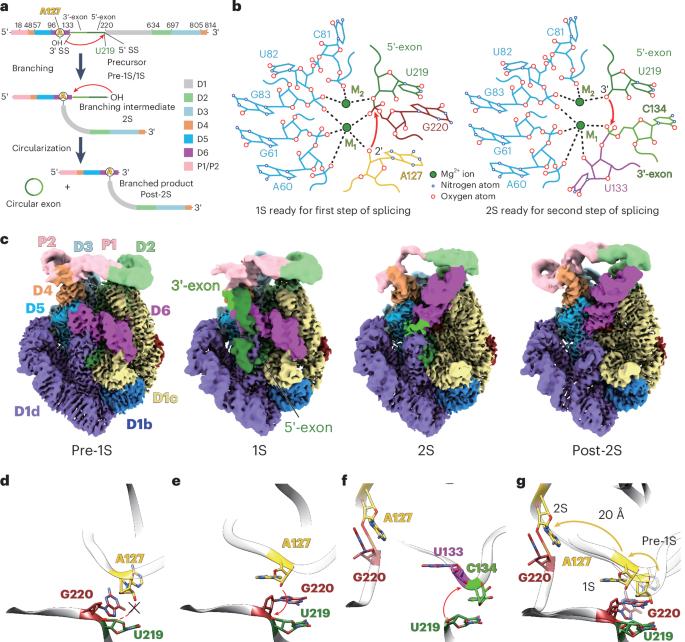
Circularly permuted group II introns (CP introns) consist of rearranged structural domains separated by two tethered exons, generating branched introns and circular exons via back-splicing. Structural and mechanistic understanding of circular RNA (circRNA) generation by CP introns remains elusive. We resolve cryo-electron microscopy structures of a natural CP intron in different states during back-splicing at a resolution of 2.5–2.9 Å. Domain 6 (D6) undergoes a conformational change of 65° after branching, to facilitate 3′-exon recognition and circularization. Previously unseen tertiary interactions compact the catalytic triad and D6 for splicing without protein, whereas a metal ion, M35, is observed to stabilize the 5′-exon during splicing. While these unique features were not observed in canonical group II introns and spliceosomes, they are common in CP introns, as demonstrated by the cryo-EM structure of another CP intron discovered by comparative genomics analysis. Our results elucidate the mechanism of CP intron back-splicing dynamics, with potential applications in circRNA research and therapeutics. Cryo-EM structures of circularly permuted group II introns determined at 2.5- to 2.9-Å resolutions reveal dynamic D6, unexpected interactions and metal ions for catalysis, which elucidate conserved mechanisms of back-splicing to generate circular RNAs.
期刊介绍:
Nature Structural & Molecular Biology is a comprehensive platform that combines structural and molecular research. Our journal focuses on exploring the functional and mechanistic aspects of biological processes, emphasizing how molecular components collaborate to achieve a particular function. While structural data can shed light on these insights, our publication does not require them as a prerequisite.




 京公网安备 11010802042870号
京ICP备2023020795号-1
京公网安备 11010802042870号
京ICP备2023020795号-1

 分享
分享
 求助内容:
求助内容: 应助结果提醒方式:
 扫码关注我们
