{"title":"羧甲基淀粉在各向异性辉钼矿和滑石表面的非均相吸附及其对浮选的影响","authors":"Zechao Huangfu, Wei Sun, Runqing Liu, Chen Chen, Chenyang Zhang, Heng Yu, Siyuan Liu","doi":"10.1016/j.seppur.2025.131849","DOIUrl":null,"url":null,"abstract":"<div><div>The effective recovery of talc-bearing molybdenum ores has been a research hotspot in the field of minerals processing, which is mainly attributed to the similarity of the physical and chemical properties of talc and molybdenite, especially floatability, which presents a challenge in the separation of the two during the beneficiation process. Herein, the coordination affinity, differentiated adsorption configurations, adsorption morphology, and bonding mechanisms of a polysaccharide-based depressant, carboxymethyl starch (CMS), on the layered hydrophobic minerals molybdenite and talc have been compared and its special use in flotation was investigated by various advanced techniques, including density functional theory (DFT) simulation, time-of-flight secondary ion mass spectrometry (TOF-SIMS) and X-ray photoelectron spectroscopy (XPS). The CMS adsorption on the talc surface was more affinitive than that of molybdenite and it is possible to achieve the selective separation of laminar hydrophobic minerals molybdenite and talc through the utilization of differential wettability. Flotation kinetics with 400 mg/L CMS as a depressant and 3*10<sup>−3</sup> mol/L sodium diethyldithiocarbamate (DDTC) as a collector has highlighted the importance of the mineral particle sizes that the better depressant activity of CMS on the coarse-grained talc surface in comparison to that of molybdenite is attributed to the greater adsorption energy and more homogeneous adsorption morphology of CMS on the talc basal surface which is the dominant surface affecting the floatability.</div></div>","PeriodicalId":427,"journal":{"name":"Separation and Purification Technology","volume":"363 ","pages":"Article 131849"},"PeriodicalIF":9.0000,"publicationDate":"2025-08-14","publicationTypes":"Journal Article","fieldsOfStudy":null,"isOpenAccess":false,"openAccessPdf":"","citationCount":"0","resultStr":"{\"title\":\"Heterogeneous adsorption of carboxymethyl starch on anisotropic molybdenite and talc surfaces and its effect on flotation\",\"authors\":\"Zechao Huangfu, Wei Sun, Runqing Liu, Chen Chen, Chenyang Zhang, Heng Yu, Siyuan Liu\",\"doi\":\"10.1016/j.seppur.2025.131849\",\"DOIUrl\":null,\"url\":null,\"abstract\":\"<div><div>The effective recovery of talc-bearing molybdenum ores has been a research hotspot in the field of minerals processing, which is mainly attributed to the similarity of the physical and chemical properties of talc and molybdenite, especially floatability, which presents a challenge in the separation of the two during the beneficiation process. Herein, the coordination affinity, differentiated adsorption configurations, adsorption morphology, and bonding mechanisms of a polysaccharide-based depressant, carboxymethyl starch (CMS), on the layered hydrophobic minerals molybdenite and talc have been compared and its special use in flotation was investigated by various advanced techniques, including density functional theory (DFT) simulation, time-of-flight secondary ion mass spectrometry (TOF-SIMS) and X-ray photoelectron spectroscopy (XPS). The CMS adsorption on the talc surface was more affinitive than that of molybdenite and it is possible to achieve the selective separation of laminar hydrophobic minerals molybdenite and talc through the utilization of differential wettability. Flotation kinetics with 400 mg/L CMS as a depressant and 3*10<sup>−3</sup> mol/L sodium diethyldithiocarbamate (DDTC) as a collector has highlighted the importance of the mineral particle sizes that the better depressant activity of CMS on the coarse-grained talc surface in comparison to that of molybdenite is attributed to the greater adsorption energy and more homogeneous adsorption morphology of CMS on the talc basal surface which is the dominant surface affecting the floatability.</div></div>\",\"PeriodicalId\":427,\"journal\":{\"name\":\"Separation and Purification Technology\",\"volume\":\"363 \",\"pages\":\"Article 131849\"},\"PeriodicalIF\":9.0000,\"publicationDate\":\"2025-08-14\",\"publicationTypes\":\"Journal Article\",\"fieldsOfStudy\":null,\"isOpenAccess\":false,\"openAccessPdf\":\"\",\"citationCount\":\"0\",\"resultStr\":null,\"platform\":\"Semanticscholar\",\"paperid\":null,\"PeriodicalName\":\"Separation and Purification Technology\",\"FirstCategoryId\":\"5\",\"ListUrlMain\":\"https://www.sciencedirect.com/science/article/pii/S1383586625004460\",\"RegionNum\":1,\"RegionCategory\":\"工程技术\",\"ArticlePicture\":[],\"TitleCN\":null,\"AbstractTextCN\":null,\"PMCID\":null,\"EPubDate\":\"2025/1/30 0:00:00\",\"PubModel\":\"Epub\",\"JCR\":\"Q1\",\"JCRName\":\"ENGINEERING, CHEMICAL\",\"Score\":null,\"Total\":0}","platform":"Semanticscholar","paperid":null,"PeriodicalName":"Separation and Purification Technology","FirstCategoryId":"5","ListUrlMain":"https://www.sciencedirect.com/science/article/pii/S1383586625004460","RegionNum":1,"RegionCategory":"工程技术","ArticlePicture":[],"TitleCN":null,"AbstractTextCN":null,"PMCID":null,"EPubDate":"2025/1/30 0:00:00","PubModel":"Epub","JCR":"Q1","JCRName":"ENGINEERING, CHEMICAL","Score":null,"Total":0}
Heterogeneous adsorption of carboxymethyl starch on anisotropic molybdenite and talc surfaces and its effect on flotation
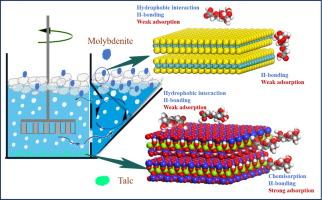
The effective recovery of talc-bearing molybdenum ores has been a research hotspot in the field of minerals processing, which is mainly attributed to the similarity of the physical and chemical properties of talc and molybdenite, especially floatability, which presents a challenge in the separation of the two during the beneficiation process. Herein, the coordination affinity, differentiated adsorption configurations, adsorption morphology, and bonding mechanisms of a polysaccharide-based depressant, carboxymethyl starch (CMS), on the layered hydrophobic minerals molybdenite and talc have been compared and its special use in flotation was investigated by various advanced techniques, including density functional theory (DFT) simulation, time-of-flight secondary ion mass spectrometry (TOF-SIMS) and X-ray photoelectron spectroscopy (XPS). The CMS adsorption on the talc surface was more affinitive than that of molybdenite and it is possible to achieve the selective separation of laminar hydrophobic minerals molybdenite and talc through the utilization of differential wettability. Flotation kinetics with 400 mg/L CMS as a depressant and 3*10−3 mol/L sodium diethyldithiocarbamate (DDTC) as a collector has highlighted the importance of the mineral particle sizes that the better depressant activity of CMS on the coarse-grained talc surface in comparison to that of molybdenite is attributed to the greater adsorption energy and more homogeneous adsorption morphology of CMS on the talc basal surface which is the dominant surface affecting the floatability.
期刊介绍:
Separation and Purification Technology is a premier journal committed to sharing innovative methods for separation and purification in chemical and environmental engineering, encompassing both homogeneous solutions and heterogeneous mixtures. Our scope includes the separation and/or purification of liquids, vapors, and gases, as well as carbon capture and separation techniques. However, it's important to note that methods solely intended for analytical purposes are not within the scope of the journal. Additionally, disciplines such as soil science, polymer science, and metallurgy fall outside the purview of Separation and Purification Technology. Join us in advancing the field of separation and purification methods for sustainable solutions in chemical and environmental engineering.




 京公网安备 11010802042870号
京ICP备2023020795号-1
京公网安备 11010802042870号
京ICP备2023020795号-1

 分享
分享
 求助内容:
求助内容: 应助结果提醒方式:
 扫码关注我们
