Yu Liu , Deyang Kong , Junzheng Song , Zhao Wang , Yurong Guo , Lei Yu , Xing Gao , Yen Leng Pak , Jibin Song , Juyoung Yoon
{"title":"阴离子七甲基菁氨酸作为活性硫物种激活探针:NIR-II荧光成像在体内谷胱甘肽可视化中的应用","authors":"Yu Liu , Deyang Kong , Junzheng Song , Zhao Wang , Yurong Guo , Lei Yu , Xing Gao , Yen Leng Pak , Jibin Song , Juyoung Yoon","doi":"10.1016/j.snb.2025.137371","DOIUrl":null,"url":null,"abstract":"<div><div>Understanding glutathione (GSH)-related pathophysiological mechanisms requires their effective visualization. Current fluorescence probes for GSH visualization that operate in the visible and near-infrared (NIR-I) windows suffer from limited penetration in tissue and significant tissue autofluorescence. As part of this study, a GSH-activatable second near-infrared (NIR-II) fluorescent probe (denoted as <strong>T2S2</strong>) was developed to visualize GSH <em>in vivo</em> in a highly sensitive and selective manner. <strong>T2S2</strong> contains an anionic polymethylcyanide framework coupled to a 3,4-dimethoxybenzenethiol fluorescence quenching moiety specifically activated by GSH. In response to this activation, the NIR-II fluorescence is significantly enhanced, enabling the effective discrimination of GSH from similar biothiols with low molecular weight. The GSH detection limit of <strong>T2S2</strong> was established to be 90 nM, accompanied by a color change from blue-green to yellow-green. Notably, the <strong>T2S2</strong> probe was found to be highly selective and sensitive to GSH <em>in vivo</em>. Hence, this study presents a promising approach for developing activatable NIR-II fluorescent probes to image GSH and other biomarkers <em>in vivo</em>.</div></div>","PeriodicalId":425,"journal":{"name":"Sensors and Actuators B: Chemical","volume":"430 ","pages":"Article 137371"},"PeriodicalIF":3.7000,"publicationDate":"2025-05-01","publicationTypes":"Journal Article","fieldsOfStudy":null,"isOpenAccess":false,"openAccessPdf":"","citationCount":"0","resultStr":"{\"title\":\"Anionic heptamethine cyanine as reactive sulfur species-activated probe: Application of NIR-II fluorescence imaging for in vivo visualization of glutathione\",\"authors\":\"Yu Liu , Deyang Kong , Junzheng Song , Zhao Wang , Yurong Guo , Lei Yu , Xing Gao , Yen Leng Pak , Jibin Song , Juyoung Yoon\",\"doi\":\"10.1016/j.snb.2025.137371\",\"DOIUrl\":null,\"url\":null,\"abstract\":\"<div><div>Understanding glutathione (GSH)-related pathophysiological mechanisms requires their effective visualization. Current fluorescence probes for GSH visualization that operate in the visible and near-infrared (NIR-I) windows suffer from limited penetration in tissue and significant tissue autofluorescence. As part of this study, a GSH-activatable second near-infrared (NIR-II) fluorescent probe (denoted as <strong>T2S2</strong>) was developed to visualize GSH <em>in vivo</em> in a highly sensitive and selective manner. <strong>T2S2</strong> contains an anionic polymethylcyanide framework coupled to a 3,4-dimethoxybenzenethiol fluorescence quenching moiety specifically activated by GSH. In response to this activation, the NIR-II fluorescence is significantly enhanced, enabling the effective discrimination of GSH from similar biothiols with low molecular weight. The GSH detection limit of <strong>T2S2</strong> was established to be 90 nM, accompanied by a color change from blue-green to yellow-green. Notably, the <strong>T2S2</strong> probe was found to be highly selective and sensitive to GSH <em>in vivo</em>. Hence, this study presents a promising approach for developing activatable NIR-II fluorescent probes to image GSH and other biomarkers <em>in vivo</em>.</div></div>\",\"PeriodicalId\":425,\"journal\":{\"name\":\"Sensors and Actuators B: Chemical\",\"volume\":\"430 \",\"pages\":\"Article 137371\"},\"PeriodicalIF\":3.7000,\"publicationDate\":\"2025-05-01\",\"publicationTypes\":\"Journal Article\",\"fieldsOfStudy\":null,\"isOpenAccess\":false,\"openAccessPdf\":\"\",\"citationCount\":\"0\",\"resultStr\":null,\"platform\":\"Semanticscholar\",\"paperid\":null,\"PeriodicalName\":\"Sensors and Actuators B: Chemical\",\"FirstCategoryId\":\"92\",\"ListUrlMain\":\"https://www.sciencedirect.com/science/article/pii/S0925400525001467\",\"RegionNum\":1,\"RegionCategory\":\"化学\",\"ArticlePicture\":[],\"TitleCN\":null,\"AbstractTextCN\":null,\"PMCID\":null,\"EPubDate\":\"2025/2/1 0:00:00\",\"PubModel\":\"Epub\",\"JCR\":\"Q1\",\"JCRName\":\"CHEMISTRY, ANALYTICAL\",\"Score\":null,\"Total\":0}","platform":"Semanticscholar","paperid":null,"PeriodicalName":"Sensors and Actuators B: Chemical","FirstCategoryId":"92","ListUrlMain":"https://www.sciencedirect.com/science/article/pii/S0925400525001467","RegionNum":1,"RegionCategory":"化学","ArticlePicture":[],"TitleCN":null,"AbstractTextCN":null,"PMCID":null,"EPubDate":"2025/2/1 0:00:00","PubModel":"Epub","JCR":"Q1","JCRName":"CHEMISTRY, ANALYTICAL","Score":null,"Total":0}
Anionic heptamethine cyanine as reactive sulfur species-activated probe: Application of NIR-II fluorescence imaging for in vivo visualization of glutathione
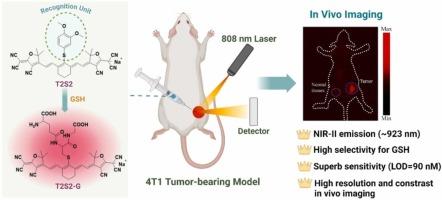
Understanding glutathione (GSH)-related pathophysiological mechanisms requires their effective visualization. Current fluorescence probes for GSH visualization that operate in the visible and near-infrared (NIR-I) windows suffer from limited penetration in tissue and significant tissue autofluorescence. As part of this study, a GSH-activatable second near-infrared (NIR-II) fluorescent probe (denoted as T2S2) was developed to visualize GSH in vivo in a highly sensitive and selective manner. T2S2 contains an anionic polymethylcyanide framework coupled to a 3,4-dimethoxybenzenethiol fluorescence quenching moiety specifically activated by GSH. In response to this activation, the NIR-II fluorescence is significantly enhanced, enabling the effective discrimination of GSH from similar biothiols with low molecular weight. The GSH detection limit of T2S2 was established to be 90 nM, accompanied by a color change from blue-green to yellow-green. Notably, the T2S2 probe was found to be highly selective and sensitive to GSH in vivo. Hence, this study presents a promising approach for developing activatable NIR-II fluorescent probes to image GSH and other biomarkers in vivo.
期刊介绍:
Sensors & Actuators, B: Chemical is an international journal focused on the research and development of chemical transducers. It covers chemical sensors and biosensors, chemical actuators, and analytical microsystems. The journal is interdisciplinary, aiming to publish original works showcasing substantial advancements beyond the current state of the art in these fields, with practical applicability to solving meaningful analytical problems. Review articles are accepted by invitation from an Editor of the journal.




 京公网安备 11010802042870号
京ICP备2023020795号-1
京公网安备 11010802042870号
京ICP备2023020795号-1

 分享
分享
 求助内容:
求助内容: 应助结果提醒方式:
 扫码关注我们
