Leiqian Zhang, Han Ding, Haiqi Gao, Jiaming Gong, Hele Guo, Shuoqing Zhang, Yi Yu, Guanjie He, Tao Deng, Ivan P. Parkin, Johan Hofkens, Xiulin Fan, Feili Lai and Tianxi Liu
{"title":"高能、耐用、超高回收效率锌碘电池的集成设计","authors":"Leiqian Zhang, Han Ding, Haiqi Gao, Jiaming Gong, Hele Guo, Shuoqing Zhang, Yi Yu, Guanjie He, Tao Deng, Ivan P. Parkin, Johan Hofkens, Xiulin Fan, Feili Lai and Tianxi Liu","doi":"10.1039/D4EE05873A","DOIUrl":null,"url":null,"abstract":"<p >Zinc–iodine batteries (ZIBs) have long struggled with the uncontrolled spread of polyiodide in aqueous electrolytes, despite their environmentally friendly, inherently safe, and cost-effective nature. Here, we present an integral redesign of ZIBs that encompasses both the electrolyte and cell structure. The developed self-sieving polyiodide-capable liquid–liquid biphasic electrolyte can achieve an impressive polyiodide extraction efficiency of 99.98%, harnessing a meticulously iodine-containing hydrophobic solvated shell in conjunction with the salt-out effect. This advancement facilitates a membrane-free design with a Coulombic efficiency of ∼100% at 0.1C, alongside an ultra-low self-discharge rate of ∼3.4% per month and capacity retention of 83.1% after 1300 cycles (iodine areal loading: 22.2 mg cm<small><sup>−2</sup></small>). Furthermore, the integrated cell structure, paired with the low-cost electrolyte ($4.6 L<small><sup>−1</sup></small>), enables rapid assembly into A h-level batteries within hours (1.18 A h after 100 cycles with a capacity retention of 86.7%), supports electrolyte regeneration with ∼100% recycling efficiency, and extends to ZIBs with a two-electron iodine conversion reaction. This endeavor establishes a novel paradigm for the development of practical zinc–iodine batteries.</p>","PeriodicalId":72,"journal":{"name":"Energy & Environmental Science","volume":" 5","pages":" 2462-2473"},"PeriodicalIF":30.5000,"publicationDate":"2025-02-03","publicationTypes":"Journal Article","fieldsOfStudy":null,"isOpenAccess":false,"openAccessPdf":"https://pubs.rsc.org/en/content/articlepdf/2025/ee/d4ee05873a?page=search","citationCount":"0","resultStr":"{\"title\":\"An integrated design for high-energy, durable zinc–iodine batteries with ultra-high recycling efficiency†\",\"authors\":\"Leiqian Zhang, Han Ding, Haiqi Gao, Jiaming Gong, Hele Guo, Shuoqing Zhang, Yi Yu, Guanjie He, Tao Deng, Ivan P. Parkin, Johan Hofkens, Xiulin Fan, Feili Lai and Tianxi Liu\",\"doi\":\"10.1039/D4EE05873A\",\"DOIUrl\":null,\"url\":null,\"abstract\":\"<p >Zinc–iodine batteries (ZIBs) have long struggled with the uncontrolled spread of polyiodide in aqueous electrolytes, despite their environmentally friendly, inherently safe, and cost-effective nature. Here, we present an integral redesign of ZIBs that encompasses both the electrolyte and cell structure. The developed self-sieving polyiodide-capable liquid–liquid biphasic electrolyte can achieve an impressive polyiodide extraction efficiency of 99.98%, harnessing a meticulously iodine-containing hydrophobic solvated shell in conjunction with the salt-out effect. This advancement facilitates a membrane-free design with a Coulombic efficiency of ∼100% at 0.1C, alongside an ultra-low self-discharge rate of ∼3.4% per month and capacity retention of 83.1% after 1300 cycles (iodine areal loading: 22.2 mg cm<small><sup>−2</sup></small>). Furthermore, the integrated cell structure, paired with the low-cost electrolyte ($4.6 L<small><sup>−1</sup></small>), enables rapid assembly into A h-level batteries within hours (1.18 A h after 100 cycles with a capacity retention of 86.7%), supports electrolyte regeneration with ∼100% recycling efficiency, and extends to ZIBs with a two-electron iodine conversion reaction. This endeavor establishes a novel paradigm for the development of practical zinc–iodine batteries.</p>\",\"PeriodicalId\":72,\"journal\":{\"name\":\"Energy & Environmental Science\",\"volume\":\" 5\",\"pages\":\" 2462-2473\"},\"PeriodicalIF\":30.5000,\"publicationDate\":\"2025-02-03\",\"publicationTypes\":\"Journal Article\",\"fieldsOfStudy\":null,\"isOpenAccess\":false,\"openAccessPdf\":\"https://pubs.rsc.org/en/content/articlepdf/2025/ee/d4ee05873a?page=search\",\"citationCount\":\"0\",\"resultStr\":null,\"platform\":\"Semanticscholar\",\"paperid\":null,\"PeriodicalName\":\"Energy & Environmental Science\",\"FirstCategoryId\":\"88\",\"ListUrlMain\":\"https://pubs.rsc.org/en/content/articlelanding/2025/ee/d4ee05873a\",\"RegionNum\":1,\"RegionCategory\":\"材料科学\",\"ArticlePicture\":[],\"TitleCN\":null,\"AbstractTextCN\":null,\"PMCID\":null,\"EPubDate\":\"\",\"PubModel\":\"\",\"JCR\":\"Q1\",\"JCRName\":\"CHEMISTRY, MULTIDISCIPLINARY\",\"Score\":null,\"Total\":0}","platform":"Semanticscholar","paperid":null,"PeriodicalName":"Energy & Environmental Science","FirstCategoryId":"88","ListUrlMain":"https://pubs.rsc.org/en/content/articlelanding/2025/ee/d4ee05873a","RegionNum":1,"RegionCategory":"材料科学","ArticlePicture":[],"TitleCN":null,"AbstractTextCN":null,"PMCID":null,"EPubDate":"","PubModel":"","JCR":"Q1","JCRName":"CHEMISTRY, MULTIDISCIPLINARY","Score":null,"Total":0}
引用次数: 0
摘要
长期以来,锌碘电池(zbs)一直在与水电解质中聚碘化物的不受控制的扩散作斗争,尽管它们具有环保、固有的安全性和成本效益。在这里,我们提出了一个完整的重新设计的ZIBs,包括电解质和电池结构。所开发的自筛多碘化液-液双相电解质,利用精心制备的含碘疏水溶剂化壳和盐出效应,可实现99.98%的多碘提取效率。这一进步促进了无膜设计,在0.1C时库仑效率为~ 100%,同时具有每月~ 3.4%的超低自放电率,在1300次循环后容量保持率为83.1%(碘面积负载:22.2 mg cm−2)。此外,集成电池结构与低成本电解质(4.6 L−1美元)相结合,可以在数小时内快速组装成A h级电池(100次循环后1.18 A h,容量保留率为86.7%),支持电解质再生,回收效率为100%,并通过双电子碘转换反应扩展到zib。这一努力为实用锌碘电池的发展建立了一个新的范例。
An integrated design for high-energy, durable zinc–iodine batteries with ultra-high recycling efficiency†
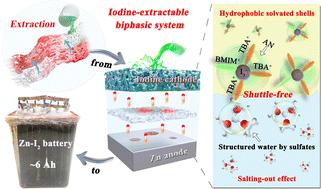
Zinc–iodine batteries (ZIBs) have long struggled with the uncontrolled spread of polyiodide in aqueous electrolytes, despite their environmentally friendly, inherently safe, and cost-effective nature. Here, we present an integral redesign of ZIBs that encompasses both the electrolyte and cell structure. The developed self-sieving polyiodide-capable liquid–liquid biphasic electrolyte can achieve an impressive polyiodide extraction efficiency of 99.98%, harnessing a meticulously iodine-containing hydrophobic solvated shell in conjunction with the salt-out effect. This advancement facilitates a membrane-free design with a Coulombic efficiency of ∼100% at 0.1C, alongside an ultra-low self-discharge rate of ∼3.4% per month and capacity retention of 83.1% after 1300 cycles (iodine areal loading: 22.2 mg cm−2). Furthermore, the integrated cell structure, paired with the low-cost electrolyte ($4.6 L−1), enables rapid assembly into A h-level batteries within hours (1.18 A h after 100 cycles with a capacity retention of 86.7%), supports electrolyte regeneration with ∼100% recycling efficiency, and extends to ZIBs with a two-electron iodine conversion reaction. This endeavor establishes a novel paradigm for the development of practical zinc–iodine batteries.
期刊介绍:
Energy & Environmental Science, a peer-reviewed scientific journal, publishes original research and review articles covering interdisciplinary topics in the (bio)chemical and (bio)physical sciences, as well as chemical engineering disciplines. Published monthly by the Royal Society of Chemistry (RSC), a not-for-profit publisher, Energy & Environmental Science is recognized as a leading journal. It boasts an impressive impact factor of 8.500 as of 2009, ranking 8th among 140 journals in the category "Chemistry, Multidisciplinary," second among 71 journals in "Energy & Fuels," second among 128 journals in "Engineering, Chemical," and first among 181 scientific journals in "Environmental Sciences."
Energy & Environmental Science publishes various types of articles, including Research Papers (original scientific work), Review Articles, Perspectives, and Minireviews (feature review-type articles of broad interest), Communications (original scientific work of an urgent nature), Opinions (personal, often speculative viewpoints or hypotheses on current topics), and Analysis Articles (in-depth examination of energy-related issues).





 京公网安备 11010802042870号
京ICP备2023020795号-1
京公网安备 11010802042870号
京ICP备2023020795号-1

 分享
分享
 求助内容:
求助内容: 应助结果提醒方式:
 扫码关注我们
