{"title":"美国成年人肠道菌群饮食指数与中风相关","authors":"Jingjing Liu and Shaoqiang Huang","doi":"10.1039/D4FO04649H","DOIUrl":null,"url":null,"abstract":"<p >\r\n <em>Aims</em>: Emerging evidence underscores the diet–microbiota–gut–brain axis as vital to brain health. The dietary index for gut microbiota (DI-GM), quantifying diet quality linked to gut microbiota diversity, reflects healthier gut microbiota with higher scores. Therefore, this study was designed to explore the unclear association between DI-GM and stroke. <em>Methods</em>: A cross-sectional analysis was conducted using data from 48 677 participants aged ≥20 years in the National Health and Nutrition Examination Survey (NHANES). Demographic and dietary data were collected, and multivariable weighted logistic regression analysis was performed to evaluate the association between the DI-GM and stroke. Additionally, restricted cubic spline (RCS), subgroup analyses, and receiver operating characteristic (ROC) curve were conducted. <em>Results</em>: In participants aged ≥20 years, the odds ratio (OR) was 0.96 (95% CI: 0.92–1.00, <em>P</em> = 0.075) in the crude model, but after adjustment, the OR was 0.93 (95% CI: 0.89–0.98, <em>P</em> = 0.003), while higher beneficial to gut microbiota scores were consistently associated with lower stroke prevalence with ORs of 0.87 (95% CI: 0.83–0.90, <em>P</em> < 0.001) in the crude model and 0.88 (95% CI: 0.83–0.93, <em>P</em> < 0.001) after adjustment. Among participants aged 20–29 years, no significant association was observed. For those aged ≥30 years, higher DI-GM and beneficial to gut microbiota scores were associated with lower stroke prevalence, with DI-GM showing ORs of 0.93 (95% CI: 0.89–0.97, <em>P</em> < 0.001) in the crude model and 0.93 (95% CI: 0.89–0.98, <em>P</em> = 0.003) after adjustment, and beneficial to gut microbiota scores showing ORs of 0.82 (95% CI: 0.79–0.86, <em>P</em> < 0.001) in the crude model and 0.88 (95% CI: 0.83–0.93, <em>P</em> < 0.001) after adjustment. RCS indicated a linear relationship between DI-GM and stroke. <em>Conclusion</em>: The DI-GM was inversely and linearly associated with stroke prevalence, particularly in adults aged 30 years and above.</p>","PeriodicalId":77,"journal":{"name":"Food & Function","volume":" 4","pages":" 1458-1468"},"PeriodicalIF":5.4000,"publicationDate":"2025-02-03","publicationTypes":"Journal Article","fieldsOfStudy":null,"isOpenAccess":false,"openAccessPdf":"","citationCount":"0","resultStr":"{\"title\":\"Dietary index for gut microbiota is associated with stroke among US adults†\",\"authors\":\"Jingjing Liu and Shaoqiang Huang\",\"doi\":\"10.1039/D4FO04649H\",\"DOIUrl\":null,\"url\":null,\"abstract\":\"<p >\\r\\n <em>Aims</em>: Emerging evidence underscores the diet–microbiota–gut–brain axis as vital to brain health. The dietary index for gut microbiota (DI-GM), quantifying diet quality linked to gut microbiota diversity, reflects healthier gut microbiota with higher scores. Therefore, this study was designed to explore the unclear association between DI-GM and stroke. <em>Methods</em>: A cross-sectional analysis was conducted using data from 48 677 participants aged ≥20 years in the National Health and Nutrition Examination Survey (NHANES). Demographic and dietary data were collected, and multivariable weighted logistic regression analysis was performed to evaluate the association between the DI-GM and stroke. Additionally, restricted cubic spline (RCS), subgroup analyses, and receiver operating characteristic (ROC) curve were conducted. <em>Results</em>: In participants aged ≥20 years, the odds ratio (OR) was 0.96 (95% CI: 0.92–1.00, <em>P</em> = 0.075) in the crude model, but after adjustment, the OR was 0.93 (95% CI: 0.89–0.98, <em>P</em> = 0.003), while higher beneficial to gut microbiota scores were consistently associated with lower stroke prevalence with ORs of 0.87 (95% CI: 0.83–0.90, <em>P</em> < 0.001) in the crude model and 0.88 (95% CI: 0.83–0.93, <em>P</em> < 0.001) after adjustment. Among participants aged 20–29 years, no significant association was observed. For those aged ≥30 years, higher DI-GM and beneficial to gut microbiota scores were associated with lower stroke prevalence, with DI-GM showing ORs of 0.93 (95% CI: 0.89–0.97, <em>P</em> < 0.001) in the crude model and 0.93 (95% CI: 0.89–0.98, <em>P</em> = 0.003) after adjustment, and beneficial to gut microbiota scores showing ORs of 0.82 (95% CI: 0.79–0.86, <em>P</em> < 0.001) in the crude model and 0.88 (95% CI: 0.83–0.93, <em>P</em> < 0.001) after adjustment. RCS indicated a linear relationship between DI-GM and stroke. <em>Conclusion</em>: The DI-GM was inversely and linearly associated with stroke prevalence, particularly in adults aged 30 years and above.</p>\",\"PeriodicalId\":77,\"journal\":{\"name\":\"Food & Function\",\"volume\":\" 4\",\"pages\":\" 1458-1468\"},\"PeriodicalIF\":5.4000,\"publicationDate\":\"2025-02-03\",\"publicationTypes\":\"Journal Article\",\"fieldsOfStudy\":null,\"isOpenAccess\":false,\"openAccessPdf\":\"\",\"citationCount\":\"0\",\"resultStr\":null,\"platform\":\"Semanticscholar\",\"paperid\":null,\"PeriodicalName\":\"Food & Function\",\"FirstCategoryId\":\"97\",\"ListUrlMain\":\"https://pubs.rsc.org/en/content/articlelanding/2025/fo/d4fo04649h\",\"RegionNum\":1,\"RegionCategory\":\"农林科学\",\"ArticlePicture\":[],\"TitleCN\":null,\"AbstractTextCN\":null,\"PMCID\":null,\"EPubDate\":\"\",\"PubModel\":\"\",\"JCR\":\"Q1\",\"JCRName\":\"BIOCHEMISTRY & MOLECULAR BIOLOGY\",\"Score\":null,\"Total\":0}","platform":"Semanticscholar","paperid":null,"PeriodicalName":"Food & Function","FirstCategoryId":"97","ListUrlMain":"https://pubs.rsc.org/en/content/articlelanding/2025/fo/d4fo04649h","RegionNum":1,"RegionCategory":"农林科学","ArticlePicture":[],"TitleCN":null,"AbstractTextCN":null,"PMCID":null,"EPubDate":"","PubModel":"","JCR":"Q1","JCRName":"BIOCHEMISTRY & MOLECULAR BIOLOGY","Score":null,"Total":0}
引用次数: 0
摘要
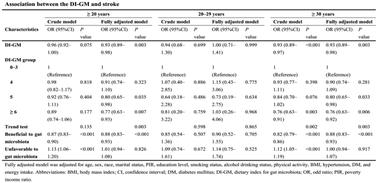
目的:新出现的证据强调饮食-微生物-肠道-大脑轴对大脑健康至关重要。肠道微生物群膳食指数(DI-GM)量化了与肠道微生物群多样性相关的饮食质量,得分越高,反映出肠道微生物群越健康。因此,本研究旨在探讨DI-GM与脑卒中之间的不明确关联。方法:对全国健康与营养调查(NHANES)中年龄≥20岁的48677名参与者的数据进行横断面分析。收集人口统计和饮食数据,并进行多变量加权logistic回归分析,以评估DI-GM与脑卒中之间的关系。此外,还进行了限制性三次样条(RCS)、亚组分析和受试者工作特征(ROC)曲线分析。结果:在年龄≥20岁的参与者中,粗模型的比值比(OR)为0.96 (95% CI: 0.92-1.00, P = 0.075),但调整后的比值比为0.93 (95% CI: 0.89-0.98, P = 0.003),而较高的肠道微生物群有益评分与较低的卒中患病率一致相关,粗模型的比值比为0.87 (95% CI: 0.83-0.90, P < 0.001),调整后的比值比为0.88 (95% CI: 0.83-0.93, P < 0.001)。在20-29岁的参与者中,没有观察到显著的关联。对于年龄≥30岁的患者,较高的DI-GM评分和有益肠道微生物群评分与较低的卒中患病率相关,在粗模型中DI-GM的or值为0.93 (95% CI: 0.89-0.97, P < 0.001),调整后的or值为0.93 (95% CI: 0.89-0.98, P = 0.003),而在粗模型中有益肠道微生物群评分的or值为0.82 (95% CI: 0.79-0.86, P < 0.001),调整后的or值为0.88 (95% CI: 0.83-0.93, P < 0.001)。RCS显示DI-GM与脑卒中呈线性关系。结论:DI-GM与卒中患病率呈负相关和线性相关,特别是在30岁及以上的成年人中。
Dietary index for gut microbiota is associated with stroke among US adults†
Aims: Emerging evidence underscores the diet–microbiota–gut–brain axis as vital to brain health. The dietary index for gut microbiota (DI-GM), quantifying diet quality linked to gut microbiota diversity, reflects healthier gut microbiota with higher scores. Therefore, this study was designed to explore the unclear association between DI-GM and stroke. Methods: A cross-sectional analysis was conducted using data from 48 677 participants aged ≥20 years in the National Health and Nutrition Examination Survey (NHANES). Demographic and dietary data were collected, and multivariable weighted logistic regression analysis was performed to evaluate the association between the DI-GM and stroke. Additionally, restricted cubic spline (RCS), subgroup analyses, and receiver operating characteristic (ROC) curve were conducted. Results: In participants aged ≥20 years, the odds ratio (OR) was 0.96 (95% CI: 0.92–1.00, P = 0.075) in the crude model, but after adjustment, the OR was 0.93 (95% CI: 0.89–0.98, P = 0.003), while higher beneficial to gut microbiota scores were consistently associated with lower stroke prevalence with ORs of 0.87 (95% CI: 0.83–0.90, P < 0.001) in the crude model and 0.88 (95% CI: 0.83–0.93, P < 0.001) after adjustment. Among participants aged 20–29 years, no significant association was observed. For those aged ≥30 years, higher DI-GM and beneficial to gut microbiota scores were associated with lower stroke prevalence, with DI-GM showing ORs of 0.93 (95% CI: 0.89–0.97, P < 0.001) in the crude model and 0.93 (95% CI: 0.89–0.98, P = 0.003) after adjustment, and beneficial to gut microbiota scores showing ORs of 0.82 (95% CI: 0.79–0.86, P < 0.001) in the crude model and 0.88 (95% CI: 0.83–0.93, P < 0.001) after adjustment. RCS indicated a linear relationship between DI-GM and stroke. Conclusion: The DI-GM was inversely and linearly associated with stroke prevalence, particularly in adults aged 30 years and above.
期刊介绍:
Food & Function provides a unique venue for physicists, chemists, biochemists, nutritionists and other food scientists to publish work at the interface of the chemistry, physics and biology of food. The journal focuses on food and the functions of food in relation to health.




 京公网安备 11010802042870号
京ICP备2023020795号-1
京公网安备 11010802042870号
京ICP备2023020795号-1

 分享
分享
 求助内容:
求助内容: 应助结果提醒方式:
 扫码关注我们
