Hicham Mahdjoub–Araibi, Mourad Zouaoui–Rabah, Madani Hedidi, Abdelkader M. Elhorri, Assia Laib, Mohammed Zenati
{"title":"利用DFT和TD-DFT对钛醇、铁醇、镍醇和锌醇等环共轭桥组成的nlo活性推挽分子进行了理论研究。","authors":"Hicham Mahdjoub–Araibi, Mourad Zouaoui–Rabah, Madani Hedidi, Abdelkader M. Elhorri, Assia Laib, Mohammed Zenati","doi":"10.1007/s00894-025-06294-y","DOIUrl":null,"url":null,"abstract":"<div><h3>Context</h3><p>This research is based on the theoretical study of seven push–pull molecules composed of conjugated bridges based on two different organometallic rings, these bridges are linked at their ends by acceptor groups (–NO<sub>2</sub>) and donor groups (–N(CH<sub>3</sub>)<sub>2</sub>) on the α position of the rings mentioned above. The location of the donor and acceptor groups revealed that the addition of the acceptor groups near the rings (Titanol, Ferrol and Nickelol) improves the NLO response in comparison with the grafting of these groups on the Zinkol ring and also influences the positioning of the π electrons at the level of the chromophores studied. The molecule 2B gave the highest values of static first hyperpolarisabilitiy (β<sub>tot</sub>) and static second hyperpolarisabilitiy (γ<sub>av</sub>), knowing that: β<sub>tot</sub> (2B) = 135.79 * 10<sup>–30</sup> esu and γ<sub>av</sub> (2B) = 135.79 * 10<sup>–35</sup> esu. The highest values of dynamic first <span>\\(\\beta_\\parallel^\\lambda\\left(-2\\omega;\\omega,\\;\\omega\\right)\\)</span> and second <span>\\(\\gamma_\\parallel^\\lambda\\left(-2\\omega;\\omega,\\;\\omega,\\;0\\right)\\)</span> hyperpolarisabilities are assigned to the molecule 1C with the following values: <span>\\(\\gamma_\\parallel^\\lambda\\left(-2\\omega;\\omega,\\;\\omega,\\;0\\right)\\)</span> =1,218,310.00 * 10<sup>–30</sup> esu and <span>\\(\\gamma_\\parallel^\\lambda\\left(-2\\omega;\\omega,\\;\\omega,\\;0\\right)\\)</span>=1,324,520,000 * 10<sup>–35</sup> esu. The metal Zn is considered as an acceptor group and the remaining metals (Ti, Fe and Ni) are considered as donor groups. The specific solvents for the seven molecules are water, ethanol and acetonitrile. The maximum wavelengths recorded for all molecules in combination with all solvents are in the range of 421.39 to 765.28 nm. λ</p><h3>Method</h3><p>The calculations were performed using Gaussian 16 software to perform DFT calculations with B3LYP functional. The LanL2DZ basis–set was used for transition metals, while the 6–31 + + G(d,p) basis–set was used for nonmetal atoms. The functionals used are: CAM–B3LYP, LC–wPBE, LC–BLYP, M11, wB97X, M08–HX, M06–2X, MN12SX, MN15, and M06HF. The basis–sets used are: 6–31G(d,p), 6–31 + + G(d,p), cc–pVDZ, aug–cc–pVDZ, 6–311G(d,p), 6–311 + + G(d,p), cc–pVTZ, and aug–cc–pVTZ. The Natural Bond Orbital (NBO) calculations are performed by the NBO program incorporated by default in the Gaussian 16 program. The solvation models studied are the CPCM model (conductor polarizable continuum model) and the SMD model (Solvation Model Density). Excited states calculations are calculated by the time-dependent DFT method (TD–DFT).</p></div>","PeriodicalId":651,"journal":{"name":"Journal of Molecular Modeling","volume":"31 3","pages":""},"PeriodicalIF":2.5000,"publicationDate":"2025-02-03","publicationTypes":"Journal Article","fieldsOfStudy":null,"isOpenAccess":false,"openAccessPdf":"","citationCount":"0","resultStr":"{\"title\":\"Theoretical study by DFT and TD–DFT of NLO-active push–pull molecules composed of conjugated bridges based on cyclic rings: Titanol, Ferrol, Nickelol and Zinkol\",\"authors\":\"Hicham Mahdjoub–Araibi, Mourad Zouaoui–Rabah, Madani Hedidi, Abdelkader M. Elhorri, Assia Laib, Mohammed Zenati\",\"doi\":\"10.1007/s00894-025-06294-y\",\"DOIUrl\":null,\"url\":null,\"abstract\":\"<div><h3>Context</h3><p>This research is based on the theoretical study of seven push–pull molecules composed of conjugated bridges based on two different organometallic rings, these bridges are linked at their ends by acceptor groups (–NO<sub>2</sub>) and donor groups (–N(CH<sub>3</sub>)<sub>2</sub>) on the α position of the rings mentioned above. The location of the donor and acceptor groups revealed that the addition of the acceptor groups near the rings (Titanol, Ferrol and Nickelol) improves the NLO response in comparison with the grafting of these groups on the Zinkol ring and also influences the positioning of the π electrons at the level of the chromophores studied. The molecule 2B gave the highest values of static first hyperpolarisabilitiy (β<sub>tot</sub>) and static second hyperpolarisabilitiy (γ<sub>av</sub>), knowing that: β<sub>tot</sub> (2B) = 135.79 * 10<sup>–30</sup> esu and γ<sub>av</sub> (2B) = 135.79 * 10<sup>–35</sup> esu. The highest values of dynamic first <span>\\\\(\\\\beta_\\\\parallel^\\\\lambda\\\\left(-2\\\\omega;\\\\omega,\\\\;\\\\omega\\\\right)\\\\)</span> and second <span>\\\\(\\\\gamma_\\\\parallel^\\\\lambda\\\\left(-2\\\\omega;\\\\omega,\\\\;\\\\omega,\\\\;0\\\\right)\\\\)</span> hyperpolarisabilities are assigned to the molecule 1C with the following values: <span>\\\\(\\\\gamma_\\\\parallel^\\\\lambda\\\\left(-2\\\\omega;\\\\omega,\\\\;\\\\omega,\\\\;0\\\\right)\\\\)</span> =1,218,310.00 * 10<sup>–30</sup> esu and <span>\\\\(\\\\gamma_\\\\parallel^\\\\lambda\\\\left(-2\\\\omega;\\\\omega,\\\\;\\\\omega,\\\\;0\\\\right)\\\\)</span>=1,324,520,000 * 10<sup>–35</sup> esu. The metal Zn is considered as an acceptor group and the remaining metals (Ti, Fe and Ni) are considered as donor groups. The specific solvents for the seven molecules are water, ethanol and acetonitrile. The maximum wavelengths recorded for all molecules in combination with all solvents are in the range of 421.39 to 765.28 nm. λ</p><h3>Method</h3><p>The calculations were performed using Gaussian 16 software to perform DFT calculations with B3LYP functional. The LanL2DZ basis–set was used for transition metals, while the 6–31 + + G(d,p) basis–set was used for nonmetal atoms. The functionals used are: CAM–B3LYP, LC–wPBE, LC–BLYP, M11, wB97X, M08–HX, M06–2X, MN12SX, MN15, and M06HF. The basis–sets used are: 6–31G(d,p), 6–31 + + G(d,p), cc–pVDZ, aug–cc–pVDZ, 6–311G(d,p), 6–311 + + G(d,p), cc–pVTZ, and aug–cc–pVTZ. The Natural Bond Orbital (NBO) calculations are performed by the NBO program incorporated by default in the Gaussian 16 program. The solvation models studied are the CPCM model (conductor polarizable continuum model) and the SMD model (Solvation Model Density). Excited states calculations are calculated by the time-dependent DFT method (TD–DFT).</p></div>\",\"PeriodicalId\":651,\"journal\":{\"name\":\"Journal of Molecular Modeling\",\"volume\":\"31 3\",\"pages\":\"\"},\"PeriodicalIF\":2.5000,\"publicationDate\":\"2025-02-03\",\"publicationTypes\":\"Journal Article\",\"fieldsOfStudy\":null,\"isOpenAccess\":false,\"openAccessPdf\":\"\",\"citationCount\":\"0\",\"resultStr\":null,\"platform\":\"Semanticscholar\",\"paperid\":null,\"PeriodicalName\":\"Journal of Molecular Modeling\",\"FirstCategoryId\":\"92\",\"ListUrlMain\":\"https://link.springer.com/article/10.1007/s00894-025-06294-y\",\"RegionNum\":4,\"RegionCategory\":\"化学\",\"ArticlePicture\":[],\"TitleCN\":null,\"AbstractTextCN\":null,\"PMCID\":null,\"EPubDate\":\"\",\"PubModel\":\"\",\"JCR\":\"Q4\",\"JCRName\":\"BIOCHEMISTRY & MOLECULAR BIOLOGY\",\"Score\":null,\"Total\":0}","platform":"Semanticscholar","paperid":null,"PeriodicalName":"Journal of Molecular Modeling","FirstCategoryId":"92","ListUrlMain":"https://link.springer.com/article/10.1007/s00894-025-06294-y","RegionNum":4,"RegionCategory":"化学","ArticlePicture":[],"TitleCN":null,"AbstractTextCN":null,"PMCID":null,"EPubDate":"","PubModel":"","JCR":"Q4","JCRName":"BIOCHEMISTRY & MOLECULAR BIOLOGY","Score":null,"Total":0}
Theoretical study by DFT and TD–DFT of NLO-active push–pull molecules composed of conjugated bridges based on cyclic rings: Titanol, Ferrol, Nickelol and Zinkol
Context
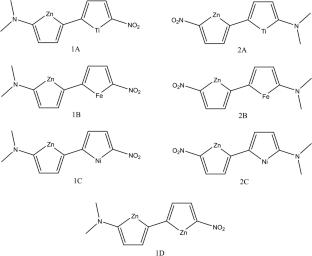
This research is based on the theoretical study of seven push–pull molecules composed of conjugated bridges based on two different organometallic rings, these bridges are linked at their ends by acceptor groups (–NO2) and donor groups (–N(CH3)2) on the α position of the rings mentioned above. The location of the donor and acceptor groups revealed that the addition of the acceptor groups near the rings (Titanol, Ferrol and Nickelol) improves the NLO response in comparison with the grafting of these groups on the Zinkol ring and also influences the positioning of the π electrons at the level of the chromophores studied. The molecule 2B gave the highest values of static first hyperpolarisabilitiy (βtot) and static second hyperpolarisabilitiy (γav), knowing that: βtot (2B) = 135.79 * 10–30 esu and γav (2B) = 135.79 * 10–35 esu. The highest values of dynamic first \(\beta_\parallel^\lambda\left(-2\omega;\omega,\;\omega\right)\) and second \(\gamma_\parallel^\lambda\left(-2\omega;\omega,\;\omega,\;0\right)\) hyperpolarisabilities are assigned to the molecule 1C with the following values: \(\gamma_\parallel^\lambda\left(-2\omega;\omega,\;\omega,\;0\right)\) =1,218,310.00 * 10–30 esu and \(\gamma_\parallel^\lambda\left(-2\omega;\omega,\;\omega,\;0\right)\)=1,324,520,000 * 10–35 esu. The metal Zn is considered as an acceptor group and the remaining metals (Ti, Fe and Ni) are considered as donor groups. The specific solvents for the seven molecules are water, ethanol and acetonitrile. The maximum wavelengths recorded for all molecules in combination with all solvents are in the range of 421.39 to 765.28 nm. λ
Method
The calculations were performed using Gaussian 16 software to perform DFT calculations with B3LYP functional. The LanL2DZ basis–set was used for transition metals, while the 6–31 + + G(d,p) basis–set was used for nonmetal atoms. The functionals used are: CAM–B3LYP, LC–wPBE, LC–BLYP, M11, wB97X, M08–HX, M06–2X, MN12SX, MN15, and M06HF. The basis–sets used are: 6–31G(d,p), 6–31 + + G(d,p), cc–pVDZ, aug–cc–pVDZ, 6–311G(d,p), 6–311 + + G(d,p), cc–pVTZ, and aug–cc–pVTZ. The Natural Bond Orbital (NBO) calculations are performed by the NBO program incorporated by default in the Gaussian 16 program. The solvation models studied are the CPCM model (conductor polarizable continuum model) and the SMD model (Solvation Model Density). Excited states calculations are calculated by the time-dependent DFT method (TD–DFT).
期刊介绍:
The Journal of Molecular Modeling focuses on "hardcore" modeling, publishing high-quality research and reports. Founded in 1995 as a purely electronic journal, it has adapted its format to include a full-color print edition, and adjusted its aims and scope fit the fast-changing field of molecular modeling, with a particular focus on three-dimensional modeling.
Today, the journal covers all aspects of molecular modeling including life science modeling; materials modeling; new methods; and computational chemistry.
Topics include computer-aided molecular design; rational drug design, de novo ligand design, receptor modeling and docking; cheminformatics, data analysis, visualization and mining; computational medicinal chemistry; homology modeling; simulation of peptides, DNA and other biopolymers; quantitative structure-activity relationships (QSAR) and ADME-modeling; modeling of biological reaction mechanisms; and combined experimental and computational studies in which calculations play a major role.




 京公网安备 11010802042870号
京ICP备2023020795号-1
京公网安备 11010802042870号
京ICP备2023020795号-1

 分享
分享
 求助内容:
求助内容: 应助结果提醒方式:
 扫码关注我们
