Min Zhou, Peng-Fei He, Keren Zhang, Li-Juan Deng, Ning Wang, Gang Wang, Guang-Yao Yang, Shang Ju
{"title":"美国成年人氧化平衡评分与外周动脉疾病之间的关系:一项横断面研究","authors":"Min Zhou, Peng-Fei He, Keren Zhang, Li-Juan Deng, Ning Wang, Gang Wang, Guang-Yao Yang, Shang Ju","doi":"10.3389/fnut.2024.1497784","DOIUrl":null,"url":null,"abstract":"<p><strong>Background: </strong>The Oxidative Balance Score (OBS) quantifies the overall oxidative stress burden, with higher scores indicating greater antioxidant (relative to prooxidant) activity. This study aimed to examine the association between peripheral arterial disease (PAD) and OBS.</p><p><strong>Methods and materials: </strong>Data from the National Health and Nutrition Examination Survey (NHANES, 1999-2004) were analyzed for participants with ankle-brachial index (ABI) measurements. The total Oxidative Balance Score (OBS) comprised a lifestyle OBS (four lifestyle categories) and a dietary OBS (16 dietary factors). Logistic regression analyses evaluated associations between PAD and total OBS, lifestyle OBS, and dietary OBS. Restricted cubic spline (RCS) analyses assessed dose-response relationships between ABI, PAD, and OBS. Mediation analyses investigated the roles of glucolipid metabolism and renal function in the OBS-PAD association. Sensitivity and stratification analyses were conducted to ensure robustness.</p><p><strong>Results: </strong>This study included 2,437 eligible adult participants. Logistic regression analysis, adjusted for multiple potential confounders, revealed negative associations between lifestyle OBS (OR = 0.88; 95% CI: 0.79, 1.00), total OBS (OR = 0.97; 95% CI: 0.94, 0.99), and the likelihood of PAD (all <i>p</i> < 0.05). Restricted cubic spline (RCS) analysis demonstrated a linear relationship between total OBS and PAD, with the likelihood of PAD decreasing as total OBS increased <i>p</i> for nonlinearity = 0.736. Dietary OBS, lifestyle OBS, and total OBS all showed positive linear correlations with ABI levels (all <i>p</i> < 0.05). Mediation analysis indicated that fasting plasma glucose (FPG) and creatinine (CREA) mediated 5.9 and 0.8% of the association between total OBS and PAD, respectively (all <i>p</i> < 0.05). Sensitivity analyses confirmed the negative association between total OBS and PAD <i>p</i> < 0.05, supporting the stability of the results. Stratified analyses highlighted the significant influence of Age, particularly in the younger population aged 20-44 years, a group warranting greater attention.</p><p><strong>Conclusion: </strong>Our study demonstrated that higher total OBS is associated with a lower likelihood of PAD. Adopting an antioxidant-rich diet alongside a healthy lifestyle may help mitigate PAD risk. Additionally, modulating FPG and CREA levels could offer potential value in addressing the link between low OBS and PAD.</p>","PeriodicalId":12473,"journal":{"name":"Frontiers in Nutrition","volume":"11 ","pages":"1497784"},"PeriodicalIF":4.0000,"publicationDate":"2025-01-17","publicationTypes":"Journal Article","fieldsOfStudy":null,"isOpenAccess":false,"openAccessPdf":"https://www.ncbi.nlm.nih.gov/pmc/articles/PMC11782040/pdf/","citationCount":"0","resultStr":"{\"title\":\"Association between oxidative balance scores and peripheral artery disease in US adults: a cross-sectional study.\",\"authors\":\"Min Zhou, Peng-Fei He, Keren Zhang, Li-Juan Deng, Ning Wang, Gang Wang, Guang-Yao Yang, Shang Ju\",\"doi\":\"10.3389/fnut.2024.1497784\",\"DOIUrl\":null,\"url\":null,\"abstract\":\"<p><strong>Background: </strong>The Oxidative Balance Score (OBS) quantifies the overall oxidative stress burden, with higher scores indicating greater antioxidant (relative to prooxidant) activity. This study aimed to examine the association between peripheral arterial disease (PAD) and OBS.</p><p><strong>Methods and materials: </strong>Data from the National Health and Nutrition Examination Survey (NHANES, 1999-2004) were analyzed for participants with ankle-brachial index (ABI) measurements. The total Oxidative Balance Score (OBS) comprised a lifestyle OBS (four lifestyle categories) and a dietary OBS (16 dietary factors). Logistic regression analyses evaluated associations between PAD and total OBS, lifestyle OBS, and dietary OBS. Restricted cubic spline (RCS) analyses assessed dose-response relationships between ABI, PAD, and OBS. Mediation analyses investigated the roles of glucolipid metabolism and renal function in the OBS-PAD association. Sensitivity and stratification analyses were conducted to ensure robustness.</p><p><strong>Results: </strong>This study included 2,437 eligible adult participants. Logistic regression analysis, adjusted for multiple potential confounders, revealed negative associations between lifestyle OBS (OR = 0.88; 95% CI: 0.79, 1.00), total OBS (OR = 0.97; 95% CI: 0.94, 0.99), and the likelihood of PAD (all <i>p</i> < 0.05). Restricted cubic spline (RCS) analysis demonstrated a linear relationship between total OBS and PAD, with the likelihood of PAD decreasing as total OBS increased <i>p</i> for nonlinearity = 0.736. Dietary OBS, lifestyle OBS, and total OBS all showed positive linear correlations with ABI levels (all <i>p</i> < 0.05). Mediation analysis indicated that fasting plasma glucose (FPG) and creatinine (CREA) mediated 5.9 and 0.8% of the association between total OBS and PAD, respectively (all <i>p</i> < 0.05). Sensitivity analyses confirmed the negative association between total OBS and PAD <i>p</i> < 0.05, supporting the stability of the results. Stratified analyses highlighted the significant influence of Age, particularly in the younger population aged 20-44 years, a group warranting greater attention.</p><p><strong>Conclusion: </strong>Our study demonstrated that higher total OBS is associated with a lower likelihood of PAD. Adopting an antioxidant-rich diet alongside a healthy lifestyle may help mitigate PAD risk. Additionally, modulating FPG and CREA levels could offer potential value in addressing the link between low OBS and PAD.</p>\",\"PeriodicalId\":12473,\"journal\":{\"name\":\"Frontiers in Nutrition\",\"volume\":\"11 \",\"pages\":\"1497784\"},\"PeriodicalIF\":4.0000,\"publicationDate\":\"2025-01-17\",\"publicationTypes\":\"Journal Article\",\"fieldsOfStudy\":null,\"isOpenAccess\":false,\"openAccessPdf\":\"https://www.ncbi.nlm.nih.gov/pmc/articles/PMC11782040/pdf/\",\"citationCount\":\"0\",\"resultStr\":null,\"platform\":\"Semanticscholar\",\"paperid\":null,\"PeriodicalName\":\"Frontiers in Nutrition\",\"FirstCategoryId\":\"97\",\"ListUrlMain\":\"https://doi.org/10.3389/fnut.2024.1497784\",\"RegionNum\":2,\"RegionCategory\":\"农林科学\",\"ArticlePicture\":[],\"TitleCN\":null,\"AbstractTextCN\":null,\"PMCID\":null,\"EPubDate\":\"2024/1/1 0:00:00\",\"PubModel\":\"eCollection\",\"JCR\":\"Q2\",\"JCRName\":\"NUTRITION & DIETETICS\",\"Score\":null,\"Total\":0}","platform":"Semanticscholar","paperid":null,"PeriodicalName":"Frontiers in Nutrition","FirstCategoryId":"97","ListUrlMain":"https://doi.org/10.3389/fnut.2024.1497784","RegionNum":2,"RegionCategory":"农林科学","ArticlePicture":[],"TitleCN":null,"AbstractTextCN":null,"PMCID":null,"EPubDate":"2024/1/1 0:00:00","PubModel":"eCollection","JCR":"Q2","JCRName":"NUTRITION & DIETETICS","Score":null,"Total":0}
引用次数: 0
摘要
背景:氧化平衡评分(OBS)量化了整体氧化应激负担,分数越高表明抗氧化(相对于促氧化)活性越强。本研究旨在探讨外周动脉疾病(PAD)与OBS之间的关系。方法与材料:对1999-2004年美国国家健康与营养调查(NHANES)的数据进行分析,并测量踝关节-肱指数(ABI)。总的氧化平衡评分(OBS)包括生活方式OBS(四种生活方式类别)和饮食OBS(16种饮食因素)。Logistic回归分析评估了PAD与总OBS、生活方式OBS和饮食OBS之间的关系。限制性三次样条(RCS)分析评估了ABI、PAD和OBS之间的剂量-反应关系。中介分析研究了糖脂代谢和肾功能在OBS-PAD关联中的作用。进行敏感性和分层分析以确保稳健性。结果:本研究纳入2437名符合条件的成人受试者。经多个潜在混杂因素调整后的Logistic回归分析显示,生活方式的OBS (OR = 0.88;95% CI: 0.79, 1.00),总OBS (OR = 0.97;95% CI: 0.94, 0.99), PAD的可能性(所有p 非线性p = 0.736。饮食OBS、生活方式OBS和总OBS均与ABI水平呈线性正相关(p p p )。结论:我们的研究表明,总OBS越高,患PAD的可能性越低。采用富含抗氧化剂的饮食和健康的生活方式可能有助于降低PAD的风险。此外,调节FPG和CREA水平可以为解决低OBS和PAD之间的联系提供潜在价值。
Association between oxidative balance scores and peripheral artery disease in US adults: a cross-sectional study.
Background: The Oxidative Balance Score (OBS) quantifies the overall oxidative stress burden, with higher scores indicating greater antioxidant (relative to prooxidant) activity. This study aimed to examine the association between peripheral arterial disease (PAD) and OBS.
Methods and materials: Data from the National Health and Nutrition Examination Survey (NHANES, 1999-2004) were analyzed for participants with ankle-brachial index (ABI) measurements. The total Oxidative Balance Score (OBS) comprised a lifestyle OBS (four lifestyle categories) and a dietary OBS (16 dietary factors). Logistic regression analyses evaluated associations between PAD and total OBS, lifestyle OBS, and dietary OBS. Restricted cubic spline (RCS) analyses assessed dose-response relationships between ABI, PAD, and OBS. Mediation analyses investigated the roles of glucolipid metabolism and renal function in the OBS-PAD association. Sensitivity and stratification analyses were conducted to ensure robustness.
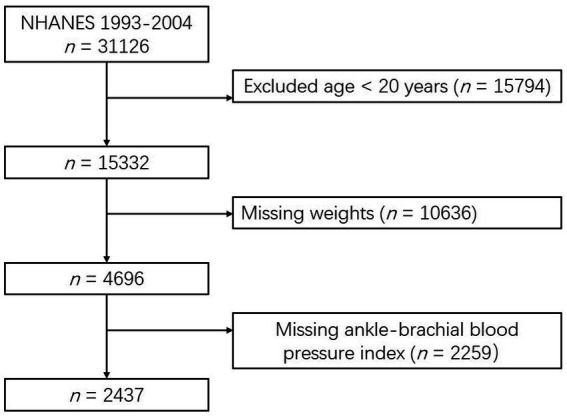
Results: This study included 2,437 eligible adult participants. Logistic regression analysis, adjusted for multiple potential confounders, revealed negative associations between lifestyle OBS (OR = 0.88; 95% CI: 0.79, 1.00), total OBS (OR = 0.97; 95% CI: 0.94, 0.99), and the likelihood of PAD (all p < 0.05). Restricted cubic spline (RCS) analysis demonstrated a linear relationship between total OBS and PAD, with the likelihood of PAD decreasing as total OBS increased p for nonlinearity = 0.736. Dietary OBS, lifestyle OBS, and total OBS all showed positive linear correlations with ABI levels (all p < 0.05). Mediation analysis indicated that fasting plasma glucose (FPG) and creatinine (CREA) mediated 5.9 and 0.8% of the association between total OBS and PAD, respectively (all p < 0.05). Sensitivity analyses confirmed the negative association between total OBS and PAD p < 0.05, supporting the stability of the results. Stratified analyses highlighted the significant influence of Age, particularly in the younger population aged 20-44 years, a group warranting greater attention.
Conclusion: Our study demonstrated that higher total OBS is associated with a lower likelihood of PAD. Adopting an antioxidant-rich diet alongside a healthy lifestyle may help mitigate PAD risk. Additionally, modulating FPG and CREA levels could offer potential value in addressing the link between low OBS and PAD.
期刊介绍:
No subject pertains more to human life than nutrition. The aim of Frontiers in Nutrition is to integrate major scientific disciplines in this vast field in order to address the most relevant and pertinent questions and developments. Our ambition is to create an integrated podium based on original research, clinical trials, and contemporary reviews to build a reputable knowledge forum in the domains of human health, dietary behaviors, agronomy & 21st century food science. Through the recognized open-access Frontiers platform we welcome manuscripts to our dedicated sections relating to different areas in the field of nutrition with a focus on human health.
Specialty sections in Frontiers in Nutrition include, for example, Clinical Nutrition, Nutrition & Sustainable Diets, Nutrition and Food Science Technology, Nutrition Methodology, Sport & Exercise Nutrition, Food Chemistry, and Nutritional Immunology. Based on the publication of rigorous scientific research, we thrive to achieve a visible impact on the global nutrition agenda addressing the grand challenges of our time, including obesity, malnutrition, hunger, food waste, sustainability and consumer health.






 京公网安备 11010802042870号
京ICP备2023020795号-1
京公网安备 11010802042870号
京ICP备2023020795号-1

 分享
分享
 求助内容:
求助内容: 应助结果提醒方式:
 扫码关注我们
