{"title":"通过Web应用程序提供的认知行为疗法对阈下抑郁、阈下失眠和阈下恐慌的有效性:开放标记6组随机临床试验先导研究。","authors":"Kayoko Taguchi, Mirai Miyoshi, Yoichi Seki, Shiori Baba, Eiji Shimizu","doi":"10.2196/63139","DOIUrl":null,"url":null,"abstract":"<p><strong>Background: </strong>A common definition of \"subthreshold\" is that the diagnostic threshold is not met but the individuals are not asymptomatic. Some symptoms are present, causing significant difficulty in functioning and negatively impacting quality of life. Despite the attention given to subthreshold symptoms and the interventions for subthreshold symptoms being efficient in preventing the transition to psychiatric disease in primary care, reports on specific interventions are insufficient.</p><p><strong>Objective: </strong>This study aimed to verify the effectiveness of internet-delivered cognitive behavioral therapy (ICBT) for subthreshold depression (SD), subthreshold insomnia (SI), and subthreshold panic (SP). Additionally, this study aimed to explore the minimally important change (MIC) of each subthreshold group's effectiveness outcome.</p><p><strong>Methods: </strong>Participants aged 18-70 years from internet research monitors were categorized into SD, SI, and SP groups based on screening assessment. They were randomly assigned to intervention or control groups within each subthreshold symptom. The intervention groups worked on 4 weeks of nonguided ICBT (\"Mentre\"), while the control groups worked on a sham app. The primary outcome was the score change from screening (T1) to 4-week follow-up (T4) using the Center for Epidemiologic Studies Depression Scale (CESD) in the SD group, the Pittsburgh Sleep Quality Index (PSQI) in the SI group, and the Panic and Agoraphobia Scale (PAS) in the SP group. Secondary outcomes were score changes in the Generalized Anxiety Disorder-7 (GAD-7) scale, the Patient Health Questionnaire 9 (PHQ-9), the CESD, the PSQI, and the PAS, except the primary outcome in each group. Secondary outcomes were analyzed using complete-case analysis and repeated-measures ANOVA. Additionally, the MIC in the primary endpoint for each group was also calculated as an exploratory outcome.</p><p><strong>Results: </strong>The SD, SP, and SI groups contained 846, 597, and 1106 participants, respectively. In the SD group, the difference in the CESD score change from baseline to follow-up between the intervention and control groups was significant (difference=0.52, 95% CI 1.29-4.66, P<.001). In the SI group, the difference in the PSQI score change was also significant (difference=0.53, 95% CI 0.11-0.94, P=.01). However, in the SP group, the difference in the PAS score change was not significant (difference=0.07, 95% CI -2.00 to 2.15, P=.94).</p><p><strong>Conclusions: </strong>Our ICBT program Mentre contributes to the improvement of SI and SD. This suggests that nonguided ICBT may be effective in preventing SI and SD from progressing to the full threshold. However, appropriate definitions of subthreshold symptoms are necessary. In particular, it is difficult to define SP, and further research that considers the specific factors of each subthreshold symptom is necessary to accumulate evidence.</p><p><strong>Trial registration: </strong>University Hospital Medical Information Network (UMIN) UMIN000051280; https://tinyurl.com/2wyahhe3.</p>","PeriodicalId":14841,"journal":{"name":"JMIR Formative Research","volume":"9 ","pages":"e63139"},"PeriodicalIF":2.0000,"publicationDate":"2025-02-03","publicationTypes":"Journal Article","fieldsOfStudy":null,"isOpenAccess":false,"openAccessPdf":"https://www.ncbi.nlm.nih.gov/pmc/articles/PMC11833268/pdf/","citationCount":"0","resultStr":"{\"title\":\"Effectiveness of Cognitive Behavioral Therapy Provided Through a Web Application for Subthreshold Depression, Subthreshold Insomnia, and Subthreshold Panic: Open-Labeled 6-Arm Randomized Clinical Trial Pilot Study.\",\"authors\":\"Kayoko Taguchi, Mirai Miyoshi, Yoichi Seki, Shiori Baba, Eiji Shimizu\",\"doi\":\"10.2196/63139\",\"DOIUrl\":null,\"url\":null,\"abstract\":\"<p><strong>Background: </strong>A common definition of \\\"subthreshold\\\" is that the diagnostic threshold is not met but the individuals are not asymptomatic. Some symptoms are present, causing significant difficulty in functioning and negatively impacting quality of life. Despite the attention given to subthreshold symptoms and the interventions for subthreshold symptoms being efficient in preventing the transition to psychiatric disease in primary care, reports on specific interventions are insufficient.</p><p><strong>Objective: </strong>This study aimed to verify the effectiveness of internet-delivered cognitive behavioral therapy (ICBT) for subthreshold depression (SD), subthreshold insomnia (SI), and subthreshold panic (SP). Additionally, this study aimed to explore the minimally important change (MIC) of each subthreshold group's effectiveness outcome.</p><p><strong>Methods: </strong>Participants aged 18-70 years from internet research monitors were categorized into SD, SI, and SP groups based on screening assessment. They were randomly assigned to intervention or control groups within each subthreshold symptom. The intervention groups worked on 4 weeks of nonguided ICBT (\\\"Mentre\\\"), while the control groups worked on a sham app. The primary outcome was the score change from screening (T1) to 4-week follow-up (T4) using the Center for Epidemiologic Studies Depression Scale (CESD) in the SD group, the Pittsburgh Sleep Quality Index (PSQI) in the SI group, and the Panic and Agoraphobia Scale (PAS) in the SP group. Secondary outcomes were score changes in the Generalized Anxiety Disorder-7 (GAD-7) scale, the Patient Health Questionnaire 9 (PHQ-9), the CESD, the PSQI, and the PAS, except the primary outcome in each group. Secondary outcomes were analyzed using complete-case analysis and repeated-measures ANOVA. Additionally, the MIC in the primary endpoint for each group was also calculated as an exploratory outcome.</p><p><strong>Results: </strong>The SD, SP, and SI groups contained 846, 597, and 1106 participants, respectively. In the SD group, the difference in the CESD score change from baseline to follow-up between the intervention and control groups was significant (difference=0.52, 95% CI 1.29-4.66, P<.001). In the SI group, the difference in the PSQI score change was also significant (difference=0.53, 95% CI 0.11-0.94, P=.01). However, in the SP group, the difference in the PAS score change was not significant (difference=0.07, 95% CI -2.00 to 2.15, P=.94).</p><p><strong>Conclusions: </strong>Our ICBT program Mentre contributes to the improvement of SI and SD. This suggests that nonguided ICBT may be effective in preventing SI and SD from progressing to the full threshold. However, appropriate definitions of subthreshold symptoms are necessary. In particular, it is difficult to define SP, and further research that considers the specific factors of each subthreshold symptom is necessary to accumulate evidence.</p><p><strong>Trial registration: </strong>University Hospital Medical Information Network (UMIN) UMIN000051280; https://tinyurl.com/2wyahhe3.</p>\",\"PeriodicalId\":14841,\"journal\":{\"name\":\"JMIR Formative Research\",\"volume\":\"9 \",\"pages\":\"e63139\"},\"PeriodicalIF\":2.0000,\"publicationDate\":\"2025-02-03\",\"publicationTypes\":\"Journal Article\",\"fieldsOfStudy\":null,\"isOpenAccess\":false,\"openAccessPdf\":\"https://www.ncbi.nlm.nih.gov/pmc/articles/PMC11833268/pdf/\",\"citationCount\":\"0\",\"resultStr\":null,\"platform\":\"Semanticscholar\",\"paperid\":null,\"PeriodicalName\":\"JMIR Formative Research\",\"FirstCategoryId\":\"1085\",\"ListUrlMain\":\"https://doi.org/10.2196/63139\",\"RegionNum\":0,\"RegionCategory\":null,\"ArticlePicture\":[],\"TitleCN\":null,\"AbstractTextCN\":null,\"PMCID\":null,\"EPubDate\":\"\",\"PubModel\":\"\",\"JCR\":\"Q3\",\"JCRName\":\"HEALTH CARE SCIENCES & SERVICES\",\"Score\":null,\"Total\":0}","platform":"Semanticscholar","paperid":null,"PeriodicalName":"JMIR Formative Research","FirstCategoryId":"1085","ListUrlMain":"https://doi.org/10.2196/63139","RegionNum":0,"RegionCategory":null,"ArticlePicture":[],"TitleCN":null,"AbstractTextCN":null,"PMCID":null,"EPubDate":"","PubModel":"","JCR":"Q3","JCRName":"HEALTH CARE SCIENCES & SERVICES","Score":null,"Total":0}
引用次数: 0
摘要
背景:“亚阈值”的常见定义是未达到诊断阈值,但个体并非无症状。出现一些症状,造成严重的功能困难,并对生活质量产生负面影响。尽管对阈下症状的关注和阈下症状的干预措施在初级保健中有效地防止过渡到精神疾病,但关于具体干预措施的报告不足。目的:本研究旨在验证网络传递认知行为疗法(ICBT)对阈下抑郁(SD)、阈下失眠(SI)和阈下恐慌(SP)的治疗效果。此外,本研究旨在探讨各亚阈值组疗效结局的最小重要变化(MIC)。方法:根据筛查评估,将18-70岁的网络研究监测对象分为SD、SI和SP组。他们被随机分配到每个阈下症状的干预组或对照组。干预组进行为期4周的非指导性ICBT(“Mentre”),而对照组则进行假应用程序。主要结果是使用流行病学研究中心抑郁量表(CESD) (SD组),匹兹堡睡眠质量指数(PSQI) (SI组)和恐慌与广场恐惧症量表(PAS) (SP组)从筛查(T1)到4周随访(T4)的评分变化。次要结局是广泛性焦虑障碍-7 (GAD-7)量表、患者健康问卷9 (PHQ-9)、CESD、PSQI和PAS的评分变化,各组的主要结局除外。次要结果分析采用全病例分析和重复测量方差分析。此外,还计算了每组主要终点的MIC作为探索性结果。结果:SD组、SP组和SI组分别有846、597和1106名参与者。在SD组中,干预组与对照组从基线到随访的CESD评分变化差异显著(差异=0.52,95% CI 1.29-4.66, p)。结论:我们的ICBT项目Mentre有助于SI和SD的改善。这表明非引导ICBT可能有效防止SI和SD进展到完全阈值。然而,阈下症状的适当定义是必要的。特别是SP很难定义,需要进一步研究,考虑每个阈下症状的具体因素,以积累证据。试验注册:大学医院医疗信息网(UMIN) UMIN000051280;https://tinyurl.com/2wyahhe3。
Effectiveness of Cognitive Behavioral Therapy Provided Through a Web Application for Subthreshold Depression, Subthreshold Insomnia, and Subthreshold Panic: Open-Labeled 6-Arm Randomized Clinical Trial Pilot Study.
Background: A common definition of "subthreshold" is that the diagnostic threshold is not met but the individuals are not asymptomatic. Some symptoms are present, causing significant difficulty in functioning and negatively impacting quality of life. Despite the attention given to subthreshold symptoms and the interventions for subthreshold symptoms being efficient in preventing the transition to psychiatric disease in primary care, reports on specific interventions are insufficient.
Objective: This study aimed to verify the effectiveness of internet-delivered cognitive behavioral therapy (ICBT) for subthreshold depression (SD), subthreshold insomnia (SI), and subthreshold panic (SP). Additionally, this study aimed to explore the minimally important change (MIC) of each subthreshold group's effectiveness outcome.
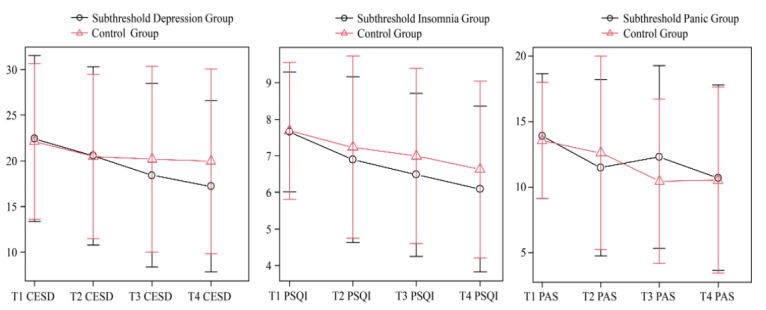
Methods: Participants aged 18-70 years from internet research monitors were categorized into SD, SI, and SP groups based on screening assessment. They were randomly assigned to intervention or control groups within each subthreshold symptom. The intervention groups worked on 4 weeks of nonguided ICBT ("Mentre"), while the control groups worked on a sham app. The primary outcome was the score change from screening (T1) to 4-week follow-up (T4) using the Center for Epidemiologic Studies Depression Scale (CESD) in the SD group, the Pittsburgh Sleep Quality Index (PSQI) in the SI group, and the Panic and Agoraphobia Scale (PAS) in the SP group. Secondary outcomes were score changes in the Generalized Anxiety Disorder-7 (GAD-7) scale, the Patient Health Questionnaire 9 (PHQ-9), the CESD, the PSQI, and the PAS, except the primary outcome in each group. Secondary outcomes were analyzed using complete-case analysis and repeated-measures ANOVA. Additionally, the MIC in the primary endpoint for each group was also calculated as an exploratory outcome.
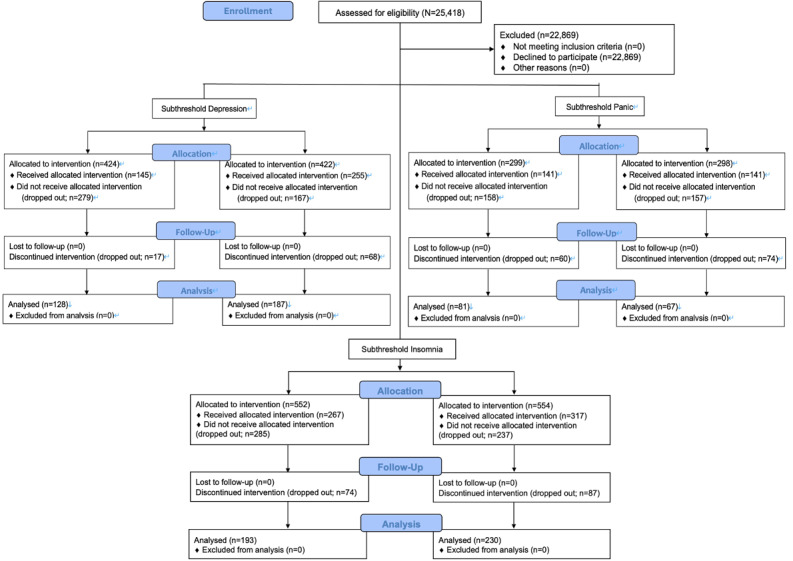
Results: The SD, SP, and SI groups contained 846, 597, and 1106 participants, respectively. In the SD group, the difference in the CESD score change from baseline to follow-up between the intervention and control groups was significant (difference=0.52, 95% CI 1.29-4.66, P<.001). In the SI group, the difference in the PSQI score change was also significant (difference=0.53, 95% CI 0.11-0.94, P=.01). However, in the SP group, the difference in the PAS score change was not significant (difference=0.07, 95% CI -2.00 to 2.15, P=.94).
Conclusions: Our ICBT program Mentre contributes to the improvement of SI and SD. This suggests that nonguided ICBT may be effective in preventing SI and SD from progressing to the full threshold. However, appropriate definitions of subthreshold symptoms are necessary. In particular, it is difficult to define SP, and further research that considers the specific factors of each subthreshold symptom is necessary to accumulate evidence.
Trial registration: University Hospital Medical Information Network (UMIN) UMIN000051280; https://tinyurl.com/2wyahhe3.





 京公网安备 11010802042870号
京ICP备2023020795号-1
京公网安备 11010802042870号
京ICP备2023020795号-1

 分享
分享
 求助内容:
求助内容: 应助结果提醒方式:
 扫码关注我们
