Ruicheng Wang, Yihong Zhu, Dehua Hu, Jie Hu, Si-wei Chen, Jieying Lin, Longjiang Xing, Yanping Huo, Shaomin Ji
{"title":"高效深蓝oled的磷氧改性蒽基发射器,接近BT.2020蓝色标准","authors":"Ruicheng Wang, Yihong Zhu, Dehua Hu, Jie Hu, Si-wei Chen, Jieying Lin, Longjiang Xing, Yanping Huo, Shaomin Ji","doi":"10.1016/j.cej.2025.160269","DOIUrl":null,"url":null,"abstract":"The development efficient deep-blue fluorescent materials present a significant challenge in the field of organic optoelectronics. The hot exciton mechanism, which facilitates the transition of excitons from high-energy excited triplet states (T<sub>n</sub>, n ≥ 2) to singlet states (S<sub>m</sub>, m ≥ 1) via reverse intersystem crossing (hRISC) pathways, has emerged as an effective strategy for designing efficient organic light-emitting diodes (OLEDs). In this study, we modified anthracene with non-conjugated triphenylphosphine oxide (PO) and tetraphenylsilane (TPS) groups to construct two positional isomers, <strong>p-TPSAnPO</strong> and <strong>m-TPSAnPO</strong>. Photophysical studies indicate that the weak electron-withdrawing and electron-donating of the PO and TPS groups endow <strong>p-TPSAnPO</strong> and <strong>m-TPSAnPO</strong> with local excited (LE) characteristics in their lowest singlet state (S<sub>1</sub>), resulting in highly efficient deep-blue emission. Doped devices based on <strong>p-TPSAnPO</strong> and <strong>m-TPSAnPO</strong> achieved maximum external quantum efficiencies (EQE<sub>max</sub>) of 10.07 % and 10.77 %, respectively, with Commission Internationale de l ́Eclairage (CIE) coordinates of (0.155, 0.043) and (0.152, 0.048), approaching BT.2020 blue standard. The theoretical calculations further reveal that the S<sub>1</sub>, T<sub>2</sub>, and T<sub>3</sub> states of these materials are localized on the anthracene moiety, while the higher-energy S<sub>2</sub> and T<sub>4</sub> states are induced by the electron-withdrawing PO group, forming charge transfer (CT) and hybridized local and charge transfer (HLCT) states. The transitions between these high-energy states create multiple hRISC pathways. Additionally, sensitization experiments on high-energy triplet states confirm that these materials indeed exhibit effective hRISC processes, enabling them to achieve high efficiency in electroluminescent applications. This work provides important theoretical and experimental guidance for designing efficient anthracene-based hot exciton deep-blue materials.","PeriodicalId":270,"journal":{"name":"Chemical Engineering Journal","volume":"82 1","pages":""},"PeriodicalIF":12.5000,"publicationDate":"2025-02-03","publicationTypes":"Journal Article","fieldsOfStudy":null,"isOpenAccess":false,"openAccessPdf":"","citationCount":"0","resultStr":"{\"title\":\"Phosphorus-oxygen modified anthracene-based emitters for high-efficiency deep-blue OLEDs approaching the BT.2020 blue standard\",\"authors\":\"Ruicheng Wang, Yihong Zhu, Dehua Hu, Jie Hu, Si-wei Chen, Jieying Lin, Longjiang Xing, Yanping Huo, Shaomin Ji\",\"doi\":\"10.1016/j.cej.2025.160269\",\"DOIUrl\":null,\"url\":null,\"abstract\":\"The development efficient deep-blue fluorescent materials present a significant challenge in the field of organic optoelectronics. The hot exciton mechanism, which facilitates the transition of excitons from high-energy excited triplet states (T<sub>n</sub>, n ≥ 2) to singlet states (S<sub>m</sub>, m ≥ 1) via reverse intersystem crossing (hRISC) pathways, has emerged as an effective strategy for designing efficient organic light-emitting diodes (OLEDs). In this study, we modified anthracene with non-conjugated triphenylphosphine oxide (PO) and tetraphenylsilane (TPS) groups to construct two positional isomers, <strong>p-TPSAnPO</strong> and <strong>m-TPSAnPO</strong>. Photophysical studies indicate that the weak electron-withdrawing and electron-donating of the PO and TPS groups endow <strong>p-TPSAnPO</strong> and <strong>m-TPSAnPO</strong> with local excited (LE) characteristics in their lowest singlet state (S<sub>1</sub>), resulting in highly efficient deep-blue emission. Doped devices based on <strong>p-TPSAnPO</strong> and <strong>m-TPSAnPO</strong> achieved maximum external quantum efficiencies (EQE<sub>max</sub>) of 10.07 % and 10.77 %, respectively, with Commission Internationale de l ́Eclairage (CIE) coordinates of (0.155, 0.043) and (0.152, 0.048), approaching BT.2020 blue standard. The theoretical calculations further reveal that the S<sub>1</sub>, T<sub>2</sub>, and T<sub>3</sub> states of these materials are localized on the anthracene moiety, while the higher-energy S<sub>2</sub> and T<sub>4</sub> states are induced by the electron-withdrawing PO group, forming charge transfer (CT) and hybridized local and charge transfer (HLCT) states. The transitions between these high-energy states create multiple hRISC pathways. Additionally, sensitization experiments on high-energy triplet states confirm that these materials indeed exhibit effective hRISC processes, enabling them to achieve high efficiency in electroluminescent applications. This work provides important theoretical and experimental guidance for designing efficient anthracene-based hot exciton deep-blue materials.\",\"PeriodicalId\":270,\"journal\":{\"name\":\"Chemical Engineering Journal\",\"volume\":\"82 1\",\"pages\":\"\"},\"PeriodicalIF\":12.5000,\"publicationDate\":\"2025-02-03\",\"publicationTypes\":\"Journal Article\",\"fieldsOfStudy\":null,\"isOpenAccess\":false,\"openAccessPdf\":\"\",\"citationCount\":\"0\",\"resultStr\":null,\"platform\":\"Semanticscholar\",\"paperid\":null,\"PeriodicalName\":\"Chemical Engineering Journal\",\"FirstCategoryId\":\"5\",\"ListUrlMain\":\"https://doi.org/10.1016/j.cej.2025.160269\",\"RegionNum\":1,\"RegionCategory\":\"工程技术\",\"ArticlePicture\":[],\"TitleCN\":null,\"AbstractTextCN\":null,\"PMCID\":null,\"EPubDate\":\"\",\"PubModel\":\"\",\"JCR\":\"Q1\",\"JCRName\":\"ENGINEERING, CHEMICAL\",\"Score\":null,\"Total\":0}","platform":"Semanticscholar","paperid":null,"PeriodicalName":"Chemical Engineering Journal","FirstCategoryId":"5","ListUrlMain":"https://doi.org/10.1016/j.cej.2025.160269","RegionNum":1,"RegionCategory":"工程技术","ArticlePicture":[],"TitleCN":null,"AbstractTextCN":null,"PMCID":null,"EPubDate":"","PubModel":"","JCR":"Q1","JCRName":"ENGINEERING, CHEMICAL","Score":null,"Total":0}
引用次数: 0
摘要
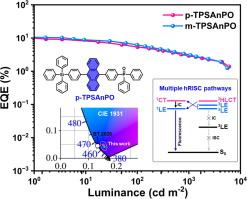
开发高效的深蓝荧光材料是有机光电子学领域的一个重大挑战。热激子机制通过反向系统间交叉(hRISC)途径促进激子从高能激发态(Tn, n ≥ 2)向单重态(Sm, m ≥ 1)转变,已成为设计高效有机发光二极管(oled)的有效策略。在这项研究中,我们用非共轭的三苯基氧化膦(PO)和四苯基硅烷(TPS)基团修饰了蒽,构建了两个位置异构体,p-TPSAnPO和m-TPSAnPO。光物理研究表明,PO和TPS基团的弱吸电子和给电子特性使p-TPSAnPO和m-TPSAnPO在最低单重态(S1)下具有局域激发(LE)特性,从而产生高效的深蓝发射。p-TPSAnPO和m-TPSAnPO掺杂器件的最大外量子效率(EQEmax)分别为10.07 %和10.77 %,CIE坐标分别为(0.155,0.043)和(0.152,0.048),接近BT.2020蓝色标准。理论计算进一步表明,这些材料的S1、T2和T3态都定位在蒽基上,而能量更高的S2和T4态是由吸电子的PO基团诱导形成的,形成电荷转移(CT)和局部与电荷转移杂化(HLCT)态。这些高能状态之间的转换创造了多个hRISC途径。此外,高能三重态的敏化实验证实,这些材料确实表现出有效的hRISC工艺,使其在电致发光应用中实现高效率。本研究为设计高效的蒽基热激子深蓝色材料提供了重要的理论和实验指导。
Phosphorus-oxygen modified anthracene-based emitters for high-efficiency deep-blue OLEDs approaching the BT.2020 blue standard
The development efficient deep-blue fluorescent materials present a significant challenge in the field of organic optoelectronics. The hot exciton mechanism, which facilitates the transition of excitons from high-energy excited triplet states (Tn, n ≥ 2) to singlet states (Sm, m ≥ 1) via reverse intersystem crossing (hRISC) pathways, has emerged as an effective strategy for designing efficient organic light-emitting diodes (OLEDs). In this study, we modified anthracene with non-conjugated triphenylphosphine oxide (PO) and tetraphenylsilane (TPS) groups to construct two positional isomers, p-TPSAnPO and m-TPSAnPO. Photophysical studies indicate that the weak electron-withdrawing and electron-donating of the PO and TPS groups endow p-TPSAnPO and m-TPSAnPO with local excited (LE) characteristics in their lowest singlet state (S1), resulting in highly efficient deep-blue emission. Doped devices based on p-TPSAnPO and m-TPSAnPO achieved maximum external quantum efficiencies (EQEmax) of 10.07 % and 10.77 %, respectively, with Commission Internationale de l ́Eclairage (CIE) coordinates of (0.155, 0.043) and (0.152, 0.048), approaching BT.2020 blue standard. The theoretical calculations further reveal that the S1, T2, and T3 states of these materials are localized on the anthracene moiety, while the higher-energy S2 and T4 states are induced by the electron-withdrawing PO group, forming charge transfer (CT) and hybridized local and charge transfer (HLCT) states. The transitions between these high-energy states create multiple hRISC pathways. Additionally, sensitization experiments on high-energy triplet states confirm that these materials indeed exhibit effective hRISC processes, enabling them to achieve high efficiency in electroluminescent applications. This work provides important theoretical and experimental guidance for designing efficient anthracene-based hot exciton deep-blue materials.
期刊介绍:
The Chemical Engineering Journal is an international research journal that invites contributions of original and novel fundamental research. It aims to provide an international platform for presenting original fundamental research, interpretative reviews, and discussions on new developments in chemical engineering. The journal welcomes papers that describe novel theory and its practical application, as well as those that demonstrate the transfer of techniques from other disciplines. It also welcomes reports on carefully conducted experimental work that is soundly interpreted. The main focus of the journal is on original and rigorous research results that have broad significance. The Catalysis section within the Chemical Engineering Journal focuses specifically on Experimental and Theoretical studies in the fields of heterogeneous catalysis, molecular catalysis, and biocatalysis. These studies have industrial impact on various sectors such as chemicals, energy, materials, foods, healthcare, and environmental protection.




 京公网安备 11010802042870号
京ICP备2023020795号-1
京公网安备 11010802042870号
京ICP备2023020795号-1

 分享
分享
 求助内容:
求助内容: 应助结果提醒方式:
 扫码关注我们
