Ting Liu , Wei Wang , Jun Du , Hongyue Liu , Jiaojiao Wu , Chuanxuan Wang , MengKe Tang , Yalin Liu , Yingzi Ju , Weidong Qu , Jianheng Zheng , Yifan Zhao , Yubin Zhang
{"title":"铝促进B1细胞产生IL-10,损害适应性免疫系统","authors":"Ting Liu , Wei Wang , Jun Du , Hongyue Liu , Jiaojiao Wu , Chuanxuan Wang , MengKe Tang , Yalin Liu , Yingzi Ju , Weidong Qu , Jianheng Zheng , Yifan Zhao , Yubin Zhang","doi":"10.1016/j.envpol.2025.125791","DOIUrl":null,"url":null,"abstract":"<div><div>Aluminum (Al) is a metal existing in the human body, yet the immunotoxicity of Al remains elusive. To investigate the immunotoxicity of Al, C57BL/6 mice were treated with 200 or 800 ppm Al via drinking water for 3 months, and thereafter the adaptive immune system was evaluated. In addition, mouse splenocytes and human peripheral blood mononuclear cells (PBMC) were treated with Al in vitro to assess the impact of Al in vitro. Treatment with Al reduced the production of IgM and IgG in the serum, and the activation of B cells, CD4 T cells and CD8 T cells in the spleen of mice; treatment with Al in vitro suppressed the production of IgM and IgG, and the activation of B cells, CD4 T cells and CD8 T cells in mouse splenocytes and human PBMC. In vitro co-culture assays suggested that the suppressed adaptive immunity was due to B cells modified by Al. In terms of mechanism, a direct action of Al on B1 cells induced the B1 cells to be IL-10-producing cells and thereby suppressed the adaptive immune system, which was critically dependent on the Jak1/3-STAT signaling. This study reveals that Al suppresses the adaptive immunity via induction of IL-10-producing B1 cells.</div></div>","PeriodicalId":311,"journal":{"name":"Environmental Pollution","volume":"368 ","pages":"Article 125791"},"PeriodicalIF":7.2000,"publicationDate":"2025-03-01","publicationTypes":"Journal Article","fieldsOfStudy":null,"isOpenAccess":false,"openAccessPdf":"","citationCount":"0","resultStr":"{\"title\":\"Aluminum promotes B1 cells to produce IL-10 and impairs adaptive immune system\",\"authors\":\"Ting Liu , Wei Wang , Jun Du , Hongyue Liu , Jiaojiao Wu , Chuanxuan Wang , MengKe Tang , Yalin Liu , Yingzi Ju , Weidong Qu , Jianheng Zheng , Yifan Zhao , Yubin Zhang\",\"doi\":\"10.1016/j.envpol.2025.125791\",\"DOIUrl\":null,\"url\":null,\"abstract\":\"<div><div>Aluminum (Al) is a metal existing in the human body, yet the immunotoxicity of Al remains elusive. To investigate the immunotoxicity of Al, C57BL/6 mice were treated with 200 or 800 ppm Al via drinking water for 3 months, and thereafter the adaptive immune system was evaluated. In addition, mouse splenocytes and human peripheral blood mononuclear cells (PBMC) were treated with Al in vitro to assess the impact of Al in vitro. Treatment with Al reduced the production of IgM and IgG in the serum, and the activation of B cells, CD4 T cells and CD8 T cells in the spleen of mice; treatment with Al in vitro suppressed the production of IgM and IgG, and the activation of B cells, CD4 T cells and CD8 T cells in mouse splenocytes and human PBMC. In vitro co-culture assays suggested that the suppressed adaptive immunity was due to B cells modified by Al. In terms of mechanism, a direct action of Al on B1 cells induced the B1 cells to be IL-10-producing cells and thereby suppressed the adaptive immune system, which was critically dependent on the Jak1/3-STAT signaling. This study reveals that Al suppresses the adaptive immunity via induction of IL-10-producing B1 cells.</div></div>\",\"PeriodicalId\":311,\"journal\":{\"name\":\"Environmental Pollution\",\"volume\":\"368 \",\"pages\":\"Article 125791\"},\"PeriodicalIF\":7.2000,\"publicationDate\":\"2025-03-01\",\"publicationTypes\":\"Journal Article\",\"fieldsOfStudy\":null,\"isOpenAccess\":false,\"openAccessPdf\":\"\",\"citationCount\":\"0\",\"resultStr\":null,\"platform\":\"Semanticscholar\",\"paperid\":null,\"PeriodicalName\":\"Environmental Pollution\",\"FirstCategoryId\":\"93\",\"ListUrlMain\":\"https://www.sciencedirect.com/science/article/pii/S0269749125001642\",\"RegionNum\":2,\"RegionCategory\":\"环境科学与生态学\",\"ArticlePicture\":[],\"TitleCN\":null,\"AbstractTextCN\":null,\"PMCID\":null,\"EPubDate\":\"2025/2/4 0:00:00\",\"PubModel\":\"Epub\",\"JCR\":\"Q1\",\"JCRName\":\"ENVIRONMENTAL SCIENCES\",\"Score\":null,\"Total\":0}","platform":"Semanticscholar","paperid":null,"PeriodicalName":"Environmental Pollution","FirstCategoryId":"93","ListUrlMain":"https://www.sciencedirect.com/science/article/pii/S0269749125001642","RegionNum":2,"RegionCategory":"环境科学与生态学","ArticlePicture":[],"TitleCN":null,"AbstractTextCN":null,"PMCID":null,"EPubDate":"2025/2/4 0:00:00","PubModel":"Epub","JCR":"Q1","JCRName":"ENVIRONMENTAL SCIENCES","Score":null,"Total":0}
Aluminum promotes B1 cells to produce IL-10 and impairs adaptive immune system
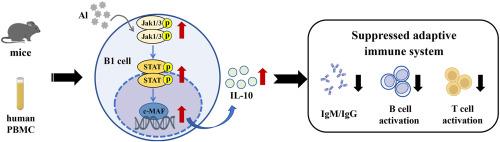
Aluminum (Al) is a metal existing in the human body, yet the immunotoxicity of Al remains elusive. To investigate the immunotoxicity of Al, C57BL/6 mice were treated with 200 or 800 ppm Al via drinking water for 3 months, and thereafter the adaptive immune system was evaluated. In addition, mouse splenocytes and human peripheral blood mononuclear cells (PBMC) were treated with Al in vitro to assess the impact of Al in vitro. Treatment with Al reduced the production of IgM and IgG in the serum, and the activation of B cells, CD4 T cells and CD8 T cells in the spleen of mice; treatment with Al in vitro suppressed the production of IgM and IgG, and the activation of B cells, CD4 T cells and CD8 T cells in mouse splenocytes and human PBMC. In vitro co-culture assays suggested that the suppressed adaptive immunity was due to B cells modified by Al. In terms of mechanism, a direct action of Al on B1 cells induced the B1 cells to be IL-10-producing cells and thereby suppressed the adaptive immune system, which was critically dependent on the Jak1/3-STAT signaling. This study reveals that Al suppresses the adaptive immunity via induction of IL-10-producing B1 cells.
期刊介绍:
Environmental Pollution is an international peer-reviewed journal that publishes high-quality research papers and review articles covering all aspects of environmental pollution and its impacts on ecosystems and human health.
Subject areas include, but are not limited to:
• Sources and occurrences of pollutants that are clearly defined and measured in environmental compartments, food and food-related items, and human bodies;
• Interlinks between contaminant exposure and biological, ecological, and human health effects, including those of climate change;
• Contaminants of emerging concerns (including but not limited to antibiotic resistant microorganisms or genes, microplastics/nanoplastics, electronic wastes, light, and noise) and/or their biological, ecological, or human health effects;
• Laboratory and field studies on the remediation/mitigation of environmental pollution via new techniques and with clear links to biological, ecological, or human health effects;
• Modeling of pollution processes, patterns, or trends that is of clear environmental and/or human health interest;
• New techniques that measure and examine environmental occurrences, transport, behavior, and effects of pollutants within the environment or the laboratory, provided that they can be clearly used to address problems within regional or global environmental compartments.





 京公网安备 11010802042870号
京ICP备2023020795号-1
京公网安备 11010802042870号
京ICP备2023020795号-1

 分享
分享
 求助内容:
求助内容: 应助结果提醒方式:
 扫码关注我们
