Bing Liu , Pan Guo , Yunkun Dai , Bo Liu , Ziyu Zhang , Jiajun Cai , Yunfei Xia , Qinmin Pan , Lixiao Shen , Yunlong Zhang , Lei Zhao , Zhenbo Wang
{"title":"为增强酸性氧还原反应剪裁FeN4位点的不对称原子应变","authors":"Bing Liu , Pan Guo , Yunkun Dai , Bo Liu , Ziyu Zhang , Jiajun Cai , Yunfei Xia , Qinmin Pan , Lixiao Shen , Yunlong Zhang , Lei Zhao , Zhenbo Wang","doi":"10.1016/j.cej.2025.160174","DOIUrl":null,"url":null,"abstract":"<div><div>Single-atom catalysts with FeN<sub>x</sub> centers are hitherto recognized as the promising alternative to Pt for oxygen reduction reaction (ORR). Nevertheless, the undesirable bonding strength to intermediates on FeN<sub>x</sub> generated by their symmetrical electronic structure still limits the desorption of intermediates, thus resulting in sluggish kinetics. Herein, an asymmetric atomic strain modulation strategy of Fe sites by constructing selective C- N cleavage around Fe- N<sub>4</sub> is proposed. Experimental investigations and theoretical calculations reveal that asymmetric atomic strains of Fe- N<sub>4</sub> induce an asymmetric electronic distribution of Fe-centers. The resultant widened d-band broadening of Fe and the increased Fe-*OH antibonding-orbital occupancy render modest adsorption between Fe sites and intermediates, thus boosting ORR intrinsic activity. The engineered asymmetric atomic strain environment accelerates the *OH desorption as verified by in-situ Raman spectroscopy. Impressively, the constructed strain-modulated FeN<sub>4</sub> catalyst (FeN<sub>4</sub>-SM) delivers superior activity and stability in the acidic medium, as evidenced by the half-wave potential (<em>E</em><sub>1/2</sub>) with 0.83 V and a loss of only 16 mV in <em>E</em><sub>1/2</sub> after 60, 000 potential cycles, as well as an exceptional peak power density of 1.086 W cm<sup>−2</sup> in H<sub>2</sub>/O<sub>2</sub> fuel cell. This work provides a foundational understanding of regulating electronic structure in asymmetric strain environment and guides the rational engineering of overadsorbed single-atomic catalysts.</div></div>","PeriodicalId":270,"journal":{"name":"Chemical Engineering Journal","volume":"507 ","pages":"Article 160174"},"PeriodicalIF":13.2000,"publicationDate":"2025-03-01","publicationTypes":"Journal Article","fieldsOfStudy":null,"isOpenAccess":false,"openAccessPdf":"","citationCount":"0","resultStr":"{\"title\":\"Tailoring asymmetric atomic strain of FeN4 sites for enhanced acidic oxygen reduction reaction\",\"authors\":\"Bing Liu , Pan Guo , Yunkun Dai , Bo Liu , Ziyu Zhang , Jiajun Cai , Yunfei Xia , Qinmin Pan , Lixiao Shen , Yunlong Zhang , Lei Zhao , Zhenbo Wang\",\"doi\":\"10.1016/j.cej.2025.160174\",\"DOIUrl\":null,\"url\":null,\"abstract\":\"<div><div>Single-atom catalysts with FeN<sub>x</sub> centers are hitherto recognized as the promising alternative to Pt for oxygen reduction reaction (ORR). Nevertheless, the undesirable bonding strength to intermediates on FeN<sub>x</sub> generated by their symmetrical electronic structure still limits the desorption of intermediates, thus resulting in sluggish kinetics. Herein, an asymmetric atomic strain modulation strategy of Fe sites by constructing selective C- N cleavage around Fe- N<sub>4</sub> is proposed. Experimental investigations and theoretical calculations reveal that asymmetric atomic strains of Fe- N<sub>4</sub> induce an asymmetric electronic distribution of Fe-centers. The resultant widened d-band broadening of Fe and the increased Fe-*OH antibonding-orbital occupancy render modest adsorption between Fe sites and intermediates, thus boosting ORR intrinsic activity. The engineered asymmetric atomic strain environment accelerates the *OH desorption as verified by in-situ Raman spectroscopy. Impressively, the constructed strain-modulated FeN<sub>4</sub> catalyst (FeN<sub>4</sub>-SM) delivers superior activity and stability in the acidic medium, as evidenced by the half-wave potential (<em>E</em><sub>1/2</sub>) with 0.83 V and a loss of only 16 mV in <em>E</em><sub>1/2</sub> after 60, 000 potential cycles, as well as an exceptional peak power density of 1.086 W cm<sup>−2</sup> in H<sub>2</sub>/O<sub>2</sub> fuel cell. This work provides a foundational understanding of regulating electronic structure in asymmetric strain environment and guides the rational engineering of overadsorbed single-atomic catalysts.</div></div>\",\"PeriodicalId\":270,\"journal\":{\"name\":\"Chemical Engineering Journal\",\"volume\":\"507 \",\"pages\":\"Article 160174\"},\"PeriodicalIF\":13.2000,\"publicationDate\":\"2025-03-01\",\"publicationTypes\":\"Journal Article\",\"fieldsOfStudy\":null,\"isOpenAccess\":false,\"openAccessPdf\":\"\",\"citationCount\":\"0\",\"resultStr\":null,\"platform\":\"Semanticscholar\",\"paperid\":null,\"PeriodicalName\":\"Chemical Engineering Journal\",\"FirstCategoryId\":\"5\",\"ListUrlMain\":\"https://www.sciencedirect.com/science/article/pii/S1385894725009799\",\"RegionNum\":1,\"RegionCategory\":\"工程技术\",\"ArticlePicture\":[],\"TitleCN\":null,\"AbstractTextCN\":null,\"PMCID\":null,\"EPubDate\":\"2025/2/3 0:00:00\",\"PubModel\":\"Epub\",\"JCR\":\"Q1\",\"JCRName\":\"ENGINEERING, CHEMICAL\",\"Score\":null,\"Total\":0}","platform":"Semanticscholar","paperid":null,"PeriodicalName":"Chemical Engineering Journal","FirstCategoryId":"5","ListUrlMain":"https://www.sciencedirect.com/science/article/pii/S1385894725009799","RegionNum":1,"RegionCategory":"工程技术","ArticlePicture":[],"TitleCN":null,"AbstractTextCN":null,"PMCID":null,"EPubDate":"2025/2/3 0:00:00","PubModel":"Epub","JCR":"Q1","JCRName":"ENGINEERING, CHEMICAL","Score":null,"Total":0}
引用次数: 0
摘要
迄今为止,具有FeNx中心的单原子催化剂被认为是替代Pt用于氧还原反应(ORR)的有前途的催化剂。然而,由于其对称的电子结构,中间体在FeNx上的键强度仍然限制了中间体的解吸,从而导致动力学缓慢。本文提出了一种通过在Fe- N4周围构建选择性C- N解理的Fe位不对称原子应变调制策略。实验研究和理论计算表明,Fe- N4的不对称原子应变导致了Fe-中心的不对称电子分布。由此产生的Fe的d波段加宽和Fe-*OH反键轨道占用的增加使得Fe位点和中间体之间的吸附适度,从而提高了ORR的固有活性。通过原位拉曼光谱证实,设计的不对称原子应变环境加速了*OH的脱附。令人惊讶的是,构建的菌株调制FeN4催化剂(FeN4- sm)在酸性介质中具有优异的活性和稳定性,证明了半波电位(E1/2)为0.83 V,在6万次电位循环后E1/2的损失仅为16 mV,以及H2/O2燃料电池的峰值功率密度为1.086 W cm−2。本研究为非对称应变环境下的电子结构调控提供了基础认识,并为过吸附单原子催化剂的合理设计提供了指导。
Tailoring asymmetric atomic strain of FeN4 sites for enhanced acidic oxygen reduction reaction
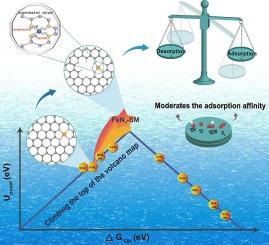
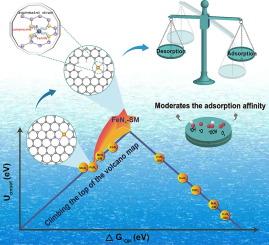
Single-atom catalysts with FeNx centers are hitherto recognized as the promising alternative to Pt for oxygen reduction reaction (ORR). Nevertheless, the undesirable bonding strength to intermediates on FeNx generated by their symmetrical electronic structure still limits the desorption of intermediates, thus resulting in sluggish kinetics. Herein, an asymmetric atomic strain modulation strategy of Fe sites by constructing selective C- N cleavage around Fe- N4 is proposed. Experimental investigations and theoretical calculations reveal that asymmetric atomic strains of Fe- N4 induce an asymmetric electronic distribution of Fe-centers. The resultant widened d-band broadening of Fe and the increased Fe-*OH antibonding-orbital occupancy render modest adsorption between Fe sites and intermediates, thus boosting ORR intrinsic activity. The engineered asymmetric atomic strain environment accelerates the *OH desorption as verified by in-situ Raman spectroscopy. Impressively, the constructed strain-modulated FeN4 catalyst (FeN4-SM) delivers superior activity and stability in the acidic medium, as evidenced by the half-wave potential (E1/2) with 0.83 V and a loss of only 16 mV in E1/2 after 60, 000 potential cycles, as well as an exceptional peak power density of 1.086 W cm−2 in H2/O2 fuel cell. This work provides a foundational understanding of regulating electronic structure in asymmetric strain environment and guides the rational engineering of overadsorbed single-atomic catalysts.
期刊介绍:
The Chemical Engineering Journal is an international research journal that invites contributions of original and novel fundamental research. It aims to provide an international platform for presenting original fundamental research, interpretative reviews, and discussions on new developments in chemical engineering. The journal welcomes papers that describe novel theory and its practical application, as well as those that demonstrate the transfer of techniques from other disciplines. It also welcomes reports on carefully conducted experimental work that is soundly interpreted. The main focus of the journal is on original and rigorous research results that have broad significance. The Catalysis section within the Chemical Engineering Journal focuses specifically on Experimental and Theoretical studies in the fields of heterogeneous catalysis, molecular catalysis, and biocatalysis. These studies have industrial impact on various sectors such as chemicals, energy, materials, foods, healthcare, and environmental protection.




 京公网安备 11010802042870号
京ICP备2023020795号-1
京公网安备 11010802042870号
京ICP备2023020795号-1

 分享
分享
 求助内容:
求助内容: 应助结果提醒方式:
 扫码关注我们
