Matthias Filez, Valentijn De Coster, Hilde Poelman, Valerie Briois, Anthony Beauvois, Jolien Dendooven, Maarten B. J. Roeffaers, Vladimir Galvita, Christophe Detavernier
{"title":"用x射线吸收纳米热法选择性地监测催化反应中活性金属纳米颗粒的操作温度","authors":"Matthias Filez, Valentijn De Coster, Hilde Poelman, Valerie Briois, Anthony Beauvois, Jolien Dendooven, Maarten B. J. Roeffaers, Vladimir Galvita, Christophe Detavernier","doi":"10.1038/s41929-025-01295-9","DOIUrl":null,"url":null,"abstract":"Heat involved in catalytic reactions can influence the local temperature and performance of the active site, potentially causing catalyst degradation and runaway scenarios. Yet, broadly applicable thermometry methods to selectively probe the temperature of the catalytically active phase—where reactions take place—are generally lacking. Here we explore extended X-ray absorption fine-structure thermometry to monitor the operando temperature of active Ni nanoparticles, fully deconvoluted from their metal-oxide support. During dry reforming of methane, the reaction’s endothermicity causes Ni nanoparticles to become local heat sinks with their temperature deviating 90 °C from the reactor temperature. By thermometry at the single nanoparticle level, we chart the energy balance of nanoparticles and relate their temperature to reaction kinetics. Covering the full temperature range relevant to catalysis, this broadly applicable method enables temperature monitoring of individual catalyst components separately. Applying extended X-ray absorption fine-structure thermometry to existing datasets worldwide can generate enhanced understanding on reaction-induced temperature phenomena in heterogeneous catalysis. Monitoring the temperature of a catalyst’s active site during reactions can offer important insights into reactivity, but broadly applicable methods are lacking. Here the authors evaluate the potential of extended X-ray absorption fine-structure thermometry to observe variations in the temperature of nickel nanoparticles throughout representative gas–solid reactions.","PeriodicalId":18845,"journal":{"name":"Nature Catalysis","volume":"8 2","pages":"187-195"},"PeriodicalIF":44.6000,"publicationDate":"2025-02-04","publicationTypes":"Journal Article","fieldsOfStudy":null,"isOpenAccess":false,"openAccessPdf":"","citationCount":"0","resultStr":"{\"title\":\"Selectively monitoring the operando temperature of active metal nanoparticles during catalytic reactions by X-ray absorption nanothermometry\",\"authors\":\"Matthias Filez, Valentijn De Coster, Hilde Poelman, Valerie Briois, Anthony Beauvois, Jolien Dendooven, Maarten B. J. Roeffaers, Vladimir Galvita, Christophe Detavernier\",\"doi\":\"10.1038/s41929-025-01295-9\",\"DOIUrl\":null,\"url\":null,\"abstract\":\"Heat involved in catalytic reactions can influence the local temperature and performance of the active site, potentially causing catalyst degradation and runaway scenarios. Yet, broadly applicable thermometry methods to selectively probe the temperature of the catalytically active phase—where reactions take place—are generally lacking. Here we explore extended X-ray absorption fine-structure thermometry to monitor the operando temperature of active Ni nanoparticles, fully deconvoluted from their metal-oxide support. During dry reforming of methane, the reaction’s endothermicity causes Ni nanoparticles to become local heat sinks with their temperature deviating 90 °C from the reactor temperature. By thermometry at the single nanoparticle level, we chart the energy balance of nanoparticles and relate their temperature to reaction kinetics. Covering the full temperature range relevant to catalysis, this broadly applicable method enables temperature monitoring of individual catalyst components separately. Applying extended X-ray absorption fine-structure thermometry to existing datasets worldwide can generate enhanced understanding on reaction-induced temperature phenomena in heterogeneous catalysis. Monitoring the temperature of a catalyst’s active site during reactions can offer important insights into reactivity, but broadly applicable methods are lacking. Here the authors evaluate the potential of extended X-ray absorption fine-structure thermometry to observe variations in the temperature of nickel nanoparticles throughout representative gas–solid reactions.\",\"PeriodicalId\":18845,\"journal\":{\"name\":\"Nature Catalysis\",\"volume\":\"8 2\",\"pages\":\"187-195\"},\"PeriodicalIF\":44.6000,\"publicationDate\":\"2025-02-04\",\"publicationTypes\":\"Journal Article\",\"fieldsOfStudy\":null,\"isOpenAccess\":false,\"openAccessPdf\":\"\",\"citationCount\":\"0\",\"resultStr\":null,\"platform\":\"Semanticscholar\",\"paperid\":null,\"PeriodicalName\":\"Nature Catalysis\",\"FirstCategoryId\":\"92\",\"ListUrlMain\":\"https://www.nature.com/articles/s41929-025-01295-9\",\"RegionNum\":1,\"RegionCategory\":\"化学\",\"ArticlePicture\":[],\"TitleCN\":null,\"AbstractTextCN\":null,\"PMCID\":null,\"EPubDate\":\"\",\"PubModel\":\"\",\"JCR\":\"Q1\",\"JCRName\":\"CHEMISTRY, PHYSICAL\",\"Score\":null,\"Total\":0}","platform":"Semanticscholar","paperid":null,"PeriodicalName":"Nature Catalysis","FirstCategoryId":"92","ListUrlMain":"https://www.nature.com/articles/s41929-025-01295-9","RegionNum":1,"RegionCategory":"化学","ArticlePicture":[],"TitleCN":null,"AbstractTextCN":null,"PMCID":null,"EPubDate":"","PubModel":"","JCR":"Q1","JCRName":"CHEMISTRY, PHYSICAL","Score":null,"Total":0}
Selectively monitoring the operando temperature of active metal nanoparticles during catalytic reactions by X-ray absorption nanothermometry
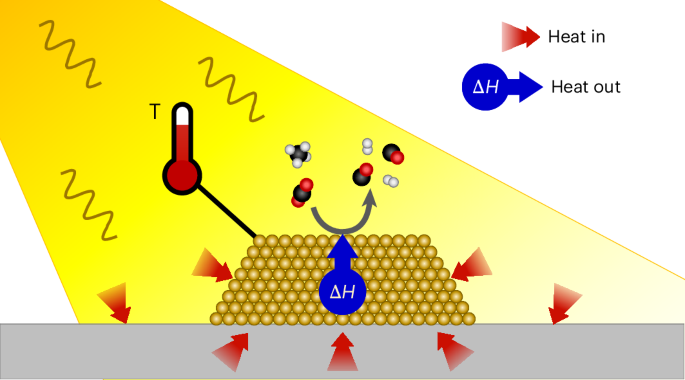
Heat involved in catalytic reactions can influence the local temperature and performance of the active site, potentially causing catalyst degradation and runaway scenarios. Yet, broadly applicable thermometry methods to selectively probe the temperature of the catalytically active phase—where reactions take place—are generally lacking. Here we explore extended X-ray absorption fine-structure thermometry to monitor the operando temperature of active Ni nanoparticles, fully deconvoluted from their metal-oxide support. During dry reforming of methane, the reaction’s endothermicity causes Ni nanoparticles to become local heat sinks with their temperature deviating 90 °C from the reactor temperature. By thermometry at the single nanoparticle level, we chart the energy balance of nanoparticles and relate their temperature to reaction kinetics. Covering the full temperature range relevant to catalysis, this broadly applicable method enables temperature monitoring of individual catalyst components separately. Applying extended X-ray absorption fine-structure thermometry to existing datasets worldwide can generate enhanced understanding on reaction-induced temperature phenomena in heterogeneous catalysis. Monitoring the temperature of a catalyst’s active site during reactions can offer important insights into reactivity, but broadly applicable methods are lacking. Here the authors evaluate the potential of extended X-ray absorption fine-structure thermometry to observe variations in the temperature of nickel nanoparticles throughout representative gas–solid reactions.
期刊介绍:
Nature Catalysis serves as a platform for researchers across chemistry and related fields, focusing on homogeneous catalysis, heterogeneous catalysis, and biocatalysts, encompassing both fundamental and applied studies. With a particular emphasis on advancing sustainable industries and processes, the journal provides comprehensive coverage of catalysis research, appealing to scientists, engineers, and researchers in academia and industry.
Maintaining the high standards of the Nature brand, Nature Catalysis boasts a dedicated team of professional editors, rigorous peer-review processes, and swift publication times, ensuring editorial independence and quality. The journal publishes work spanning heterogeneous catalysis, homogeneous catalysis, and biocatalysis, covering areas such as catalytic synthesis, mechanisms, characterization, computational studies, nanoparticle catalysis, electrocatalysis, photocatalysis, environmental catalysis, asymmetric catalysis, and various forms of organocatalysis.





 京公网安备 11010802042870号
京ICP备2023020795号-1
京公网安备 11010802042870号
京ICP备2023020795号-1

 分享
分享
 求助内容:
求助内容: 应助结果提醒方式:
 扫码关注我们
