{"title":"氢甲酰化与甲醇合成气重整相结合","authors":"Andreas Bonde , Joakim Bøgelund Jakobsen , Alexander Ahrens , Weiheng Huang , Ralf Jackstell , Matthias Beller , Troels Skrydstrup","doi":"10.1016/j.chempr.2024.102396","DOIUrl":null,"url":null,"abstract":"<div><div>Commodity chemical production is heavily dependent on fossil feedstocks. Transitioning to renewable resources is a pressing necessity, with green methanol being a promising candidate for rethinking chemical platforms. Here, we report how interlocking methanol-to-syngas reforming and hydroformylation of olefins may integrate methanol as a platform for accessing renewable oxo-products. This study demonstrates the importance of interlocking kinetics and selectivity of a ruthenium-catalyzed acceptorless dehydrogenation and a rhodium-catalyzed hydroformylation. Notably, coal- or natural gas-derived syngas can be substituted with fuel-grade e-methanol obtained from captured CO<sub>2</sub> and green hydrogen. Although these conditions do not replicate large-scale industrial settings, we consider this dual-catalysis approach a proof of concept illustrating the potential to synthesize oxo-products entirely from CO<sub>2</sub>-derived methanol. We envision that redesigning chemical value chains to extend from renewable platforms like methanol could play a pivotal role toward establishing a more sustainable chemical industry.</div></div>","PeriodicalId":268,"journal":{"name":"Chem","volume":"11 3","pages":"Article 102396"},"PeriodicalIF":19.1000,"publicationDate":"2025-03-13","publicationTypes":"Journal Article","fieldsOfStudy":null,"isOpenAccess":false,"openAccessPdf":"","citationCount":"0","resultStr":"{\"title\":\"Integrating hydroformylations with methanol-to-syngas reforming\",\"authors\":\"Andreas Bonde , Joakim Bøgelund Jakobsen , Alexander Ahrens , Weiheng Huang , Ralf Jackstell , Matthias Beller , Troels Skrydstrup\",\"doi\":\"10.1016/j.chempr.2024.102396\",\"DOIUrl\":null,\"url\":null,\"abstract\":\"<div><div>Commodity chemical production is heavily dependent on fossil feedstocks. Transitioning to renewable resources is a pressing necessity, with green methanol being a promising candidate for rethinking chemical platforms. Here, we report how interlocking methanol-to-syngas reforming and hydroformylation of olefins may integrate methanol as a platform for accessing renewable oxo-products. This study demonstrates the importance of interlocking kinetics and selectivity of a ruthenium-catalyzed acceptorless dehydrogenation and a rhodium-catalyzed hydroformylation. Notably, coal- or natural gas-derived syngas can be substituted with fuel-grade e-methanol obtained from captured CO<sub>2</sub> and green hydrogen. Although these conditions do not replicate large-scale industrial settings, we consider this dual-catalysis approach a proof of concept illustrating the potential to synthesize oxo-products entirely from CO<sub>2</sub>-derived methanol. We envision that redesigning chemical value chains to extend from renewable platforms like methanol could play a pivotal role toward establishing a more sustainable chemical industry.</div></div>\",\"PeriodicalId\":268,\"journal\":{\"name\":\"Chem\",\"volume\":\"11 3\",\"pages\":\"Article 102396\"},\"PeriodicalIF\":19.1000,\"publicationDate\":\"2025-03-13\",\"publicationTypes\":\"Journal Article\",\"fieldsOfStudy\":null,\"isOpenAccess\":false,\"openAccessPdf\":\"\",\"citationCount\":\"0\",\"resultStr\":null,\"platform\":\"Semanticscholar\",\"paperid\":null,\"PeriodicalName\":\"Chem\",\"FirstCategoryId\":\"92\",\"ListUrlMain\":\"https://www.sciencedirect.com/science/article/pii/S2451929424006417\",\"RegionNum\":1,\"RegionCategory\":\"化学\",\"ArticlePicture\":[],\"TitleCN\":null,\"AbstractTextCN\":null,\"PMCID\":null,\"EPubDate\":\"2025/2/4 0:00:00\",\"PubModel\":\"Epub\",\"JCR\":\"Q1\",\"JCRName\":\"CHEMISTRY, MULTIDISCIPLINARY\",\"Score\":null,\"Total\":0}","platform":"Semanticscholar","paperid":null,"PeriodicalName":"Chem","FirstCategoryId":"92","ListUrlMain":"https://www.sciencedirect.com/science/article/pii/S2451929424006417","RegionNum":1,"RegionCategory":"化学","ArticlePicture":[],"TitleCN":null,"AbstractTextCN":null,"PMCID":null,"EPubDate":"2025/2/4 0:00:00","PubModel":"Epub","JCR":"Q1","JCRName":"CHEMISTRY, MULTIDISCIPLINARY","Score":null,"Total":0}
Integrating hydroformylations with methanol-to-syngas reforming
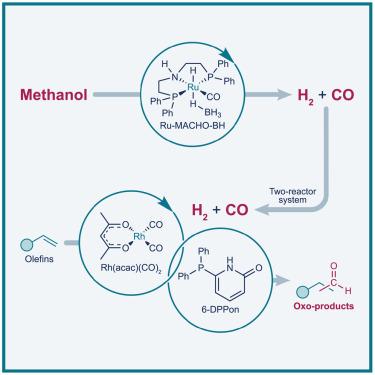
Commodity chemical production is heavily dependent on fossil feedstocks. Transitioning to renewable resources is a pressing necessity, with green methanol being a promising candidate for rethinking chemical platforms. Here, we report how interlocking methanol-to-syngas reforming and hydroformylation of olefins may integrate methanol as a platform for accessing renewable oxo-products. This study demonstrates the importance of interlocking kinetics and selectivity of a ruthenium-catalyzed acceptorless dehydrogenation and a rhodium-catalyzed hydroformylation. Notably, coal- or natural gas-derived syngas can be substituted with fuel-grade e-methanol obtained from captured CO2 and green hydrogen. Although these conditions do not replicate large-scale industrial settings, we consider this dual-catalysis approach a proof of concept illustrating the potential to synthesize oxo-products entirely from CO2-derived methanol. We envision that redesigning chemical value chains to extend from renewable platforms like methanol could play a pivotal role toward establishing a more sustainable chemical industry.
期刊介绍:
Chem, affiliated with Cell as its sister journal, serves as a platform for groundbreaking research and illustrates how fundamental inquiries in chemistry and its related fields can contribute to addressing future global challenges. It was established in 2016, and is currently edited by Robert Eagling.





 京公网安备 11010802042870号
京ICP备2023020795号-1
京公网安备 11010802042870号
京ICP备2023020795号-1

 分享
分享
 求助内容:
求助内容: 应助结果提醒方式:
 扫码关注我们
