{"title":"含大体积硅基取代基的二硫代丁二烯的合成及其对功能化硅烷的反应性","authors":"Katharina Münster, Shunsuke Kudo, Takuya Kuwabara, Eriko Shimamura, Shunsuke Furukawa, Yusuke Yoshida, Shintaro Ishida, Takeaki Iwamoto, Kazuki Tanifuji, Yasuhiro Ohki, Mao Minoura and Masaichi Saito","doi":"10.1039/D4DT03537B","DOIUrl":null,"url":null,"abstract":"<p >The synthesis and full characterization of 1,4-dilithio-1,4-bis(triisopropylsilyl)-2,3-diphenylbuta-1,3-diene (<strong>1b</strong>) are reported. This molecule featuring extremely bulky silyl groups at the 1- and 4-positions serves as a precursor for the synthesis of 2,5-bis(triisopropylsilyl)-3,4-diphenyl-1-silacyclopenta-1,3-dienes (siloles) bearing various substituents at the silicon atom (SiR<small><sub>2</sub></small> = SiH<small><sub>2</sub></small> (<strong>4</strong>), SiH(OMe) (<strong>5</strong>), SiF<small><sub>2</sub></small> (<strong>6</strong>), SiBr<small><sub>2</sub></small> (<strong>7</strong>), SiBr(OMe) (<strong>8</strong>)). Importantly, compounds <strong>6</strong> and <strong>7</strong> reacted with lithium to afford 2,5-bis(triisopropylsilyl)-3,4-diphenyldilithiosilole (<strong>9</strong>). The solid-state molecular structure and solution NMR spectra reveal the formation of an aromatic ring system, as opposed to the precursors <strong>6</strong> and <strong>7</strong>, with two Li cations coordinated by the silacycle in η<small><sup>5</sup></small>-fashions. The sterically bulky dilithiosilole <strong>9</strong> can be applied as an important starting material in the pursuit of low-valent silicon species without donor stabilization.</p>","PeriodicalId":71,"journal":{"name":"Dalton Transactions","volume":" 10","pages":" 4030-4038"},"PeriodicalIF":3.3000,"publicationDate":"2025-02-04","publicationTypes":"Journal Article","fieldsOfStudy":null,"isOpenAccess":false,"openAccessPdf":"","citationCount":"0","resultStr":"{\"title\":\"Synthesis of a dilithiobutadiene bearing extremely bulky silyl substituents and its reactivity toward functionalized silanes†‡\",\"authors\":\"Katharina Münster, Shunsuke Kudo, Takuya Kuwabara, Eriko Shimamura, Shunsuke Furukawa, Yusuke Yoshida, Shintaro Ishida, Takeaki Iwamoto, Kazuki Tanifuji, Yasuhiro Ohki, Mao Minoura and Masaichi Saito\",\"doi\":\"10.1039/D4DT03537B\",\"DOIUrl\":null,\"url\":null,\"abstract\":\"<p >The synthesis and full characterization of 1,4-dilithio-1,4-bis(triisopropylsilyl)-2,3-diphenylbuta-1,3-diene (<strong>1b</strong>) are reported. This molecule featuring extremely bulky silyl groups at the 1- and 4-positions serves as a precursor for the synthesis of 2,5-bis(triisopropylsilyl)-3,4-diphenyl-1-silacyclopenta-1,3-dienes (siloles) bearing various substituents at the silicon atom (SiR<small><sub>2</sub></small> = SiH<small><sub>2</sub></small> (<strong>4</strong>), SiH(OMe) (<strong>5</strong>), SiF<small><sub>2</sub></small> (<strong>6</strong>), SiBr<small><sub>2</sub></small> (<strong>7</strong>), SiBr(OMe) (<strong>8</strong>)). Importantly, compounds <strong>6</strong> and <strong>7</strong> reacted with lithium to afford 2,5-bis(triisopropylsilyl)-3,4-diphenyldilithiosilole (<strong>9</strong>). The solid-state molecular structure and solution NMR spectra reveal the formation of an aromatic ring system, as opposed to the precursors <strong>6</strong> and <strong>7</strong>, with two Li cations coordinated by the silacycle in η<small><sup>5</sup></small>-fashions. The sterically bulky dilithiosilole <strong>9</strong> can be applied as an important starting material in the pursuit of low-valent silicon species without donor stabilization.</p>\",\"PeriodicalId\":71,\"journal\":{\"name\":\"Dalton Transactions\",\"volume\":\" 10\",\"pages\":\" 4030-4038\"},\"PeriodicalIF\":3.3000,\"publicationDate\":\"2025-02-04\",\"publicationTypes\":\"Journal Article\",\"fieldsOfStudy\":null,\"isOpenAccess\":false,\"openAccessPdf\":\"\",\"citationCount\":\"0\",\"resultStr\":null,\"platform\":\"Semanticscholar\",\"paperid\":null,\"PeriodicalName\":\"Dalton Transactions\",\"FirstCategoryId\":\"92\",\"ListUrlMain\":\"https://pubs.rsc.org/en/content/articlelanding/2025/dt/d4dt03537b\",\"RegionNum\":3,\"RegionCategory\":\"化学\",\"ArticlePicture\":[],\"TitleCN\":null,\"AbstractTextCN\":null,\"PMCID\":null,\"EPubDate\":\"\",\"PubModel\":\"\",\"JCR\":\"Q2\",\"JCRName\":\"CHEMISTRY, INORGANIC & NUCLEAR\",\"Score\":null,\"Total\":0}","platform":"Semanticscholar","paperid":null,"PeriodicalName":"Dalton Transactions","FirstCategoryId":"92","ListUrlMain":"https://pubs.rsc.org/en/content/articlelanding/2025/dt/d4dt03537b","RegionNum":3,"RegionCategory":"化学","ArticlePicture":[],"TitleCN":null,"AbstractTextCN":null,"PMCID":null,"EPubDate":"","PubModel":"","JCR":"Q2","JCRName":"CHEMISTRY, INORGANIC & NUCLEAR","Score":null,"Total":0}
Synthesis of a dilithiobutadiene bearing extremely bulky silyl substituents and its reactivity toward functionalized silanes†‡
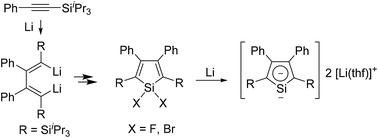
The synthesis and full characterization of 1,4-dilithio-1,4-bis(triisopropylsilyl)-2,3-diphenylbuta-1,3-diene (1b) are reported. This molecule featuring extremely bulky silyl groups at the 1- and 4-positions serves as a precursor for the synthesis of 2,5-bis(triisopropylsilyl)-3,4-diphenyl-1-silacyclopenta-1,3-dienes (siloles) bearing various substituents at the silicon atom (SiR2 = SiH2 (4), SiH(OMe) (5), SiF2 (6), SiBr2 (7), SiBr(OMe) (8)). Importantly, compounds 6 and 7 reacted with lithium to afford 2,5-bis(triisopropylsilyl)-3,4-diphenyldilithiosilole (9). The solid-state molecular structure and solution NMR spectra reveal the formation of an aromatic ring system, as opposed to the precursors 6 and 7, with two Li cations coordinated by the silacycle in η5-fashions. The sterically bulky dilithiosilole 9 can be applied as an important starting material in the pursuit of low-valent silicon species without donor stabilization.
期刊介绍:
Dalton Transactions is a journal for all areas of inorganic chemistry, which encompasses the organometallic, bioinorganic and materials chemistry of the elements, with applications including synthesis, catalysis, energy conversion/storage, electrical devices and medicine. Dalton Transactions welcomes high-quality, original submissions in all of these areas and more, where the advancement of knowledge in inorganic chemistry is significant.




 京公网安备 11010802042870号
京ICP备2023020795号-1
京公网安备 11010802042870号
京ICP备2023020795号-1

 分享
分享
 求助内容:
求助内容: 应助结果提醒方式:
 扫码关注我们
