Roshini Arulraj, Tumpa Sadhukhan and Anantharaj Sengeni
{"title":"达到完美的Ni(OH) 2:Pt平衡促进电催化水解离和氢在质子缺乏的环境中传递","authors":"Roshini Arulraj, Tumpa Sadhukhan and Anantharaj Sengeni","doi":"10.1039/D4DT03232B","DOIUrl":null,"url":null,"abstract":"<p >Despite the availability of abundant, inexpensive non-noble metal-based anode catalysts for alkaline water electrolysis, the cathodic hydrogen evolution reaction (HER) continues to be a challenge, even in the case of state-of-the-art Pt catalysts. In such proton-deficient environments, a metal hydroxide-/oxide-based co-catalyst that can help polarize the H–O bond in water has been found to promote proton abstraction and subsequent reduction into H<small><sub>2</sub></small> on Pt and Ru surfaces. In this regard, the Ni(OH)<small><sub>2</sub></small> : Pt co-catalyst is one of the best. However, the relationship between the ratio of Ni(OH)<small><sub>2</sub></small> and Pt and the alkaline HER is not well-understood, although it is essential for further advancements. Herein, we report the results of a systematic study aimed at gradually increasing the Ni(OH)<small><sub>2</sub></small> : Pt ratio and studying the physical, chemical, and electrochemical properties of the catalyst, which led us to achieve the perfect balance between Ni(OH)<small><sub>2</sub></small> and Pt. The optimised Ni(OH)<small><sub>2</sub></small> : Pt-3 catalyst with a Pt to Ni(OH)<small><sub>2</sub></small> ratio of 3.3 atom% outperformed commercial Pt/C (20 wt%) by requiring only 9 and 50 mV for −10 and −100 mA cm<small><sup>−2</sup></small>, respectively, and exhibited faster kinetics with a very low Tafel slope of 40 mV dec<small><sup>−1</sup></small>, which is an impressive feat in a proton-deficient pH of 14. Thus, this study provides new insights into the role of the ratio of Ni(OH)<small><sub>2</sub></small> and Pt in alkaline HERs.</p>","PeriodicalId":71,"journal":{"name":"Dalton Transactions","volume":" 11","pages":" 4672-4684"},"PeriodicalIF":3.3000,"publicationDate":"2025-02-04","publicationTypes":"Journal Article","fieldsOfStudy":null,"isOpenAccess":false,"openAccessPdf":"","citationCount":"0","resultStr":"{\"title\":\"Achieving the optimal Ni(OH)2 : Pt ratio for enhancing electrocatalytic water-dissociation and H2 delivery in proton-deficient environments†\",\"authors\":\"Roshini Arulraj, Tumpa Sadhukhan and Anantharaj Sengeni\",\"doi\":\"10.1039/D4DT03232B\",\"DOIUrl\":null,\"url\":null,\"abstract\":\"<p >Despite the availability of abundant, inexpensive non-noble metal-based anode catalysts for alkaline water electrolysis, the cathodic hydrogen evolution reaction (HER) continues to be a challenge, even in the case of state-of-the-art Pt catalysts. In such proton-deficient environments, a metal hydroxide-/oxide-based co-catalyst that can help polarize the H–O bond in water has been found to promote proton abstraction and subsequent reduction into H<small><sub>2</sub></small> on Pt and Ru surfaces. In this regard, the Ni(OH)<small><sub>2</sub></small> : Pt co-catalyst is one of the best. However, the relationship between the ratio of Ni(OH)<small><sub>2</sub></small> and Pt and the alkaline HER is not well-understood, although it is essential for further advancements. Herein, we report the results of a systematic study aimed at gradually increasing the Ni(OH)<small><sub>2</sub></small> : Pt ratio and studying the physical, chemical, and electrochemical properties of the catalyst, which led us to achieve the perfect balance between Ni(OH)<small><sub>2</sub></small> and Pt. The optimised Ni(OH)<small><sub>2</sub></small> : Pt-3 catalyst with a Pt to Ni(OH)<small><sub>2</sub></small> ratio of 3.3 atom% outperformed commercial Pt/C (20 wt%) by requiring only 9 and 50 mV for −10 and −100 mA cm<small><sup>−2</sup></small>, respectively, and exhibited faster kinetics with a very low Tafel slope of 40 mV dec<small><sup>−1</sup></small>, which is an impressive feat in a proton-deficient pH of 14. Thus, this study provides new insights into the role of the ratio of Ni(OH)<small><sub>2</sub></small> and Pt in alkaline HERs.</p>\",\"PeriodicalId\":71,\"journal\":{\"name\":\"Dalton Transactions\",\"volume\":\" 11\",\"pages\":\" 4672-4684\"},\"PeriodicalIF\":3.3000,\"publicationDate\":\"2025-02-04\",\"publicationTypes\":\"Journal Article\",\"fieldsOfStudy\":null,\"isOpenAccess\":false,\"openAccessPdf\":\"\",\"citationCount\":\"0\",\"resultStr\":null,\"platform\":\"Semanticscholar\",\"paperid\":null,\"PeriodicalName\":\"Dalton Transactions\",\"FirstCategoryId\":\"92\",\"ListUrlMain\":\"https://pubs.rsc.org/en/content/articlelanding/2025/dt/d4dt03232b\",\"RegionNum\":3,\"RegionCategory\":\"化学\",\"ArticlePicture\":[],\"TitleCN\":null,\"AbstractTextCN\":null,\"PMCID\":null,\"EPubDate\":\"\",\"PubModel\":\"\",\"JCR\":\"Q2\",\"JCRName\":\"CHEMISTRY, INORGANIC & NUCLEAR\",\"Score\":null,\"Total\":0}","platform":"Semanticscholar","paperid":null,"PeriodicalName":"Dalton Transactions","FirstCategoryId":"92","ListUrlMain":"https://pubs.rsc.org/en/content/articlelanding/2025/dt/d4dt03232b","RegionNum":3,"RegionCategory":"化学","ArticlePicture":[],"TitleCN":null,"AbstractTextCN":null,"PMCID":null,"EPubDate":"","PubModel":"","JCR":"Q2","JCRName":"CHEMISTRY, INORGANIC & NUCLEAR","Score":null,"Total":0}
引用次数: 0
摘要
尽管碱水电解具有丰富而廉价的非贵金属阳极催化剂,但阴极析氢反应(HER)仍然是最先进的Pt的痛苦。在这种质子缺乏的环境中,发现了一种基于金属氢氧化物/氧化物的助催化剂,它可以帮助水中的氢氧键极化,促进质子的提取,并随后在Pt和Ru表面还原成H2。其中,Ni(OH)2:Pt是最好的组合之一。然而,Ni(OH)2和Pt的比例与碱性HER之间的关系尚不清楚,尽管这对进一步的研究至关重要。在这里,我们报告了一项旨在逐步提高Ni(OH)2:Pt比例并研究其物理,化学和电化学性能的系统研究结果,该研究使我们在Ni(OH)2和Pt之间取得了完美的平衡。优化后的Ni(OH)2:Pt-3只有3.3个原子。Pt to Ni(OH)2比商业Pt/C (20 wt.%)的性能更好,在-10和-100 mA cm-2下分别仅需9和50 mV,并且表现出更快的动力学,Tafel斜率非常低,为40 mV / dec1,在质子缺乏的pH值为14的情况下,这是一个令人印象深刻的成就。因此,本研究对Ni(OH)2和Pt的比例在碱性HER中的作用有了新的认识。
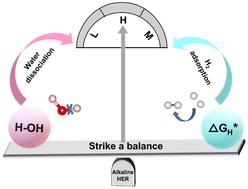
Achieving the optimal Ni(OH)2 : Pt ratio for enhancing electrocatalytic water-dissociation and H2 delivery in proton-deficient environments†
Despite the availability of abundant, inexpensive non-noble metal-based anode catalysts for alkaline water electrolysis, the cathodic hydrogen evolution reaction (HER) continues to be a challenge, even in the case of state-of-the-art Pt catalysts. In such proton-deficient environments, a metal hydroxide-/oxide-based co-catalyst that can help polarize the H–O bond in water has been found to promote proton abstraction and subsequent reduction into H2 on Pt and Ru surfaces. In this regard, the Ni(OH)2 : Pt co-catalyst is one of the best. However, the relationship between the ratio of Ni(OH)2 and Pt and the alkaline HER is not well-understood, although it is essential for further advancements. Herein, we report the results of a systematic study aimed at gradually increasing the Ni(OH)2 : Pt ratio and studying the physical, chemical, and electrochemical properties of the catalyst, which led us to achieve the perfect balance between Ni(OH)2 and Pt. The optimised Ni(OH)2 : Pt-3 catalyst with a Pt to Ni(OH)2 ratio of 3.3 atom% outperformed commercial Pt/C (20 wt%) by requiring only 9 and 50 mV for −10 and −100 mA cm−2, respectively, and exhibited faster kinetics with a very low Tafel slope of 40 mV dec−1, which is an impressive feat in a proton-deficient pH of 14. Thus, this study provides new insights into the role of the ratio of Ni(OH)2 and Pt in alkaline HERs.
期刊介绍:
Dalton Transactions is a journal for all areas of inorganic chemistry, which encompasses the organometallic, bioinorganic and materials chemistry of the elements, with applications including synthesis, catalysis, energy conversion/storage, electrical devices and medicine. Dalton Transactions welcomes high-quality, original submissions in all of these areas and more, where the advancement of knowledge in inorganic chemistry is significant.




 京公网安备 11010802042870号
京ICP备2023020795号-1
京公网安备 11010802042870号
京ICP备2023020795号-1

 分享
分享
 求助内容:
求助内容: 应助结果提醒方式:
 扫码关注我们
