Anton F. Rogozhin, Vasily A. Ilichev, Dmitry I. Pavlov and Mikhail N. Bochkarev
{"title":"结构异构体二异位2-巯基苯并恶唑和2-羟基苯并噻唑配体设计二维钠基发光配位聚合物","authors":"Anton F. Rogozhin, Vasily A. Ilichev, Dmitry I. Pavlov and Mikhail N. Bochkarev","doi":"10.1039/D4DT03427A","DOIUrl":null,"url":null,"abstract":"<p >The novel ditopic centrosymmetric soft-base ligands 3,7-dihydrobenzo[1,2-<em>d</em>:4,5-<em>d</em>′]bis(oxazole)-2,6-dithione (H<small><sub>2</sub></small><strong>L<small><sup>1</sup></small></strong>) and 3,7-dihydrobenzo[1,2-<em>d</em>:4,5-<em>d</em>′]bis(thiazole)-2,6-dione (H<small><sub>2</sub></small><strong>L<small><sup>2</sup></small></strong>) were obtained <em>via</em> a one-pot method. Both compounds form 2D coordination polymers (CPs) through the reaction of free ligands with sodium bis(trismethylsilyl)amide in various solvent media. H<small><sub>2</sub></small><strong>L<small><sup>1</sup></small></strong> containing products were [Na<small><sub>2</sub></small><strong>L<small><sup>1</sup></small></strong>(DME)<small><sub>2</sub></small>]<small><sub><em>n</em></sub></small> (<strong>1</strong>) and [Na<small><sub>2</sub></small><strong>L<small><sup>1</sup></small></strong>(DMSO)<small><sub>4</sub></small>]<small><sub><em>n</em></sub></small> (<strong>2</strong>), and for H<small><sub>2</sub></small><strong>L<small><sup>2</sup></small></strong>, [Na<small><sub>6</sub></small><strong>L<small><sup>2</sup></small></strong><small><sub>3</sub></small>(DMSO)<small><sub>12</sub></small>]<small><sub><em>n</em></sub></small> (<strong>3</strong>) was formed. X-ray analysis revealed that compound <strong>1</strong> is a 2D CP, in which deprotonated H<small><sub>2</sub></small><strong>L<small><sup>1</sup></small></strong> acts as a tetratopic linker, linking four sodium atoms <em>via</em> nitrogen and bridging sulfur. Unlike <strong>1</strong>, in CP <strong>2</strong>, deprotonated H<small><sub>2</sub></small><strong>L<small><sup>1</sup></small></strong> acts as a ditopic linker coordinating sodium atoms in an unprecedented Na<small><sub>4</sub></small>O<small><sub>4</sub></small> metallocenter formed by the oxygens of DMSO molecules. Compound <strong>3</strong> is a 2D CP featuring rare Na<small><sub>3</sub></small>O<small><sub>6</sub></small> secondary building unit (SBU), whereas H<small><sub>2</sub></small><strong>L<small><sup>2</sup></small></strong> exhibits both bridging and mixed chelating/bridging mode, linking four sodium atoms <em>via</em> nitrogen and oxygen atoms. Despite the fact that free ligands H<small><sub>2</sub></small><strong>L<small><sup>1</sup></small></strong> and H<small><sub>2</sub></small><strong>L<small><sup>2</sup></small></strong> are non-luminescent in solution and in the solid state, their deprotonated forms at 298 K in DME media demonstrate moderate photoluminescence (PL) in DME solutions with broad bands in the range of 360–500 nm. At 77 K, the same solutions show broadened and intense PL consisting of bands in the 360–670 nm region corresponding to ligand fluorescence and phosphorescence. CPs <strong>1–3</strong> in the solid state exhibit PL at 298 and 77 K. At 298 K, CPs <strong>1</strong> and <strong>3</strong> exhibit intense fluorescence in the range of 370–450 nm and moderate microsecond timescale phosphorescence in the range of 500–670 nm, while CP <strong>2</strong> exhibits only fluorescence. Upon cooling to 77 K, all three CPs demonstrate both fluorescence and phosphorescence. Based on the low-temperature phosphorescence spectra of <strong>1</strong> and <strong>3</strong> in DME solutions, the triplet energy levels of H<small><sub>2</sub></small><strong>L<small><sup>1</sup></small></strong> and H<small><sub>2</sub></small><strong>L<small><sup>2</sup></small></strong> were established at 21 000 and 20 800 cm<small><sup>−1</sup></small>, respectively.</p>","PeriodicalId":71,"journal":{"name":"Dalton Transactions","volume":" 11","pages":" 4589-4598"},"PeriodicalIF":3.3000,"publicationDate":"2025-02-04","publicationTypes":"Journal Article","fieldsOfStudy":null,"isOpenAccess":false,"openAccessPdf":"","citationCount":"0","resultStr":"{\"title\":\"Structurally isomeric ditopic 2-mercaptobenzoxazole and 2-hydroxybenzothiazole as ligands for design of 2D sodium-based luminescent coordination polymers†\",\"authors\":\"Anton F. Rogozhin, Vasily A. Ilichev, Dmitry I. Pavlov and Mikhail N. Bochkarev\",\"doi\":\"10.1039/D4DT03427A\",\"DOIUrl\":null,\"url\":null,\"abstract\":\"<p >The novel ditopic centrosymmetric soft-base ligands 3,7-dihydrobenzo[1,2-<em>d</em>:4,5-<em>d</em>′]bis(oxazole)-2,6-dithione (H<small><sub>2</sub></small><strong>L<small><sup>1</sup></small></strong>) and 3,7-dihydrobenzo[1,2-<em>d</em>:4,5-<em>d</em>′]bis(thiazole)-2,6-dione (H<small><sub>2</sub></small><strong>L<small><sup>2</sup></small></strong>) were obtained <em>via</em> a one-pot method. Both compounds form 2D coordination polymers (CPs) through the reaction of free ligands with sodium bis(trismethylsilyl)amide in various solvent media. H<small><sub>2</sub></small><strong>L<small><sup>1</sup></small></strong> containing products were [Na<small><sub>2</sub></small><strong>L<small><sup>1</sup></small></strong>(DME)<small><sub>2</sub></small>]<small><sub><em>n</em></sub></small> (<strong>1</strong>) and [Na<small><sub>2</sub></small><strong>L<small><sup>1</sup></small></strong>(DMSO)<small><sub>4</sub></small>]<small><sub><em>n</em></sub></small> (<strong>2</strong>), and for H<small><sub>2</sub></small><strong>L<small><sup>2</sup></small></strong>, [Na<small><sub>6</sub></small><strong>L<small><sup>2</sup></small></strong><small><sub>3</sub></small>(DMSO)<small><sub>12</sub></small>]<small><sub><em>n</em></sub></small> (<strong>3</strong>) was formed. X-ray analysis revealed that compound <strong>1</strong> is a 2D CP, in which deprotonated H<small><sub>2</sub></small><strong>L<small><sup>1</sup></small></strong> acts as a tetratopic linker, linking four sodium atoms <em>via</em> nitrogen and bridging sulfur. Unlike <strong>1</strong>, in CP <strong>2</strong>, deprotonated H<small><sub>2</sub></small><strong>L<small><sup>1</sup></small></strong> acts as a ditopic linker coordinating sodium atoms in an unprecedented Na<small><sub>4</sub></small>O<small><sub>4</sub></small> metallocenter formed by the oxygens of DMSO molecules. Compound <strong>3</strong> is a 2D CP featuring rare Na<small><sub>3</sub></small>O<small><sub>6</sub></small> secondary building unit (SBU), whereas H<small><sub>2</sub></small><strong>L<small><sup>2</sup></small></strong> exhibits both bridging and mixed chelating/bridging mode, linking four sodium atoms <em>via</em> nitrogen and oxygen atoms. Despite the fact that free ligands H<small><sub>2</sub></small><strong>L<small><sup>1</sup></small></strong> and H<small><sub>2</sub></small><strong>L<small><sup>2</sup></small></strong> are non-luminescent in solution and in the solid state, their deprotonated forms at 298 K in DME media demonstrate moderate photoluminescence (PL) in DME solutions with broad bands in the range of 360–500 nm. At 77 K, the same solutions show broadened and intense PL consisting of bands in the 360–670 nm region corresponding to ligand fluorescence and phosphorescence. CPs <strong>1–3</strong> in the solid state exhibit PL at 298 and 77 K. At 298 K, CPs <strong>1</strong> and <strong>3</strong> exhibit intense fluorescence in the range of 370–450 nm and moderate microsecond timescale phosphorescence in the range of 500–670 nm, while CP <strong>2</strong> exhibits only fluorescence. Upon cooling to 77 K, all three CPs demonstrate both fluorescence and phosphorescence. Based on the low-temperature phosphorescence spectra of <strong>1</strong> and <strong>3</strong> in DME solutions, the triplet energy levels of H<small><sub>2</sub></small><strong>L<small><sup>1</sup></small></strong> and H<small><sub>2</sub></small><strong>L<small><sup>2</sup></small></strong> were established at 21 000 and 20 800 cm<small><sup>−1</sup></small>, respectively.</p>\",\"PeriodicalId\":71,\"journal\":{\"name\":\"Dalton Transactions\",\"volume\":\" 11\",\"pages\":\" 4589-4598\"},\"PeriodicalIF\":3.3000,\"publicationDate\":\"2025-02-04\",\"publicationTypes\":\"Journal Article\",\"fieldsOfStudy\":null,\"isOpenAccess\":false,\"openAccessPdf\":\"\",\"citationCount\":\"0\",\"resultStr\":null,\"platform\":\"Semanticscholar\",\"paperid\":null,\"PeriodicalName\":\"Dalton Transactions\",\"FirstCategoryId\":\"92\",\"ListUrlMain\":\"https://pubs.rsc.org/en/content/articlelanding/2025/dt/d4dt03427a\",\"RegionNum\":3,\"RegionCategory\":\"化学\",\"ArticlePicture\":[],\"TitleCN\":null,\"AbstractTextCN\":null,\"PMCID\":null,\"EPubDate\":\"\",\"PubModel\":\"\",\"JCR\":\"Q2\",\"JCRName\":\"CHEMISTRY, INORGANIC & NUCLEAR\",\"Score\":null,\"Total\":0}","platform":"Semanticscholar","paperid":null,"PeriodicalName":"Dalton Transactions","FirstCategoryId":"92","ListUrlMain":"https://pubs.rsc.org/en/content/articlelanding/2025/dt/d4dt03427a","RegionNum":3,"RegionCategory":"化学","ArticlePicture":[],"TitleCN":null,"AbstractTextCN":null,"PMCID":null,"EPubDate":"","PubModel":"","JCR":"Q2","JCRName":"CHEMISTRY, INORGANIC & NUCLEAR","Score":null,"Total":0}
Structurally isomeric ditopic 2-mercaptobenzoxazole and 2-hydroxybenzothiazole as ligands for design of 2D sodium-based luminescent coordination polymers†
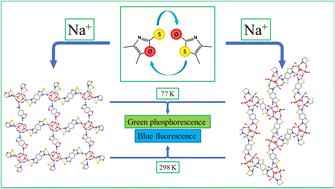
The novel ditopic centrosymmetric soft-base ligands 3,7-dihydrobenzo[1,2-d:4,5-d′]bis(oxazole)-2,6-dithione (H2L1) and 3,7-dihydrobenzo[1,2-d:4,5-d′]bis(thiazole)-2,6-dione (H2L2) were obtained via a one-pot method. Both compounds form 2D coordination polymers (CPs) through the reaction of free ligands with sodium bis(trismethylsilyl)amide in various solvent media. H2L1 containing products were [Na2L1(DME)2]n (1) and [Na2L1(DMSO)4]n (2), and for H2L2, [Na6L23(DMSO)12]n (3) was formed. X-ray analysis revealed that compound 1 is a 2D CP, in which deprotonated H2L1 acts as a tetratopic linker, linking four sodium atoms via nitrogen and bridging sulfur. Unlike 1, in CP 2, deprotonated H2L1 acts as a ditopic linker coordinating sodium atoms in an unprecedented Na4O4 metallocenter formed by the oxygens of DMSO molecules. Compound 3 is a 2D CP featuring rare Na3O6 secondary building unit (SBU), whereas H2L2 exhibits both bridging and mixed chelating/bridging mode, linking four sodium atoms via nitrogen and oxygen atoms. Despite the fact that free ligands H2L1 and H2L2 are non-luminescent in solution and in the solid state, their deprotonated forms at 298 K in DME media demonstrate moderate photoluminescence (PL) in DME solutions with broad bands in the range of 360–500 nm. At 77 K, the same solutions show broadened and intense PL consisting of bands in the 360–670 nm region corresponding to ligand fluorescence and phosphorescence. CPs 1–3 in the solid state exhibit PL at 298 and 77 K. At 298 K, CPs 1 and 3 exhibit intense fluorescence in the range of 370–450 nm and moderate microsecond timescale phosphorescence in the range of 500–670 nm, while CP 2 exhibits only fluorescence. Upon cooling to 77 K, all three CPs demonstrate both fluorescence and phosphorescence. Based on the low-temperature phosphorescence spectra of 1 and 3 in DME solutions, the triplet energy levels of H2L1 and H2L2 were established at 21 000 and 20 800 cm−1, respectively.
期刊介绍:
Dalton Transactions is a journal for all areas of inorganic chemistry, which encompasses the organometallic, bioinorganic and materials chemistry of the elements, with applications including synthesis, catalysis, energy conversion/storage, electrical devices and medicine. Dalton Transactions welcomes high-quality, original submissions in all of these areas and more, where the advancement of knowledge in inorganic chemistry is significant.




 京公网安备 11010802042870号
京ICP备2023020795号-1
京公网安备 11010802042870号
京ICP备2023020795号-1

 分享
分享
 求助内容:
求助内容: 应助结果提醒方式:
 扫码关注我们
