{"title":"可持续合成1,4-二取代1,2,3-三唑用铜锰氧化物纳米催化剂的设计与研制","authors":"Manish Rawat, Nitish Kumar Sinha, Srishti Rawat, Kemant Pratap, Vandana Saraswat, Akash Kumar and Sahil Kohli","doi":"10.1039/D4DT02898H","DOIUrl":null,"url":null,"abstract":"<p >Designing heterogeneous nanocatalysts comprising abundantly available transition metals for various organic transformations has captured significant interest in recent years owing to their convenient separation, reusability and low metal contamination after the reaction. Herein, we report the design and synthesis of CuO@MnO<small><sub>2</sub></small> nanocomposites using malachite, which is a renewable copper precursor with an <em>E</em>-factor of 1.64. The as-prepared CuO@MnO<small><sub>2</sub></small> nanocomposites were well characterized through field emission scanning electron microscopy (FESEM), high-resolution transmission electron microscopy (HR-TEM), powder X-ray diffraction (pXRD), energy-dispersive X-ray analysis (EDX), X-ray photoelectron spectroscopy (XPS), and Brunauer–Emmett–Teller techniques (BET). The catalytic efficiency of CuO@MnO<small><sub>2</sub></small> nanocomposites was explored for the synthesis of 1,4-disubstituted 1,2,3-triazoles from phenylacetylene, benzyl bromide and sodium azide under neat conditions. The sustainability of the present methodology was explored by evaluating green chemistry metrics such as the <em>E</em>-factor (0.84), reaction mass efficiency (54.45%), process mass intensity (1.84) and turnover number (901).</p>","PeriodicalId":71,"journal":{"name":"Dalton Transactions","volume":" 11","pages":" 4626-4636"},"PeriodicalIF":3.3000,"publicationDate":"2025-02-04","publicationTypes":"Journal Article","fieldsOfStudy":null,"isOpenAccess":false,"openAccessPdf":"","citationCount":"0","resultStr":"{\"title\":\"Design and development of a copper–manganese oxide nanocatalyst for the sustainable synthesis of 1,4-disubstituted 1,2,3-triazoles†‡\",\"authors\":\"Manish Rawat, Nitish Kumar Sinha, Srishti Rawat, Kemant Pratap, Vandana Saraswat, Akash Kumar and Sahil Kohli\",\"doi\":\"10.1039/D4DT02898H\",\"DOIUrl\":null,\"url\":null,\"abstract\":\"<p >Designing heterogeneous nanocatalysts comprising abundantly available transition metals for various organic transformations has captured significant interest in recent years owing to their convenient separation, reusability and low metal contamination after the reaction. Herein, we report the design and synthesis of CuO@MnO<small><sub>2</sub></small> nanocomposites using malachite, which is a renewable copper precursor with an <em>E</em>-factor of 1.64. The as-prepared CuO@MnO<small><sub>2</sub></small> nanocomposites were well characterized through field emission scanning electron microscopy (FESEM), high-resolution transmission electron microscopy (HR-TEM), powder X-ray diffraction (pXRD), energy-dispersive X-ray analysis (EDX), X-ray photoelectron spectroscopy (XPS), and Brunauer–Emmett–Teller techniques (BET). The catalytic efficiency of CuO@MnO<small><sub>2</sub></small> nanocomposites was explored for the synthesis of 1,4-disubstituted 1,2,3-triazoles from phenylacetylene, benzyl bromide and sodium azide under neat conditions. The sustainability of the present methodology was explored by evaluating green chemistry metrics such as the <em>E</em>-factor (0.84), reaction mass efficiency (54.45%), process mass intensity (1.84) and turnover number (901).</p>\",\"PeriodicalId\":71,\"journal\":{\"name\":\"Dalton Transactions\",\"volume\":\" 11\",\"pages\":\" 4626-4636\"},\"PeriodicalIF\":3.3000,\"publicationDate\":\"2025-02-04\",\"publicationTypes\":\"Journal Article\",\"fieldsOfStudy\":null,\"isOpenAccess\":false,\"openAccessPdf\":\"\",\"citationCount\":\"0\",\"resultStr\":null,\"platform\":\"Semanticscholar\",\"paperid\":null,\"PeriodicalName\":\"Dalton Transactions\",\"FirstCategoryId\":\"92\",\"ListUrlMain\":\"https://pubs.rsc.org/en/content/articlelanding/2025/dt/d4dt02898h\",\"RegionNum\":3,\"RegionCategory\":\"化学\",\"ArticlePicture\":[],\"TitleCN\":null,\"AbstractTextCN\":null,\"PMCID\":null,\"EPubDate\":\"\",\"PubModel\":\"\",\"JCR\":\"Q2\",\"JCRName\":\"CHEMISTRY, INORGANIC & NUCLEAR\",\"Score\":null,\"Total\":0}","platform":"Semanticscholar","paperid":null,"PeriodicalName":"Dalton Transactions","FirstCategoryId":"92","ListUrlMain":"https://pubs.rsc.org/en/content/articlelanding/2025/dt/d4dt02898h","RegionNum":3,"RegionCategory":"化学","ArticlePicture":[],"TitleCN":null,"AbstractTextCN":null,"PMCID":null,"EPubDate":"","PubModel":"","JCR":"Q2","JCRName":"CHEMISTRY, INORGANIC & NUCLEAR","Score":null,"Total":0}
Design and development of a copper–manganese oxide nanocatalyst for the sustainable synthesis of 1,4-disubstituted 1,2,3-triazoles†‡
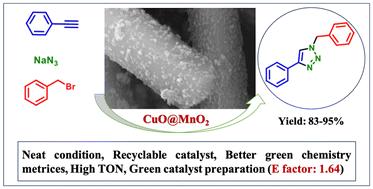
Designing heterogeneous nanocatalysts comprising abundantly available transition metals for various organic transformations has captured significant interest in recent years owing to their convenient separation, reusability and low metal contamination after the reaction. Herein, we report the design and synthesis of CuO@MnO2 nanocomposites using malachite, which is a renewable copper precursor with an E-factor of 1.64. The as-prepared CuO@MnO2 nanocomposites were well characterized through field emission scanning electron microscopy (FESEM), high-resolution transmission electron microscopy (HR-TEM), powder X-ray diffraction (pXRD), energy-dispersive X-ray analysis (EDX), X-ray photoelectron spectroscopy (XPS), and Brunauer–Emmett–Teller techniques (BET). The catalytic efficiency of CuO@MnO2 nanocomposites was explored for the synthesis of 1,4-disubstituted 1,2,3-triazoles from phenylacetylene, benzyl bromide and sodium azide under neat conditions. The sustainability of the present methodology was explored by evaluating green chemistry metrics such as the E-factor (0.84), reaction mass efficiency (54.45%), process mass intensity (1.84) and turnover number (901).
期刊介绍:
Dalton Transactions is a journal for all areas of inorganic chemistry, which encompasses the organometallic, bioinorganic and materials chemistry of the elements, with applications including synthesis, catalysis, energy conversion/storage, electrical devices and medicine. Dalton Transactions welcomes high-quality, original submissions in all of these areas and more, where the advancement of knowledge in inorganic chemistry is significant.




 京公网安备 11010802042870号
京ICP备2023020795号-1
京公网安备 11010802042870号
京ICP备2023020795号-1

 分享
分享
 求助内容:
求助内容: 应助结果提醒方式:
 扫码关注我们
