Yifan Xiao, Can Ma, Tangyou Sun, Qianju Song, Liang Bian, Zao Yi, Zhiqiang Hao, Chaojun Tang, Pinghui Wu and Qingdong Zeng
{"title":"Ti和GaAs宽带太阳能捕获吸收体的热辐射分析","authors":"Yifan Xiao, Can Ma, Tangyou Sun, Qianju Song, Liang Bian, Zao Yi, Zhiqiang Hao, Chaojun Tang, Pinghui Wu and Qingdong Zeng","doi":"10.1039/D4DT03202K","DOIUrl":null,"url":null,"abstract":"<p >This study employed a time-domain finite-difference (FDTD) approach to design an efficient solar energy-capturing absorber consisting of a high melting point metal (Ti) and a semiconductor (GaAs). The structure generated cavity resonance (CR) and surface plasmon resonance (SPR), leading to extremely high absorption across different wavelength bands. The structure exhibited >90% absorption over a wide wavelength range (280–3000 nm). It achieved an average absorption efficiency of 97.0% in the wavelength range from 280 nm to 3000 nm at an air mass of 1.5 (AM1.5). The structure showed insensitivity to the angle of incidence, maintaining stable absorption of over 94% for angles of incidence ranging from 0° to 60°. The structure could also operate at 1400 K, with thermal radiation efficiencies of up to 98.2%. As the operating temperature increased from 600 K to 1400 K (with a temperature gradient of 200 K), the thermal radiation efficiency of the structure remained above 98% at all times. Based on the excellent radiation and absorption properties of this absorber, it holds promising application in the fields of solar energy absorption and thermal emission.</p>","PeriodicalId":71,"journal":{"name":"Dalton Transactions","volume":" 11","pages":" 4619-4625"},"PeriodicalIF":3.3000,"publicationDate":"2025-02-04","publicationTypes":"Journal Article","fieldsOfStudy":null,"isOpenAccess":false,"openAccessPdf":"","citationCount":"0","resultStr":"{\"title\":\"Thermal radiation analysis of a broadband solar energy-capturing absorber using Ti and GaAs\",\"authors\":\"Yifan Xiao, Can Ma, Tangyou Sun, Qianju Song, Liang Bian, Zao Yi, Zhiqiang Hao, Chaojun Tang, Pinghui Wu and Qingdong Zeng\",\"doi\":\"10.1039/D4DT03202K\",\"DOIUrl\":null,\"url\":null,\"abstract\":\"<p >This study employed a time-domain finite-difference (FDTD) approach to design an efficient solar energy-capturing absorber consisting of a high melting point metal (Ti) and a semiconductor (GaAs). The structure generated cavity resonance (CR) and surface plasmon resonance (SPR), leading to extremely high absorption across different wavelength bands. The structure exhibited >90% absorption over a wide wavelength range (280–3000 nm). It achieved an average absorption efficiency of 97.0% in the wavelength range from 280 nm to 3000 nm at an air mass of 1.5 (AM1.5). The structure showed insensitivity to the angle of incidence, maintaining stable absorption of over 94% for angles of incidence ranging from 0° to 60°. The structure could also operate at 1400 K, with thermal radiation efficiencies of up to 98.2%. As the operating temperature increased from 600 K to 1400 K (with a temperature gradient of 200 K), the thermal radiation efficiency of the structure remained above 98% at all times. Based on the excellent radiation and absorption properties of this absorber, it holds promising application in the fields of solar energy absorption and thermal emission.</p>\",\"PeriodicalId\":71,\"journal\":{\"name\":\"Dalton Transactions\",\"volume\":\" 11\",\"pages\":\" 4619-4625\"},\"PeriodicalIF\":3.3000,\"publicationDate\":\"2025-02-04\",\"publicationTypes\":\"Journal Article\",\"fieldsOfStudy\":null,\"isOpenAccess\":false,\"openAccessPdf\":\"\",\"citationCount\":\"0\",\"resultStr\":null,\"platform\":\"Semanticscholar\",\"paperid\":null,\"PeriodicalName\":\"Dalton Transactions\",\"FirstCategoryId\":\"92\",\"ListUrlMain\":\"https://pubs.rsc.org/en/content/articlelanding/2025/dt/d4dt03202k\",\"RegionNum\":3,\"RegionCategory\":\"化学\",\"ArticlePicture\":[],\"TitleCN\":null,\"AbstractTextCN\":null,\"PMCID\":null,\"EPubDate\":\"\",\"PubModel\":\"\",\"JCR\":\"Q2\",\"JCRName\":\"CHEMISTRY, INORGANIC & NUCLEAR\",\"Score\":null,\"Total\":0}","platform":"Semanticscholar","paperid":null,"PeriodicalName":"Dalton Transactions","FirstCategoryId":"92","ListUrlMain":"https://pubs.rsc.org/en/content/articlelanding/2025/dt/d4dt03202k","RegionNum":3,"RegionCategory":"化学","ArticlePicture":[],"TitleCN":null,"AbstractTextCN":null,"PMCID":null,"EPubDate":"","PubModel":"","JCR":"Q2","JCRName":"CHEMISTRY, INORGANIC & NUCLEAR","Score":null,"Total":0}
Thermal radiation analysis of a broadband solar energy-capturing absorber using Ti and GaAs
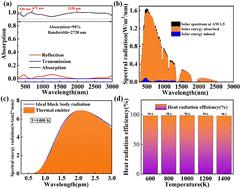
This study employed a time-domain finite-difference (FDTD) approach to design an efficient solar energy-capturing absorber consisting of a high melting point metal (Ti) and a semiconductor (GaAs). The structure generated cavity resonance (CR) and surface plasmon resonance (SPR), leading to extremely high absorption across different wavelength bands. The structure exhibited >90% absorption over a wide wavelength range (280–3000 nm). It achieved an average absorption efficiency of 97.0% in the wavelength range from 280 nm to 3000 nm at an air mass of 1.5 (AM1.5). The structure showed insensitivity to the angle of incidence, maintaining stable absorption of over 94% for angles of incidence ranging from 0° to 60°. The structure could also operate at 1400 K, with thermal radiation efficiencies of up to 98.2%. As the operating temperature increased from 600 K to 1400 K (with a temperature gradient of 200 K), the thermal radiation efficiency of the structure remained above 98% at all times. Based on the excellent radiation and absorption properties of this absorber, it holds promising application in the fields of solar energy absorption and thermal emission.
期刊介绍:
Dalton Transactions is a journal for all areas of inorganic chemistry, which encompasses the organometallic, bioinorganic and materials chemistry of the elements, with applications including synthesis, catalysis, energy conversion/storage, electrical devices and medicine. Dalton Transactions welcomes high-quality, original submissions in all of these areas and more, where the advancement of knowledge in inorganic chemistry is significant.




 京公网安备 11010802042870号
京ICP备2023020795号-1
京公网安备 11010802042870号
京ICP备2023020795号-1

 分享
分享
 求助内容:
求助内容: 应助结果提醒方式:
 扫码关注我们
