Carmelo Mastroeni , Erica Fiorbelli , Samantha Sigolo , Valentina Novara , Eliana Carboni , Ivan Eisner , Paolo Fantinati , Antonio Gallo
{"title":"采用苯甲酸钠复合孕育剂提高仓顶全株玉米青贮品质","authors":"Carmelo Mastroeni , Erica Fiorbelli , Samantha Sigolo , Valentina Novara , Eliana Carboni , Ivan Eisner , Paolo Fantinati , Antonio Gallo","doi":"10.1016/j.anifeedsci.2024.116176","DOIUrl":null,"url":null,"abstract":"<div><div>The aim of this study was to determine the effect of a commercial bacterial inoculant in combination with sodium benzoate on aerobic spoilage of whole-plant corn silage (WPCS) in the upper layer of a bunker silo. More specifically, we compared control silage (CTR) that was treated with water alone and experimental silage (OS) that was inoculated with SiloSolve® OS (a combination of <em>Enterococcus faecium</em> [DSM 22502/1k20602], <em>Lactococcus lactis</em> [DSM 11037/1k2081], and <em>Lactiplantibacillus plantarum</em> [DSM 16568/1k20720]) in combination with sodium-benzoate. After harvest, 1000 kg of freshly chopped corn was divided into two equal groups (OS and CTR), followed by homogenization with a pitchfork. For each group, 12 silo-NET bags (SNBs; high density polyethylene, 27 ×120 cm, 200 µm mesh pores) were filled with approximately 5.5 kg of freshly chopped forage, and then buried at a depth of 0.30 m in different regions of a bunker silo (26 m long, 8.5 m wide, 3.5 m high) for 98, 142, or 217 days. The bunker silo was divided lengthwise into two equal parts, and a 2-m buffer zone separated the CTR group and the OS group. After application of each treatment, the SNBs were removed from the ensiled mass, weighed, and mixed thoroughly, followed by measurement of chemical, fermentative, and microbiological parameters. The OS group had a decreased loss of dry matter (5.3 ± 4.72 <em>vs.</em> 12.5 ± 4.72 g/kg DM, P < 0.05), greater aerobic stability (302.0 ± 64.5 <em>vs.</em> 225.7 ± 64.5 h, P < 0.05), a lower count of yeasts (2.33 ± 0.84 <em>vs.</em> 3.74 ± 0.84 log<sub>10</sub>[CFU/g], P < 0.05), and a lower count of molds (2.24 ± 0.50 <em>vs.</em> 3.12 ± 0.50 log<sub>10</sub>[CFU/g], P < 0.05). During the feed-out phase, the temperature of the core and top layer of the bunker and the amount of WPCS waste were determined for the two groups. The temperature was consistently lower in the OS group, and the total amount of waste (2.01 % of total WPCS) was 43 % lower in the OS group. We conclude that treatment of the top layer of WPCS in a bunker silo with a commercial inoculant and sodium benzoate can decrease spoilage and increase the economic value of silage.</div></div>","PeriodicalId":7861,"journal":{"name":"Animal Feed Science and Technology","volume":"319 ","pages":"Article 116176"},"PeriodicalIF":2.7000,"publicationDate":"2025-01-01","publicationTypes":"Journal Article","fieldsOfStudy":null,"isOpenAccess":false,"openAccessPdf":"","citationCount":"0","resultStr":"{\"title\":\"Improving the quality of whole-plant corn silage in the top layer of a silo by using an inoculant in combination with sodium benzoate\",\"authors\":\"Carmelo Mastroeni , Erica Fiorbelli , Samantha Sigolo , Valentina Novara , Eliana Carboni , Ivan Eisner , Paolo Fantinati , Antonio Gallo\",\"doi\":\"10.1016/j.anifeedsci.2024.116176\",\"DOIUrl\":null,\"url\":null,\"abstract\":\"<div><div>The aim of this study was to determine the effect of a commercial bacterial inoculant in combination with sodium benzoate on aerobic spoilage of whole-plant corn silage (WPCS) in the upper layer of a bunker silo. More specifically, we compared control silage (CTR) that was treated with water alone and experimental silage (OS) that was inoculated with SiloSolve® OS (a combination of <em>Enterococcus faecium</em> [DSM 22502/1k20602], <em>Lactococcus lactis</em> [DSM 11037/1k2081], and <em>Lactiplantibacillus plantarum</em> [DSM 16568/1k20720]) in combination with sodium-benzoate. After harvest, 1000 kg of freshly chopped corn was divided into two equal groups (OS and CTR), followed by homogenization with a pitchfork. For each group, 12 silo-NET bags (SNBs; high density polyethylene, 27 ×120 cm, 200 µm mesh pores) were filled with approximately 5.5 kg of freshly chopped forage, and then buried at a depth of 0.30 m in different regions of a bunker silo (26 m long, 8.5 m wide, 3.5 m high) for 98, 142, or 217 days. The bunker silo was divided lengthwise into two equal parts, and a 2-m buffer zone separated the CTR group and the OS group. After application of each treatment, the SNBs were removed from the ensiled mass, weighed, and mixed thoroughly, followed by measurement of chemical, fermentative, and microbiological parameters. The OS group had a decreased loss of dry matter (5.3 ± 4.72 <em>vs.</em> 12.5 ± 4.72 g/kg DM, P < 0.05), greater aerobic stability (302.0 ± 64.5 <em>vs.</em> 225.7 ± 64.5 h, P < 0.05), a lower count of yeasts (2.33 ± 0.84 <em>vs.</em> 3.74 ± 0.84 log<sub>10</sub>[CFU/g], P < 0.05), and a lower count of molds (2.24 ± 0.50 <em>vs.</em> 3.12 ± 0.50 log<sub>10</sub>[CFU/g], P < 0.05). During the feed-out phase, the temperature of the core and top layer of the bunker and the amount of WPCS waste were determined for the two groups. The temperature was consistently lower in the OS group, and the total amount of waste (2.01 % of total WPCS) was 43 % lower in the OS group. We conclude that treatment of the top layer of WPCS in a bunker silo with a commercial inoculant and sodium benzoate can decrease spoilage and increase the economic value of silage.</div></div>\",\"PeriodicalId\":7861,\"journal\":{\"name\":\"Animal Feed Science and Technology\",\"volume\":\"319 \",\"pages\":\"Article 116176\"},\"PeriodicalIF\":2.7000,\"publicationDate\":\"2025-01-01\",\"publicationTypes\":\"Journal Article\",\"fieldsOfStudy\":null,\"isOpenAccess\":false,\"openAccessPdf\":\"\",\"citationCount\":\"0\",\"resultStr\":null,\"platform\":\"Semanticscholar\",\"paperid\":null,\"PeriodicalName\":\"Animal Feed Science and Technology\",\"FirstCategoryId\":\"97\",\"ListUrlMain\":\"https://www.sciencedirect.com/science/article/pii/S0377840124003043\",\"RegionNum\":2,\"RegionCategory\":\"农林科学\",\"ArticlePicture\":[],\"TitleCN\":null,\"AbstractTextCN\":null,\"PMCID\":null,\"EPubDate\":\"2024/12/7 0:00:00\",\"PubModel\":\"Epub\",\"JCR\":\"Q1\",\"JCRName\":\"AGRICULTURE, DAIRY & ANIMAL SCIENCE\",\"Score\":null,\"Total\":0}","platform":"Semanticscholar","paperid":null,"PeriodicalName":"Animal Feed Science and Technology","FirstCategoryId":"97","ListUrlMain":"https://www.sciencedirect.com/science/article/pii/S0377840124003043","RegionNum":2,"RegionCategory":"农林科学","ArticlePicture":[],"TitleCN":null,"AbstractTextCN":null,"PMCID":null,"EPubDate":"2024/12/7 0:00:00","PubModel":"Epub","JCR":"Q1","JCRName":"AGRICULTURE, DAIRY & ANIMAL SCIENCE","Score":null,"Total":0}
引用次数: 0
摘要
本研究的目的是确定商业细菌接种剂与苯甲酸钠联合使用对仓仓上层全株玉米青贮(WPCS)好氧变质的影响。更具体地说,我们比较了单独用水处理的对照青贮饲料(CTR)和接种SiloSolve®OS(屎肠球菌[DSM 22502/1k20602]、乳酸乳球菌[DSM 11037/1k2081]和植物乳杆菌[DSM 16568/1k20720]的组合)与苯甲酸钠联合处理的实验青贮饲料(OS)。收获后,将1000 kg新鲜切碎的玉米分成两组(OS组和CTR组),用干草叉进行均质处理。每组12个筒仓- net袋(SNBs;高密度聚乙烯(27 ×120 cm, 200 µm孔)填充约5.5 kg新鲜切碎的牧草,然后在一个仓仓(长26 m,宽8.5 m,高3.5 m)的不同区域以0.30 m的深度埋置98,142或217天。将掩体筒仓纵向分成两等份,用2 m缓冲区将CTR组和OS组隔开。每次处理后,将SNBs从青贮体中取出,称重并彻底混合,然后测量化学、发酵和微生物参数。操作系统组干物质损失下降(5.3 ± 4.72 vs 12.5 ±4.72 g / kg DM, P & lt; 0.05),更大的有氧稳定性(302.0 ± 64.5 vs 225.7 ±64.5 h P & lt; 0.05),较低的酵母数(2.33 ±0.84 vs 3.74 ±0.84 log10 (CFU / g), P & lt; 0.05),和较低的模具数(2.24 ± 0.50 vs 3.12 ±0.50 log10 (CFU / g), P & lt; 0.05)。在进料阶段,测定两组料仓的堆芯和顶层温度以及WPCS废弃物量。操作系统组的温度持续较低,并且总浪费量(占总WPCS的2.01 %)在操作系统组降低了43 %。综上所述,用商业接种剂和苯甲酸钠处理仓仓青贮饲料的顶层,可以减少青贮饲料的腐坏,提高青贮饲料的经济价值。
Improving the quality of whole-plant corn silage in the top layer of a silo by using an inoculant in combination with sodium benzoate
The aim of this study was to determine the effect of a commercial bacterial inoculant in combination with sodium benzoate on aerobic spoilage of whole-plant corn silage (WPCS) in the upper layer of a bunker silo. More specifically, we compared control silage (CTR) that was treated with water alone and experimental silage (OS) that was inoculated with SiloSolve® OS (a combination of Enterococcus faecium [DSM 22502/1k20602], Lactococcus lactis [DSM 11037/1k2081], and Lactiplantibacillus plantarum [DSM 16568/1k20720]) in combination with sodium-benzoate. After harvest, 1000 kg of freshly chopped corn was divided into two equal groups (OS and CTR), followed by homogenization with a pitchfork. For each group, 12 silo-NET bags (SNBs; high density polyethylene, 27 ×120 cm, 200 µm mesh pores) were filled with approximately 5.5 kg of freshly chopped forage, and then buried at a depth of 0.30 m in different regions of a bunker silo (26 m long, 8.5 m wide, 3.5 m high) for 98, 142, or 217 days. The bunker silo was divided lengthwise into two equal parts, and a 2-m buffer zone separated the CTR group and the OS group. After application of each treatment, the SNBs were removed from the ensiled mass, weighed, and mixed thoroughly, followed by measurement of chemical, fermentative, and microbiological parameters. The OS group had a decreased loss of dry matter (5.3 ± 4.72 vs. 12.5 ± 4.72 g/kg DM, P < 0.05), greater aerobic stability (302.0 ± 64.5 vs. 225.7 ± 64.5 h, P < 0.05), a lower count of yeasts (2.33 ± 0.84 vs. 3.74 ± 0.84 log10[CFU/g], P < 0.05), and a lower count of molds (2.24 ± 0.50 vs. 3.12 ± 0.50 log10[CFU/g], P < 0.05). During the feed-out phase, the temperature of the core and top layer of the bunker and the amount of WPCS waste were determined for the two groups. The temperature was consistently lower in the OS group, and the total amount of waste (2.01 % of total WPCS) was 43 % lower in the OS group. We conclude that treatment of the top layer of WPCS in a bunker silo with a commercial inoculant and sodium benzoate can decrease spoilage and increase the economic value of silage.
期刊介绍:
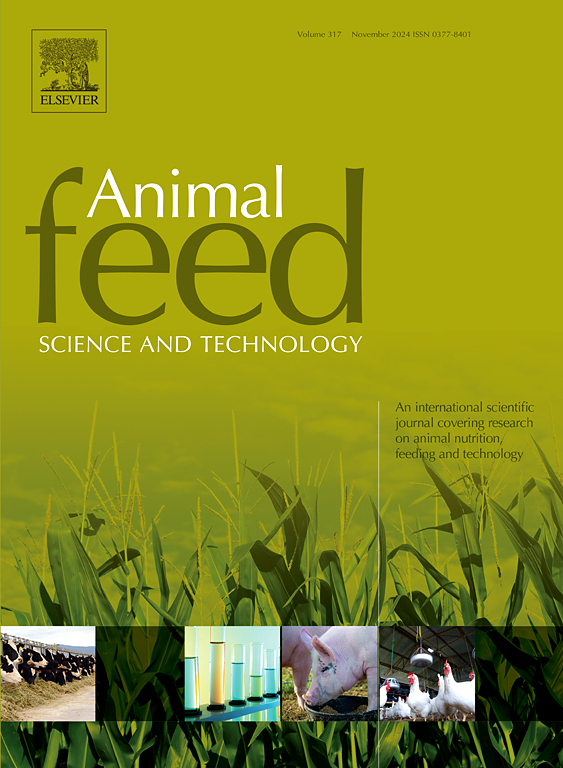
Animal Feed Science and Technology is a unique journal publishing scientific papers of international interest focusing on animal feeds and their feeding.
Papers describing research on feed for ruminants and non-ruminants, including poultry, horses, companion animals and aquatic animals, are welcome.
The journal covers the following areas:
Nutritive value of feeds (e.g., assessment, improvement)
Methods of conserving and processing feeds that affect their nutritional value
Agronomic and climatic factors influencing the nutritive value of feeds
Utilization of feeds and the improvement of such
Metabolic, production, reproduction and health responses, as well as potential environmental impacts, of diet inputs and feed technologies (e.g., feeds, feed additives, feed components, mycotoxins)
Mathematical models relating directly to animal-feed interactions
Analytical and experimental methods for feed evaluation
Environmental impacts of feed technologies in animal production.




 京公网安备 11010802042870号
京ICP备2023020795号-1
京公网安备 11010802042870号
京ICP备2023020795号-1

 分享
分享
 求助内容:
求助内容: 应助结果提醒方式:
 扫码关注我们
