T. Jothilakshmi, S. Deepika, N. Sivakumar, K.L. Meghanathan
{"title":"金属有机框架衍生ZnCo2O4@CoMoO4高性能非对称超级电容器正极","authors":"T. Jothilakshmi, S. Deepika, N. Sivakumar, K.L. Meghanathan","doi":"10.1016/j.matchemphys.2025.130484","DOIUrl":null,"url":null,"abstract":"<div><div>The development of MOF-derived metal oxide composites for electrodes has emerged as a promising strategy for enhancing the performance of asymmetric supercapacitors. These advanced materials offer significant potential in improving energy storage efficiency and stability in modern applications. In this study, we introduce a novel electrode material featuring a nanoflower-like MOF/ZnCo<sub>2</sub>O<sub>4</sub>@CoMoO<sub>4</sub>. The unique MOF characteristics, including tuneable porous nature and high surface area, provide to an overall surface area of 522.734 m<sup>2</sup>g⁻<sup>1</sup> for the material. Due to its distinctive structure and synergic effect between multiple components of MOF/ZnCo<sub>2</sub>O<sub>4</sub>@CoMoO<sub>4</sub> electrode exhibits exceptional electrochemical performance, achieving an high specific capacitance of 2073 Fg⁻<sup>1</sup> at 1 Ag⁻<sup>1</sup> and demonstrating remarkable cyclic efficiency, retains over 97 % of its initial capacitance after 5000 cycles. The asymmetric supercapacitor achieves an energy density of 45.5 Whkg⁻<sup>1</sup> and a power density of 850 Wkg⁻<sup>1</sup>. The remarkable electrochemical behaviour of the MOF/ZnCo<sub>2</sub>O<sub>4</sub>@CoMoO<sub>4</sub> nanoflower electrode positions it as a promising candidate for future energy storage applications.</div></div>","PeriodicalId":18227,"journal":{"name":"Materials Chemistry and Physics","volume":"334 ","pages":"Article 130484"},"PeriodicalIF":4.7000,"publicationDate":"2025-04-01","publicationTypes":"Journal Article","fieldsOfStudy":null,"isOpenAccess":false,"openAccessPdf":"","citationCount":"0","resultStr":"{\"title\":\"Metal-organic framework-derived ZnCo2O4@CoMoO4 positive electrode for high-performance asymmetric supercapacitors\",\"authors\":\"T. Jothilakshmi, S. Deepika, N. Sivakumar, K.L. Meghanathan\",\"doi\":\"10.1016/j.matchemphys.2025.130484\",\"DOIUrl\":null,\"url\":null,\"abstract\":\"<div><div>The development of MOF-derived metal oxide composites for electrodes has emerged as a promising strategy for enhancing the performance of asymmetric supercapacitors. These advanced materials offer significant potential in improving energy storage efficiency and stability in modern applications. In this study, we introduce a novel electrode material featuring a nanoflower-like MOF/ZnCo<sub>2</sub>O<sub>4</sub>@CoMoO<sub>4</sub>. The unique MOF characteristics, including tuneable porous nature and high surface area, provide to an overall surface area of 522.734 m<sup>2</sup>g⁻<sup>1</sup> for the material. Due to its distinctive structure and synergic effect between multiple components of MOF/ZnCo<sub>2</sub>O<sub>4</sub>@CoMoO<sub>4</sub> electrode exhibits exceptional electrochemical performance, achieving an high specific capacitance of 2073 Fg⁻<sup>1</sup> at 1 Ag⁻<sup>1</sup> and demonstrating remarkable cyclic efficiency, retains over 97 % of its initial capacitance after 5000 cycles. The asymmetric supercapacitor achieves an energy density of 45.5 Whkg⁻<sup>1</sup> and a power density of 850 Wkg⁻<sup>1</sup>. The remarkable electrochemical behaviour of the MOF/ZnCo<sub>2</sub>O<sub>4</sub>@CoMoO<sub>4</sub> nanoflower electrode positions it as a promising candidate for future energy storage applications.</div></div>\",\"PeriodicalId\":18227,\"journal\":{\"name\":\"Materials Chemistry and Physics\",\"volume\":\"334 \",\"pages\":\"Article 130484\"},\"PeriodicalIF\":4.7000,\"publicationDate\":\"2025-04-01\",\"publicationTypes\":\"Journal Article\",\"fieldsOfStudy\":null,\"isOpenAccess\":false,\"openAccessPdf\":\"\",\"citationCount\":\"0\",\"resultStr\":null,\"platform\":\"Semanticscholar\",\"paperid\":null,\"PeriodicalName\":\"Materials Chemistry and Physics\",\"FirstCategoryId\":\"88\",\"ListUrlMain\":\"https://www.sciencedirect.com/science/article/pii/S0254058425001300\",\"RegionNum\":3,\"RegionCategory\":\"材料科学\",\"ArticlePicture\":[],\"TitleCN\":null,\"AbstractTextCN\":null,\"PMCID\":null,\"EPubDate\":\"2025/2/1 0:00:00\",\"PubModel\":\"Epub\",\"JCR\":\"Q2\",\"JCRName\":\"MATERIALS SCIENCE, MULTIDISCIPLINARY\",\"Score\":null,\"Total\":0}","platform":"Semanticscholar","paperid":null,"PeriodicalName":"Materials Chemistry and Physics","FirstCategoryId":"88","ListUrlMain":"https://www.sciencedirect.com/science/article/pii/S0254058425001300","RegionNum":3,"RegionCategory":"材料科学","ArticlePicture":[],"TitleCN":null,"AbstractTextCN":null,"PMCID":null,"EPubDate":"2025/2/1 0:00:00","PubModel":"Epub","JCR":"Q2","JCRName":"MATERIALS SCIENCE, MULTIDISCIPLINARY","Score":null,"Total":0}
Metal-organic framework-derived ZnCo2O4@CoMoO4 positive electrode for high-performance asymmetric supercapacitors
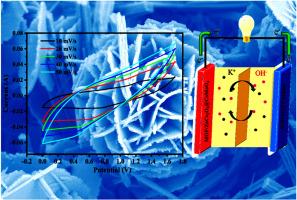
The development of MOF-derived metal oxide composites for electrodes has emerged as a promising strategy for enhancing the performance of asymmetric supercapacitors. These advanced materials offer significant potential in improving energy storage efficiency and stability in modern applications. In this study, we introduce a novel electrode material featuring a nanoflower-like MOF/ZnCo2O4@CoMoO4. The unique MOF characteristics, including tuneable porous nature and high surface area, provide to an overall surface area of 522.734 m2g⁻1 for the material. Due to its distinctive structure and synergic effect between multiple components of MOF/ZnCo2O4@CoMoO4 electrode exhibits exceptional electrochemical performance, achieving an high specific capacitance of 2073 Fg⁻1 at 1 Ag⁻1 and demonstrating remarkable cyclic efficiency, retains over 97 % of its initial capacitance after 5000 cycles. The asymmetric supercapacitor achieves an energy density of 45.5 Whkg⁻1 and a power density of 850 Wkg⁻1. The remarkable electrochemical behaviour of the MOF/ZnCo2O4@CoMoO4 nanoflower electrode positions it as a promising candidate for future energy storage applications.
期刊介绍:
Materials Chemistry and Physics is devoted to short communications, full-length research papers and feature articles on interrelationships among structure, properties, processing and performance of materials. The Editors welcome manuscripts on thin films, surface and interface science, materials degradation and reliability, metallurgy, semiconductors and optoelectronic materials, fine ceramics, magnetics, superconductors, specialty polymers, nano-materials and composite materials.




 京公网安备 11010802042870号
京ICP备2023020795号-1
京公网安备 11010802042870号
京ICP备2023020795号-1

 分享
分享
 求助内容:
求助内容: 应助结果提醒方式:
 扫码关注我们
