Jiajun Li , Bin Zou , Amirbek Bekeshev , Marzhan Akhmetova , Raigul Orynbassar , Xin Wang , Yuan Hu
{"title":"环氧树脂中有机磷阻燃性能的实用机器学习模型选择与解释","authors":"Jiajun Li , Bin Zou , Amirbek Bekeshev , Marzhan Akhmetova , Raigul Orynbassar , Xin Wang , Yuan Hu","doi":"10.1016/j.polymdegradstab.2025.111209","DOIUrl":null,"url":null,"abstract":"<div><div>The traditional trial-and-error method for developing organophosphorus flame retardants is time-consuming and expensive. This work constructed machine learning models for limiting oxygen index (LOI), peak heat release rate (PHRR), and UL-94 for epoxy resin on the basis of the collected multifactor database, including the structure of organophosphorus flame retardants, addition amounts, matrix combustion performance, and flux. The training and test sets were divided on the basis of molecular groups to avoid data leakage within the same molecule group, in contrast to conventional random splitting. The best results for LOI and PHRR prediction were achieved via the XGBoost algorithm and ECFP4 fingerprints, with mean absolute errors of 1.61% and 125.5 kW/m<sup>2</sup> on the test set, respectively. For UL-94 classification, the MACCS with XGBoost achieved 79% accuracy. The Shapley additive explanation for the model indicated that the addition amount and matrix combustion performance data were the two most important features. This work could help develop a more accurate and reliable prediction model for flame retardancy.</div></div>","PeriodicalId":406,"journal":{"name":"Polymer Degradation and Stability","volume":"234 ","pages":"Article 111209"},"PeriodicalIF":8.1000,"publicationDate":"2025-04-01","publicationTypes":"Journal Article","fieldsOfStudy":null,"isOpenAccess":false,"openAccessPdf":"","citationCount":"0","resultStr":"{\"title\":\"Practical machine learning model selection and interpretation for organophosphorus flame retardancy in Epoxy resin\",\"authors\":\"Jiajun Li , Bin Zou , Amirbek Bekeshev , Marzhan Akhmetova , Raigul Orynbassar , Xin Wang , Yuan Hu\",\"doi\":\"10.1016/j.polymdegradstab.2025.111209\",\"DOIUrl\":null,\"url\":null,\"abstract\":\"<div><div>The traditional trial-and-error method for developing organophosphorus flame retardants is time-consuming and expensive. This work constructed machine learning models for limiting oxygen index (LOI), peak heat release rate (PHRR), and UL-94 for epoxy resin on the basis of the collected multifactor database, including the structure of organophosphorus flame retardants, addition amounts, matrix combustion performance, and flux. The training and test sets were divided on the basis of molecular groups to avoid data leakage within the same molecule group, in contrast to conventional random splitting. The best results for LOI and PHRR prediction were achieved via the XGBoost algorithm and ECFP4 fingerprints, with mean absolute errors of 1.61% and 125.5 kW/m<sup>2</sup> on the test set, respectively. For UL-94 classification, the MACCS with XGBoost achieved 79% accuracy. The Shapley additive explanation for the model indicated that the addition amount and matrix combustion performance data were the two most important features. This work could help develop a more accurate and reliable prediction model for flame retardancy.</div></div>\",\"PeriodicalId\":406,\"journal\":{\"name\":\"Polymer Degradation and Stability\",\"volume\":\"234 \",\"pages\":\"Article 111209\"},\"PeriodicalIF\":8.1000,\"publicationDate\":\"2025-04-01\",\"publicationTypes\":\"Journal Article\",\"fieldsOfStudy\":null,\"isOpenAccess\":false,\"openAccessPdf\":\"\",\"citationCount\":\"0\",\"resultStr\":null,\"platform\":\"Semanticscholar\",\"paperid\":null,\"PeriodicalName\":\"Polymer Degradation and Stability\",\"FirstCategoryId\":\"92\",\"ListUrlMain\":\"https://www.sciencedirect.com/science/article/pii/S0141391025000400\",\"RegionNum\":2,\"RegionCategory\":\"化学\",\"ArticlePicture\":[],\"TitleCN\":null,\"AbstractTextCN\":null,\"PMCID\":null,\"EPubDate\":\"2025/1/19 0:00:00\",\"PubModel\":\"Epub\",\"JCR\":\"Q1\",\"JCRName\":\"POLYMER SCIENCE\",\"Score\":null,\"Total\":0}","platform":"Semanticscholar","paperid":null,"PeriodicalName":"Polymer Degradation and Stability","FirstCategoryId":"92","ListUrlMain":"https://www.sciencedirect.com/science/article/pii/S0141391025000400","RegionNum":2,"RegionCategory":"化学","ArticlePicture":[],"TitleCN":null,"AbstractTextCN":null,"PMCID":null,"EPubDate":"2025/1/19 0:00:00","PubModel":"Epub","JCR":"Q1","JCRName":"POLYMER SCIENCE","Score":null,"Total":0}
Practical machine learning model selection and interpretation for organophosphorus flame retardancy in Epoxy resin
The traditional trial-and-error method for developing organophosphorus flame retardants is time-consuming and expensive. This work constructed machine learning models for limiting oxygen index (LOI), peak heat release rate (PHRR), and UL-94 for epoxy resin on the basis of the collected multifactor database, including the structure of organophosphorus flame retardants, addition amounts, matrix combustion performance, and flux. The training and test sets were divided on the basis of molecular groups to avoid data leakage within the same molecule group, in contrast to conventional random splitting. The best results for LOI and PHRR prediction were achieved via the XGBoost algorithm and ECFP4 fingerprints, with mean absolute errors of 1.61% and 125.5 kW/m2 on the test set, respectively. For UL-94 classification, the MACCS with XGBoost achieved 79% accuracy. The Shapley additive explanation for the model indicated that the addition amount and matrix combustion performance data were the two most important features. This work could help develop a more accurate and reliable prediction model for flame retardancy.
期刊介绍:
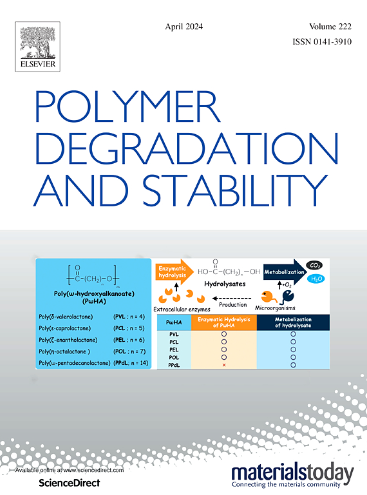
Polymer Degradation and Stability deals with the degradation reactions and their control which are a major preoccupation of practitioners of the many and diverse aspects of modern polymer technology.
Deteriorative reactions occur during processing, when polymers are subjected to heat, oxygen and mechanical stress, and during the useful life of the materials when oxygen and sunlight are the most important degradative agencies. In more specialised applications, degradation may be induced by high energy radiation, ozone, atmospheric pollutants, mechanical stress, biological action, hydrolysis and many other influences. The mechanisms of these reactions and stabilisation processes must be understood if the technology and application of polymers are to continue to advance. The reporting of investigations of this kind is therefore a major function of this journal.
However there are also new developments in polymer technology in which degradation processes find positive applications. For example, photodegradable plastics are now available, the recycling of polymeric products will become increasingly important, degradation and combustion studies are involved in the definition of the fire hazards which are associated with polymeric materials and the microelectronics industry is vitally dependent upon polymer degradation in the manufacture of its circuitry. Polymer properties may also be improved by processes like curing and grafting, the chemistry of which can be closely related to that which causes physical deterioration in other circumstances.




 京公网安备 11010802042870号
京ICP备2023020795号-1
京公网安备 11010802042870号
京ICP备2023020795号-1

 分享
分享
 求助内容:
求助内容: 应助结果提醒方式:
 扫码关注我们
