Jianyi Xu , Zhaozhe Ren , He Mi , Feng Hu , Guofang Zhang , Xin Zhao , Dandan ke , Zeming Yuan
{"title":"新型AB4型RE-Ti-Mg-Ni基超晶格负极的微观结构和电化学行为","authors":"Jianyi Xu , Zhaozhe Ren , He Mi , Feng Hu , Guofang Zhang , Xin Zhao , Dandan ke , Zeming Yuan","doi":"10.1016/j.scriptamat.2024.116508","DOIUrl":null,"url":null,"abstract":"<div><div>In this study, new AB<sub>4</sub> type superlattice negative electrodes were developed with the elemental composition of La<sub>0.8-x</sub>Ti<sub>x</sub>Mg<sub>0.2</sub>Ni<sub>3.96</sub> (<em>x</em> = 0–0.5) through a process involving induction melting followed by annealing. A thorough investigation was conducted into the microstructure and electrochemical properties. The XRD analysis shows that the <em>x</em> = 0 alloy contained AB<sub>4</sub> and 3R-A<sub>5</sub>B<sub>19</sub> phases. After partial substitution of Ti 2H-A<sub>5</sub>B<sub>19</sub> phase appeared, with Ti<sub>2</sub>Ni phase forming when <em>x</em> ≥ 0.3. Ti addition causes a preliminary rise followed by a decline in the quantity of the AB<sub>4</sub> phase, a reduction in the amount of 3R-A<sub>5</sub>B<sub>19</sub> phase, and a steady increase in the levels of 2H-A<sub>5</sub>B<sub>19</sub> and Ti<sub>2</sub>Ni phases. Electrochemical tests revealed the maximum discharge capacity decreases, while the capacity retention rises. Moreover, the high-rate discharge ability falls as Ti substitution increases. The investigations reveal that the transfer of charge taking place on the alloy's surface significantly influences the kinetic properties of all sample electrodes.</div></div>","PeriodicalId":423,"journal":{"name":"Scripta Materialia","volume":"258 ","pages":"Article 116508"},"PeriodicalIF":5.6000,"publicationDate":"2025-03-15","publicationTypes":"Journal Article","fieldsOfStudy":null,"isOpenAccess":false,"openAccessPdf":"","citationCount":"0","resultStr":"{\"title\":\"The microstructures and electrochemical behaviors of new AB4 type RE-Ti-Mg-Ni based superlattice negative electrodes\",\"authors\":\"Jianyi Xu , Zhaozhe Ren , He Mi , Feng Hu , Guofang Zhang , Xin Zhao , Dandan ke , Zeming Yuan\",\"doi\":\"10.1016/j.scriptamat.2024.116508\",\"DOIUrl\":null,\"url\":null,\"abstract\":\"<div><div>In this study, new AB<sub>4</sub> type superlattice negative electrodes were developed with the elemental composition of La<sub>0.8-x</sub>Ti<sub>x</sub>Mg<sub>0.2</sub>Ni<sub>3.96</sub> (<em>x</em> = 0–0.5) through a process involving induction melting followed by annealing. A thorough investigation was conducted into the microstructure and electrochemical properties. The XRD analysis shows that the <em>x</em> = 0 alloy contained AB<sub>4</sub> and 3R-A<sub>5</sub>B<sub>19</sub> phases. After partial substitution of Ti 2H-A<sub>5</sub>B<sub>19</sub> phase appeared, with Ti<sub>2</sub>Ni phase forming when <em>x</em> ≥ 0.3. Ti addition causes a preliminary rise followed by a decline in the quantity of the AB<sub>4</sub> phase, a reduction in the amount of 3R-A<sub>5</sub>B<sub>19</sub> phase, and a steady increase in the levels of 2H-A<sub>5</sub>B<sub>19</sub> and Ti<sub>2</sub>Ni phases. Electrochemical tests revealed the maximum discharge capacity decreases, while the capacity retention rises. Moreover, the high-rate discharge ability falls as Ti substitution increases. The investigations reveal that the transfer of charge taking place on the alloy's surface significantly influences the kinetic properties of all sample electrodes.</div></div>\",\"PeriodicalId\":423,\"journal\":{\"name\":\"Scripta Materialia\",\"volume\":\"258 \",\"pages\":\"Article 116508\"},\"PeriodicalIF\":5.6000,\"publicationDate\":\"2025-03-15\",\"publicationTypes\":\"Journal Article\",\"fieldsOfStudy\":null,\"isOpenAccess\":false,\"openAccessPdf\":\"\",\"citationCount\":\"0\",\"resultStr\":null,\"platform\":\"Semanticscholar\",\"paperid\":null,\"PeriodicalName\":\"Scripta Materialia\",\"FirstCategoryId\":\"88\",\"ListUrlMain\":\"https://www.sciencedirect.com/science/article/pii/S1359646224005414\",\"RegionNum\":2,\"RegionCategory\":\"材料科学\",\"ArticlePicture\":[],\"TitleCN\":null,\"AbstractTextCN\":null,\"PMCID\":null,\"EPubDate\":\"2024/12/13 0:00:00\",\"PubModel\":\"Epub\",\"JCR\":\"Q2\",\"JCRName\":\"MATERIALS SCIENCE, MULTIDISCIPLINARY\",\"Score\":null,\"Total\":0}","platform":"Semanticscholar","paperid":null,"PeriodicalName":"Scripta Materialia","FirstCategoryId":"88","ListUrlMain":"https://www.sciencedirect.com/science/article/pii/S1359646224005414","RegionNum":2,"RegionCategory":"材料科学","ArticlePicture":[],"TitleCN":null,"AbstractTextCN":null,"PMCID":null,"EPubDate":"2024/12/13 0:00:00","PubModel":"Epub","JCR":"Q2","JCRName":"MATERIALS SCIENCE, MULTIDISCIPLINARY","Score":null,"Total":0}
The microstructures and electrochemical behaviors of new AB4 type RE-Ti-Mg-Ni based superlattice negative electrodes
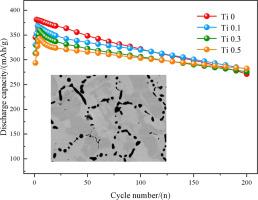
In this study, new AB4 type superlattice negative electrodes were developed with the elemental composition of La0.8-xTixMg0.2Ni3.96 (x = 0–0.5) through a process involving induction melting followed by annealing. A thorough investigation was conducted into the microstructure and electrochemical properties. The XRD analysis shows that the x = 0 alloy contained AB4 and 3R-A5B19 phases. After partial substitution of Ti 2H-A5B19 phase appeared, with Ti2Ni phase forming when x ≥ 0.3. Ti addition causes a preliminary rise followed by a decline in the quantity of the AB4 phase, a reduction in the amount of 3R-A5B19 phase, and a steady increase in the levels of 2H-A5B19 and Ti2Ni phases. Electrochemical tests revealed the maximum discharge capacity decreases, while the capacity retention rises. Moreover, the high-rate discharge ability falls as Ti substitution increases. The investigations reveal that the transfer of charge taking place on the alloy's surface significantly influences the kinetic properties of all sample electrodes.
期刊介绍:
Scripta Materialia is a LETTERS journal of Acta Materialia, providing a forum for the rapid publication of short communications on the relationship between the structure and the properties of inorganic materials. The emphasis is on originality rather than incremental research. Short reports on the development of materials with novel or substantially improved properties are also welcomed. Emphasis is on either the functional or mechanical behavior of metals, ceramics and semiconductors at all length scales.




 京公网安备 11010802042870号
京ICP备2023020795号-1
京公网安备 11010802042870号
京ICP备2023020795号-1

 分享
分享
 求助内容:
求助内容: 应助结果提醒方式:
 扫码关注我们
