Jiachen Sun , Fupeng Wang , Lin Zhang , Jiankun Shao
{"title":"一种用于双组分识别和浓度分析的新型光声气体传感器","authors":"Jiachen Sun , Fupeng Wang , Lin Zhang , Jiankun Shao","doi":"10.1016/j.infrared.2025.105711","DOIUrl":null,"url":null,"abstract":"<div><div>In this study, a neural network-assisted photoacoustic gas sensor is proposed that enables dual-component identification and concentration analysis of methane and ethylene, effectively addressing the issue of cross-interference in photoacoustic spectroscopy (PAS) technology. This sensor identifies the unknown photoacoustic second harmonic signal using a self-built photoacoustic deep neural network-component identification model, and then determines the composition of the gas sample. The traditional concentration fitting equation method and the self-built Photoacoustic Deep Neural Network-Concentration Regression Model are integrated to analyze the gas samples composed of single- and dual-component. The sensor demonstrates exceptionally high linearity, accuracy and robustness. Additionally, the minimum detection limits (MDLs) for a single-component are determined to be 0.28 ppm for methane and 1.56 ppm for ethylene. For dual-component detection, the MDLs are 8.86 ppm for methane and 4.55 ppm for ethylene. The promising results of the present study demonstrate that deep learning algorithm provides a more effective, accurate, and stable solution for elimination of cross-interference in photoacoustic gas sensor.</div></div>","PeriodicalId":13549,"journal":{"name":"Infrared Physics & Technology","volume":"145 ","pages":"Article 105711"},"PeriodicalIF":3.4000,"publicationDate":"2025-03-01","publicationTypes":"Journal Article","fieldsOfStudy":null,"isOpenAccess":false,"openAccessPdf":"","citationCount":"0","resultStr":"{\"title\":\"A novel photoacoustic gas sensor for dual-component identification and concentration analysis\",\"authors\":\"Jiachen Sun , Fupeng Wang , Lin Zhang , Jiankun Shao\",\"doi\":\"10.1016/j.infrared.2025.105711\",\"DOIUrl\":null,\"url\":null,\"abstract\":\"<div><div>In this study, a neural network-assisted photoacoustic gas sensor is proposed that enables dual-component identification and concentration analysis of methane and ethylene, effectively addressing the issue of cross-interference in photoacoustic spectroscopy (PAS) technology. This sensor identifies the unknown photoacoustic second harmonic signal using a self-built photoacoustic deep neural network-component identification model, and then determines the composition of the gas sample. The traditional concentration fitting equation method and the self-built Photoacoustic Deep Neural Network-Concentration Regression Model are integrated to analyze the gas samples composed of single- and dual-component. The sensor demonstrates exceptionally high linearity, accuracy and robustness. Additionally, the minimum detection limits (MDLs) for a single-component are determined to be 0.28 ppm for methane and 1.56 ppm for ethylene. For dual-component detection, the MDLs are 8.86 ppm for methane and 4.55 ppm for ethylene. The promising results of the present study demonstrate that deep learning algorithm provides a more effective, accurate, and stable solution for elimination of cross-interference in photoacoustic gas sensor.</div></div>\",\"PeriodicalId\":13549,\"journal\":{\"name\":\"Infrared Physics & Technology\",\"volume\":\"145 \",\"pages\":\"Article 105711\"},\"PeriodicalIF\":3.4000,\"publicationDate\":\"2025-03-01\",\"publicationTypes\":\"Journal Article\",\"fieldsOfStudy\":null,\"isOpenAccess\":false,\"openAccessPdf\":\"\",\"citationCount\":\"0\",\"resultStr\":null,\"platform\":\"Semanticscholar\",\"paperid\":null,\"PeriodicalName\":\"Infrared Physics & Technology\",\"FirstCategoryId\":\"101\",\"ListUrlMain\":\"https://www.sciencedirect.com/science/article/pii/S1350449525000040\",\"RegionNum\":3,\"RegionCategory\":\"物理与天体物理\",\"ArticlePicture\":[],\"TitleCN\":null,\"AbstractTextCN\":null,\"PMCID\":null,\"EPubDate\":\"2025/1/3 0:00:00\",\"PubModel\":\"Epub\",\"JCR\":\"Q2\",\"JCRName\":\"INSTRUMENTS & INSTRUMENTATION\",\"Score\":null,\"Total\":0}","platform":"Semanticscholar","paperid":null,"PeriodicalName":"Infrared Physics & Technology","FirstCategoryId":"101","ListUrlMain":"https://www.sciencedirect.com/science/article/pii/S1350449525000040","RegionNum":3,"RegionCategory":"物理与天体物理","ArticlePicture":[],"TitleCN":null,"AbstractTextCN":null,"PMCID":null,"EPubDate":"2025/1/3 0:00:00","PubModel":"Epub","JCR":"Q2","JCRName":"INSTRUMENTS & INSTRUMENTATION","Score":null,"Total":0}
A novel photoacoustic gas sensor for dual-component identification and concentration analysis
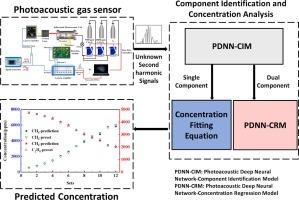
In this study, a neural network-assisted photoacoustic gas sensor is proposed that enables dual-component identification and concentration analysis of methane and ethylene, effectively addressing the issue of cross-interference in photoacoustic spectroscopy (PAS) technology. This sensor identifies the unknown photoacoustic second harmonic signal using a self-built photoacoustic deep neural network-component identification model, and then determines the composition of the gas sample. The traditional concentration fitting equation method and the self-built Photoacoustic Deep Neural Network-Concentration Regression Model are integrated to analyze the gas samples composed of single- and dual-component. The sensor demonstrates exceptionally high linearity, accuracy and robustness. Additionally, the minimum detection limits (MDLs) for a single-component are determined to be 0.28 ppm for methane and 1.56 ppm for ethylene. For dual-component detection, the MDLs are 8.86 ppm for methane and 4.55 ppm for ethylene. The promising results of the present study demonstrate that deep learning algorithm provides a more effective, accurate, and stable solution for elimination of cross-interference in photoacoustic gas sensor.
期刊介绍:
The Journal covers the entire field of infrared physics and technology: theory, experiment, application, devices and instrumentation. Infrared'' is defined as covering the near, mid and far infrared (terahertz) regions from 0.75um (750nm) to 1mm (300GHz.) Submissions in the 300GHz to 100GHz region may be accepted at the editors discretion if their content is relevant to shorter wavelengths. Submissions must be primarily concerned with and directly relevant to this spectral region.
Its core topics can be summarized as the generation, propagation and detection, of infrared radiation; the associated optics, materials and devices; and its use in all fields of science, industry, engineering and medicine.
Infrared techniques occur in many different fields, notably spectroscopy and interferometry; material characterization and processing; atmospheric physics, astronomy and space research. Scientific aspects include lasers, quantum optics, quantum electronics, image processing and semiconductor physics. Some important applications are medical diagnostics and treatment, industrial inspection and environmental monitoring.




 京公网安备 11010802042870号
京ICP备2023020795号-1
京公网安备 11010802042870号
京ICP备2023020795号-1

 分享
分享
 求助内容:
求助内容: 应助结果提醒方式:
 扫码关注我们
