{"title":"基于近红外光谱和迁移学习的茶叶分类方法","authors":"Long Liu , Bin Wang , Xiaoxuan Xu , Jing Xu","doi":"10.1016/j.infrared.2025.105713","DOIUrl":null,"url":null,"abstract":"<div><div>Tea is one of the most popular and widely consumed beverages worldwide, and accurately identifying its type is important for consumers. NIRS, a technology that uses near-infrared light for material analysis, is often employed for this purpose. Traditionally, automatic identification of NIRS has relied on classical machine learning methods. However, these conventional algorithms tend to lack accuracy when dealing with complex spectra. This article proposes a tea classification method based on a 1-dimensional residual network(1DResNet) model combined with transfer learning. The method is implemented in several steps. First, the 1DResNet model is pre-trained using a pre-training dataset. Then, the parameters of the feature extraction layers are frozen, and the model is fine-tuned using a fine-tuning dataset. Finally, the fine-tuned 1DResNet model is tested on a separate test dataset. Compared to traditional machine learning algorithms like Partial Least Squares Discriminant Analysis (PLS-DA), K-Nearest Neighbor (KNN), and Multilayer Perceptron (MLP), the fine-tuned 1DResNet model demonstrates significantly improved classification accuracy (by more than 4.32%). Furthermore, compared to a 1DResNet model without fine-tuning, accuracy improves by 4.96%. When compared to a fine-tuned 1-dimensional Convolutional Neural Network (1DCNN), the accuracy increases by 4%.This notable improvement highlights the potential of the fine-tuned 1DResNet model in handling complex spectral data. The method also performs well in transfer learning tasks; both black tea and green tea classification results demonstrate that the 1DResNet model with fine-tuning has strong potential for migration tasks. Overall, this classification method offers broader application prospects.</div></div>","PeriodicalId":13549,"journal":{"name":"Infrared Physics & Technology","volume":"145 ","pages":"Article 105713"},"PeriodicalIF":3.4000,"publicationDate":"2025-03-01","publicationTypes":"Journal Article","fieldsOfStudy":null,"isOpenAccess":false,"openAccessPdf":"","citationCount":"0","resultStr":"{\"title\":\"A tea classification method based on near infrared spectroscopy (NIRS) and transfer learning\",\"authors\":\"Long Liu , Bin Wang , Xiaoxuan Xu , Jing Xu\",\"doi\":\"10.1016/j.infrared.2025.105713\",\"DOIUrl\":null,\"url\":null,\"abstract\":\"<div><div>Tea is one of the most popular and widely consumed beverages worldwide, and accurately identifying its type is important for consumers. NIRS, a technology that uses near-infrared light for material analysis, is often employed for this purpose. Traditionally, automatic identification of NIRS has relied on classical machine learning methods. However, these conventional algorithms tend to lack accuracy when dealing with complex spectra. This article proposes a tea classification method based on a 1-dimensional residual network(1DResNet) model combined with transfer learning. The method is implemented in several steps. First, the 1DResNet model is pre-trained using a pre-training dataset. Then, the parameters of the feature extraction layers are frozen, and the model is fine-tuned using a fine-tuning dataset. Finally, the fine-tuned 1DResNet model is tested on a separate test dataset. Compared to traditional machine learning algorithms like Partial Least Squares Discriminant Analysis (PLS-DA), K-Nearest Neighbor (KNN), and Multilayer Perceptron (MLP), the fine-tuned 1DResNet model demonstrates significantly improved classification accuracy (by more than 4.32%). Furthermore, compared to a 1DResNet model without fine-tuning, accuracy improves by 4.96%. When compared to a fine-tuned 1-dimensional Convolutional Neural Network (1DCNN), the accuracy increases by 4%.This notable improvement highlights the potential of the fine-tuned 1DResNet model in handling complex spectral data. The method also performs well in transfer learning tasks; both black tea and green tea classification results demonstrate that the 1DResNet model with fine-tuning has strong potential for migration tasks. Overall, this classification method offers broader application prospects.</div></div>\",\"PeriodicalId\":13549,\"journal\":{\"name\":\"Infrared Physics & Technology\",\"volume\":\"145 \",\"pages\":\"Article 105713\"},\"PeriodicalIF\":3.4000,\"publicationDate\":\"2025-03-01\",\"publicationTypes\":\"Journal Article\",\"fieldsOfStudy\":null,\"isOpenAccess\":false,\"openAccessPdf\":\"\",\"citationCount\":\"0\",\"resultStr\":null,\"platform\":\"Semanticscholar\",\"paperid\":null,\"PeriodicalName\":\"Infrared Physics & Technology\",\"FirstCategoryId\":\"101\",\"ListUrlMain\":\"https://www.sciencedirect.com/science/article/pii/S1350449525000064\",\"RegionNum\":3,\"RegionCategory\":\"物理与天体物理\",\"ArticlePicture\":[],\"TitleCN\":null,\"AbstractTextCN\":null,\"PMCID\":null,\"EPubDate\":\"2025/1/3 0:00:00\",\"PubModel\":\"Epub\",\"JCR\":\"Q2\",\"JCRName\":\"INSTRUMENTS & INSTRUMENTATION\",\"Score\":null,\"Total\":0}","platform":"Semanticscholar","paperid":null,"PeriodicalName":"Infrared Physics & Technology","FirstCategoryId":"101","ListUrlMain":"https://www.sciencedirect.com/science/article/pii/S1350449525000064","RegionNum":3,"RegionCategory":"物理与天体物理","ArticlePicture":[],"TitleCN":null,"AbstractTextCN":null,"PMCID":null,"EPubDate":"2025/1/3 0:00:00","PubModel":"Epub","JCR":"Q2","JCRName":"INSTRUMENTS & INSTRUMENTATION","Score":null,"Total":0}
A tea classification method based on near infrared spectroscopy (NIRS) and transfer learning
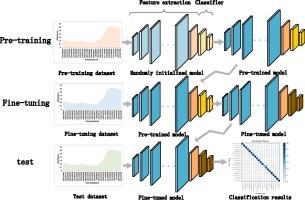
Tea is one of the most popular and widely consumed beverages worldwide, and accurately identifying its type is important for consumers. NIRS, a technology that uses near-infrared light for material analysis, is often employed for this purpose. Traditionally, automatic identification of NIRS has relied on classical machine learning methods. However, these conventional algorithms tend to lack accuracy when dealing with complex spectra. This article proposes a tea classification method based on a 1-dimensional residual network(1DResNet) model combined with transfer learning. The method is implemented in several steps. First, the 1DResNet model is pre-trained using a pre-training dataset. Then, the parameters of the feature extraction layers are frozen, and the model is fine-tuned using a fine-tuning dataset. Finally, the fine-tuned 1DResNet model is tested on a separate test dataset. Compared to traditional machine learning algorithms like Partial Least Squares Discriminant Analysis (PLS-DA), K-Nearest Neighbor (KNN), and Multilayer Perceptron (MLP), the fine-tuned 1DResNet model demonstrates significantly improved classification accuracy (by more than 4.32%). Furthermore, compared to a 1DResNet model without fine-tuning, accuracy improves by 4.96%. When compared to a fine-tuned 1-dimensional Convolutional Neural Network (1DCNN), the accuracy increases by 4%.This notable improvement highlights the potential of the fine-tuned 1DResNet model in handling complex spectral data. The method also performs well in transfer learning tasks; both black tea and green tea classification results demonstrate that the 1DResNet model with fine-tuning has strong potential for migration tasks. Overall, this classification method offers broader application prospects.
期刊介绍:
The Journal covers the entire field of infrared physics and technology: theory, experiment, application, devices and instrumentation. Infrared'' is defined as covering the near, mid and far infrared (terahertz) regions from 0.75um (750nm) to 1mm (300GHz.) Submissions in the 300GHz to 100GHz region may be accepted at the editors discretion if their content is relevant to shorter wavelengths. Submissions must be primarily concerned with and directly relevant to this spectral region.
Its core topics can be summarized as the generation, propagation and detection, of infrared radiation; the associated optics, materials and devices; and its use in all fields of science, industry, engineering and medicine.
Infrared techniques occur in many different fields, notably spectroscopy and interferometry; material characterization and processing; atmospheric physics, astronomy and space research. Scientific aspects include lasers, quantum optics, quantum electronics, image processing and semiconductor physics. Some important applications are medical diagnostics and treatment, industrial inspection and environmental monitoring.




 京公网安备 11010802042870号
京ICP备2023020795号-1
京公网安备 11010802042870号
京ICP备2023020795号-1

 分享
分享
 求助内容:
求助内容: 应助结果提醒方式:
 扫码关注我们
