{"title":"用氢取代石墨炔作为人工涂层改善锌/二氧化锰水溶液电池性能","authors":"Anirban Ghosh , Sourav Mahato , Anjan Chakraborty , Naresh Chandra Murmu , Tapas Kuila","doi":"10.1016/j.matchemphys.2025.130445","DOIUrl":null,"url":null,"abstract":"<div><div>Metallic Zn anode faces common problems of dendrite growth, severe hydrogen evolution reaction (HER), and self-corrosion in the aqueous environment of zinc-ion batteries (ZIBs), which eventually short circuits the battery and causes significant capacity loss. Among the various strategies to prevent the issues of ZIBs, the approach of in-situ synthesis of a conductive artificial layer is at the forefront. Herein, constructing a hydrogen-substituted graphdiyne (HGDY) interface using the modified Eglinton method on the Zn surface is proposed, which is highly feasible and can be attempted at ambient conditions. This strategy prolongs the lifespan of the symmetric cell to >1000 h, much higher than without protection (210 h). During practical use, the fabricated ZIB delivers a superior capacity of ∼295 mAh g<sup>−1</sup> at 0.2 A g<sup>−1</sup> and improved cycling performance due to the extensive π-conjugated system, hierarchical porous structure, and large surface area. These excellent electrochemical properties suggest that the H-substituted graphdiyne with porous carbon interface can be scaled up and used as a potential artificial coating on the surface of anode material for high-performance Zinc ion batteries.</div></div>","PeriodicalId":18227,"journal":{"name":"Materials Chemistry and Physics","volume":"334 ","pages":"Article 130445"},"PeriodicalIF":4.7000,"publicationDate":"2025-04-01","publicationTypes":"Journal Article","fieldsOfStudy":null,"isOpenAccess":false,"openAccessPdf":"","citationCount":"0","resultStr":"{\"title\":\"Improving performance of aqueous Zn//MnO2 battery using hydrogen-substituted graphdiyne as artificial coating\",\"authors\":\"Anirban Ghosh , Sourav Mahato , Anjan Chakraborty , Naresh Chandra Murmu , Tapas Kuila\",\"doi\":\"10.1016/j.matchemphys.2025.130445\",\"DOIUrl\":null,\"url\":null,\"abstract\":\"<div><div>Metallic Zn anode faces common problems of dendrite growth, severe hydrogen evolution reaction (HER), and self-corrosion in the aqueous environment of zinc-ion batteries (ZIBs), which eventually short circuits the battery and causes significant capacity loss. Among the various strategies to prevent the issues of ZIBs, the approach of in-situ synthesis of a conductive artificial layer is at the forefront. Herein, constructing a hydrogen-substituted graphdiyne (HGDY) interface using the modified Eglinton method on the Zn surface is proposed, which is highly feasible and can be attempted at ambient conditions. This strategy prolongs the lifespan of the symmetric cell to >1000 h, much higher than without protection (210 h). During practical use, the fabricated ZIB delivers a superior capacity of ∼295 mAh g<sup>−1</sup> at 0.2 A g<sup>−1</sup> and improved cycling performance due to the extensive π-conjugated system, hierarchical porous structure, and large surface area. These excellent electrochemical properties suggest that the H-substituted graphdiyne with porous carbon interface can be scaled up and used as a potential artificial coating on the surface of anode material for high-performance Zinc ion batteries.</div></div>\",\"PeriodicalId\":18227,\"journal\":{\"name\":\"Materials Chemistry and Physics\",\"volume\":\"334 \",\"pages\":\"Article 130445\"},\"PeriodicalIF\":4.7000,\"publicationDate\":\"2025-04-01\",\"publicationTypes\":\"Journal Article\",\"fieldsOfStudy\":null,\"isOpenAccess\":false,\"openAccessPdf\":\"\",\"citationCount\":\"0\",\"resultStr\":null,\"platform\":\"Semanticscholar\",\"paperid\":null,\"PeriodicalName\":\"Materials Chemistry and Physics\",\"FirstCategoryId\":\"88\",\"ListUrlMain\":\"https://www.sciencedirect.com/science/article/pii/S0254058425000914\",\"RegionNum\":3,\"RegionCategory\":\"材料科学\",\"ArticlePicture\":[],\"TitleCN\":null,\"AbstractTextCN\":null,\"PMCID\":null,\"EPubDate\":\"2025/1/23 0:00:00\",\"PubModel\":\"Epub\",\"JCR\":\"Q2\",\"JCRName\":\"MATERIALS SCIENCE, MULTIDISCIPLINARY\",\"Score\":null,\"Total\":0}","platform":"Semanticscholar","paperid":null,"PeriodicalName":"Materials Chemistry and Physics","FirstCategoryId":"88","ListUrlMain":"https://www.sciencedirect.com/science/article/pii/S0254058425000914","RegionNum":3,"RegionCategory":"材料科学","ArticlePicture":[],"TitleCN":null,"AbstractTextCN":null,"PMCID":null,"EPubDate":"2025/1/23 0:00:00","PubModel":"Epub","JCR":"Q2","JCRName":"MATERIALS SCIENCE, MULTIDISCIPLINARY","Score":null,"Total":0}
引用次数: 0
摘要
金属锌阳极在锌离子电池的水环境中存在枝晶生长、剧烈的析氢反应(HER)和自腐蚀等问题,最终导致电池短路,造成严重的容量损失。在防止ZIBs问题的各种策略中,原位合成导电人工层的方法处于最前沿。本文提出了利用改进的Eglinton方法在Zn表面构建氢取代石墨炔(HGDY)界面的方法,该方法具有很高的可行性,可以在环境条件下进行尝试。该策略将对称电池的寿命延长至1000小时,远高于无保护的210小时。在实际使用中,制造的ZIB在0.2 a g - 1时提供了优异的容量~ 295 mAh g - 1,并且由于广泛的π共轭体系,分层多孔结构和大表面积,提高了循环性能。这些优异的电化学性能表明,具有多孔碳界面的h-取代石墨炔可以扩大规模,作为高性能锌离子电池负极材料表面的人工涂层。
Improving performance of aqueous Zn//MnO2 battery using hydrogen-substituted graphdiyne as artificial coating
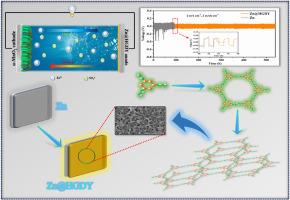
Metallic Zn anode faces common problems of dendrite growth, severe hydrogen evolution reaction (HER), and self-corrosion in the aqueous environment of zinc-ion batteries (ZIBs), which eventually short circuits the battery and causes significant capacity loss. Among the various strategies to prevent the issues of ZIBs, the approach of in-situ synthesis of a conductive artificial layer is at the forefront. Herein, constructing a hydrogen-substituted graphdiyne (HGDY) interface using the modified Eglinton method on the Zn surface is proposed, which is highly feasible and can be attempted at ambient conditions. This strategy prolongs the lifespan of the symmetric cell to >1000 h, much higher than without protection (210 h). During practical use, the fabricated ZIB delivers a superior capacity of ∼295 mAh g−1 at 0.2 A g−1 and improved cycling performance due to the extensive π-conjugated system, hierarchical porous structure, and large surface area. These excellent electrochemical properties suggest that the H-substituted graphdiyne with porous carbon interface can be scaled up and used as a potential artificial coating on the surface of anode material for high-performance Zinc ion batteries.
期刊介绍:
Materials Chemistry and Physics is devoted to short communications, full-length research papers and feature articles on interrelationships among structure, properties, processing and performance of materials. The Editors welcome manuscripts on thin films, surface and interface science, materials degradation and reliability, metallurgy, semiconductors and optoelectronic materials, fine ceramics, magnetics, superconductors, specialty polymers, nano-materials and composite materials.




 京公网安备 11010802042870号
京ICP备2023020795号-1
京公网安备 11010802042870号
京ICP备2023020795号-1

 分享
分享
 求助内容:
求助内容: 应助结果提醒方式:
 扫码关注我们
