{"title":"利用高效有机定向剂合成mse型沸石及其衍生的二氧化钛具有优异的催化性能","authors":"Shengxiang Zhang, Yuko Nishi, Kaisei Nakamura, Kai Okubo, Fumiya Takaoka, Issei Saita, Satoshi Inagaki, Yoshihiro Kubota","doi":"10.1016/j.micromeso.2024.113452","DOIUrl":null,"url":null,"abstract":"<div><div>The use of organic structure-directing agents (OSDAs) is effective in constructing zeolite frameworks with high hydrophobicity and thermal stability. Since OSDAs are guest molecules that stabilize cyclic hosts, designing guest molecules and realizing strong host-guest interactions is one of the reasonable strategies for controlling the structure of zeolites. A very powerful OSDA for the synthesis of <strong>MSE</strong>-type zeolite was designed and successfully prepared. When using conventional OSDA, TEBOP<sup>2+</sup>, more than 10 d of crystallization time was necessary to give the conventional <strong>MSE</strong>-type zeolite (=MCM-68), whereas the use of the new type of OSDA, CHDMP<sup>2+</sup>, gave another <strong>MSE</strong>-type zeolite (MSE<sub>CHDMP</sub>/STZ-1) within only 32 h of crystallization time. The computed values of stabilization energy showed that CHDMP<sup>2+</sup>-<strong>MSE</strong> composite was thermodynamically more stable than TEBOP<sup>2+</sup>-<strong>MSE</strong> composite, indicating the stronger host-guest interaction was realized by the CHDMP<sup>2+</sup>. Since CHDMP<sup>2+</sup> has a suitable C/N<sup>+</sup> value for the synthesis of high-silica zeolites, the strong host-guest interaction from the viewpoints of both geometry and hydrophobicity could cause frequent nucleation, giving the <strong>MSE</strong>-type zeolite with smaller crystals, i.e. STZ-1. The STZ-1 was thoroughly dealuminated and Ti atoms were introduced to the defect sites. Thus-obtained titanosilicate, Ti-STZ-1, was found to be an excellent catalyst for the phenol oxidation reaction. In particular, the total product yield and the <em>para</em>-selectivity were up to 92.2 % and 95.9 % in the presence of ethanol, respectively. Superior activity of Ti-STZ-1 to conventional Ti-MCM-68 was ascribed to smaller particle size caused by the stronger host-guest interaction between CHDMP<sup>2+</sup> and <strong>MSE</strong> framework.</div></div>","PeriodicalId":392,"journal":{"name":"Microporous and Mesoporous Materials","volume":"384 ","pages":"Article 113452"},"PeriodicalIF":4.7000,"publicationDate":"2025-02-15","publicationTypes":"Journal Article","fieldsOfStudy":null,"isOpenAccess":false,"openAccessPdf":"","citationCount":"0","resultStr":"{\"title\":\"Efficient synthesis of MSE-type zeolite using a highly effective organic structure-directing agent and excellent catalytic performance of its derived titanosilicate\",\"authors\":\"Shengxiang Zhang, Yuko Nishi, Kaisei Nakamura, Kai Okubo, Fumiya Takaoka, Issei Saita, Satoshi Inagaki, Yoshihiro Kubota\",\"doi\":\"10.1016/j.micromeso.2024.113452\",\"DOIUrl\":null,\"url\":null,\"abstract\":\"<div><div>The use of organic structure-directing agents (OSDAs) is effective in constructing zeolite frameworks with high hydrophobicity and thermal stability. Since OSDAs are guest molecules that stabilize cyclic hosts, designing guest molecules and realizing strong host-guest interactions is one of the reasonable strategies for controlling the structure of zeolites. A very powerful OSDA for the synthesis of <strong>MSE</strong>-type zeolite was designed and successfully prepared. When using conventional OSDA, TEBOP<sup>2+</sup>, more than 10 d of crystallization time was necessary to give the conventional <strong>MSE</strong>-type zeolite (=MCM-68), whereas the use of the new type of OSDA, CHDMP<sup>2+</sup>, gave another <strong>MSE</strong>-type zeolite (MSE<sub>CHDMP</sub>/STZ-1) within only 32 h of crystallization time. The computed values of stabilization energy showed that CHDMP<sup>2+</sup>-<strong>MSE</strong> composite was thermodynamically more stable than TEBOP<sup>2+</sup>-<strong>MSE</strong> composite, indicating the stronger host-guest interaction was realized by the CHDMP<sup>2+</sup>. Since CHDMP<sup>2+</sup> has a suitable C/N<sup>+</sup> value for the synthesis of high-silica zeolites, the strong host-guest interaction from the viewpoints of both geometry and hydrophobicity could cause frequent nucleation, giving the <strong>MSE</strong>-type zeolite with smaller crystals, i.e. STZ-1. The STZ-1 was thoroughly dealuminated and Ti atoms were introduced to the defect sites. Thus-obtained titanosilicate, Ti-STZ-1, was found to be an excellent catalyst for the phenol oxidation reaction. In particular, the total product yield and the <em>para</em>-selectivity were up to 92.2 % and 95.9 % in the presence of ethanol, respectively. Superior activity of Ti-STZ-1 to conventional Ti-MCM-68 was ascribed to smaller particle size caused by the stronger host-guest interaction between CHDMP<sup>2+</sup> and <strong>MSE</strong> framework.</div></div>\",\"PeriodicalId\":392,\"journal\":{\"name\":\"Microporous and Mesoporous Materials\",\"volume\":\"384 \",\"pages\":\"Article 113452\"},\"PeriodicalIF\":4.7000,\"publicationDate\":\"2025-02-15\",\"publicationTypes\":\"Journal Article\",\"fieldsOfStudy\":null,\"isOpenAccess\":false,\"openAccessPdf\":\"\",\"citationCount\":\"0\",\"resultStr\":null,\"platform\":\"Semanticscholar\",\"paperid\":null,\"PeriodicalName\":\"Microporous and Mesoporous Materials\",\"FirstCategoryId\":\"88\",\"ListUrlMain\":\"https://www.sciencedirect.com/science/article/pii/S1387181124004748\",\"RegionNum\":3,\"RegionCategory\":\"材料科学\",\"ArticlePicture\":[],\"TitleCN\":null,\"AbstractTextCN\":null,\"PMCID\":null,\"EPubDate\":\"2024/12/11 0:00:00\",\"PubModel\":\"Epub\",\"JCR\":\"Q1\",\"JCRName\":\"CHEMISTRY, APPLIED\",\"Score\":null,\"Total\":0}","platform":"Semanticscholar","paperid":null,"PeriodicalName":"Microporous and Mesoporous Materials","FirstCategoryId":"88","ListUrlMain":"https://www.sciencedirect.com/science/article/pii/S1387181124004748","RegionNum":3,"RegionCategory":"材料科学","ArticlePicture":[],"TitleCN":null,"AbstractTextCN":null,"PMCID":null,"EPubDate":"2024/12/11 0:00:00","PubModel":"Epub","JCR":"Q1","JCRName":"CHEMISTRY, APPLIED","Score":null,"Total":0}
Efficient synthesis of MSE-type zeolite using a highly effective organic structure-directing agent and excellent catalytic performance of its derived titanosilicate
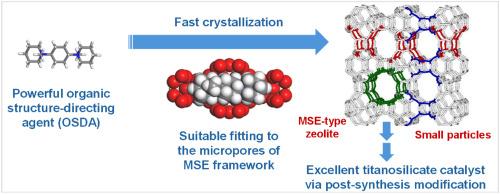
The use of organic structure-directing agents (OSDAs) is effective in constructing zeolite frameworks with high hydrophobicity and thermal stability. Since OSDAs are guest molecules that stabilize cyclic hosts, designing guest molecules and realizing strong host-guest interactions is one of the reasonable strategies for controlling the structure of zeolites. A very powerful OSDA for the synthesis of MSE-type zeolite was designed and successfully prepared. When using conventional OSDA, TEBOP2+, more than 10 d of crystallization time was necessary to give the conventional MSE-type zeolite (=MCM-68), whereas the use of the new type of OSDA, CHDMP2+, gave another MSE-type zeolite (MSECHDMP/STZ-1) within only 32 h of crystallization time. The computed values of stabilization energy showed that CHDMP2+-MSE composite was thermodynamically more stable than TEBOP2+-MSE composite, indicating the stronger host-guest interaction was realized by the CHDMP2+. Since CHDMP2+ has a suitable C/N+ value for the synthesis of high-silica zeolites, the strong host-guest interaction from the viewpoints of both geometry and hydrophobicity could cause frequent nucleation, giving the MSE-type zeolite with smaller crystals, i.e. STZ-1. The STZ-1 was thoroughly dealuminated and Ti atoms were introduced to the defect sites. Thus-obtained titanosilicate, Ti-STZ-1, was found to be an excellent catalyst for the phenol oxidation reaction. In particular, the total product yield and the para-selectivity were up to 92.2 % and 95.9 % in the presence of ethanol, respectively. Superior activity of Ti-STZ-1 to conventional Ti-MCM-68 was ascribed to smaller particle size caused by the stronger host-guest interaction between CHDMP2+ and MSE framework.
期刊介绍:
Microporous and Mesoporous Materials covers novel and significant aspects of porous solids classified as either microporous (pore size up to 2 nm) or mesoporous (pore size 2 to 50 nm). The porosity should have a specific impact on the material properties or application. Typical examples are zeolites and zeolite-like materials, pillared materials, clathrasils and clathrates, carbon molecular sieves, ordered mesoporous materials, organic/inorganic porous hybrid materials, or porous metal oxides. Both natural and synthetic porous materials are within the scope of the journal.
Topics which are particularly of interest include:
All aspects of natural microporous and mesoporous solids
The synthesis of crystalline or amorphous porous materials
The physico-chemical characterization of microporous and mesoporous solids, especially spectroscopic and microscopic
The modification of microporous and mesoporous solids, for example by ion exchange or solid-state reactions
All topics related to diffusion of mobile species in the pores of microporous and mesoporous materials
Adsorption (and other separation techniques) using microporous or mesoporous adsorbents
Catalysis by microporous and mesoporous materials
Host/guest interactions
Theoretical chemistry and modelling of host/guest interactions
All topics related to the application of microporous and mesoporous materials in industrial catalysis, separation technology, environmental protection, electrochemistry, membranes, sensors, optical devices, etc.




 京公网安备 11010802042870号
京ICP备2023020795号-1
京公网安备 11010802042870号
京ICP备2023020795号-1

 分享
分享
 求助内容:
求助内容: 应助结果提醒方式:
 扫码关注我们
