Andrey S. Barbosa , Ana Laura G. Biancolli , Bianca P.S. Santos , Jean-Jacques Bonvent , Daniel Hermida-Merino , Elisabete I. Santiago
{"title":"辐射诱导接枝阴离子交换膜的研究进展:控制高密度聚乙烯辐照前参数以提高燃料电池性能和耐久性","authors":"Andrey S. Barbosa , Ana Laura G. Biancolli , Bianca P.S. Santos , Jean-Jacques Bonvent , Daniel Hermida-Merino , Elisabete I. Santiago","doi":"10.1016/j.reactfunctpolym.2025.106149","DOIUrl":null,"url":null,"abstract":"<div><div>Manufacturing anion-exchange membranes (AEMs) with high durability is a current challenge for low-temperature alkaline fuel cells. In this work, a series of AEMs based on high-density polyethylene (HDPE) is synthetized by radiation-induced grafting (RIG) method considering various pre-irradiation conditions, such as temperature and atmosphere. The AEMs are extensively characterized, including assessments of the degree of grafting (DoG), ion-exchange capacity (IEC), water absorption properties, and hydroxide conductivity. Additionally, their molecular structure and thermal and mechanical properties are evaluated. Techniques, such as atomic force microscopy (AFM) and synchrotron small angle x-ray scattering (SAXS), are employed for analysis of AEMs morphology. Finally, the AEMs are applied in an H<sub>2</sub>-O<sub>2</sub> anion-exchange membrane fuel cell (AEMFC) and subjected to a short-term stability test. Among the tested AEMs, the one pre-irradiated at low temperature (−10 °C) and air atmosphere exhibits excellent AEMFC performance of 2.1 W cm<sup>−2</sup>. This sample possesses high OH<sup>−</sup> conductivity of 208 mS cm<sup>−1</sup> at 80 °C, and the stability test shows a conductivity loss of −0.06 % h<sup>−1</sup> during 100 h under reduced relative humidity (80 %). Applying an accurate protocol for controlling pre-irradiation parameters can effectively reduce the irradiation degradation effects.</div></div>","PeriodicalId":20916,"journal":{"name":"Reactive & Functional Polymers","volume":"208 ","pages":"Article 106149"},"PeriodicalIF":5.1000,"publicationDate":"2025-03-01","publicationTypes":"Journal Article","fieldsOfStudy":null,"isOpenAccess":false,"openAccessPdf":"","citationCount":"0","resultStr":"{\"title\":\"Advancements in radiation-induced grafted anion-exchange membranes: Controlling pre-irradiation parameters of high-density polyethylene for enhanced fuel cell performance and durability\",\"authors\":\"Andrey S. Barbosa , Ana Laura G. Biancolli , Bianca P.S. Santos , Jean-Jacques Bonvent , Daniel Hermida-Merino , Elisabete I. Santiago\",\"doi\":\"10.1016/j.reactfunctpolym.2025.106149\",\"DOIUrl\":null,\"url\":null,\"abstract\":\"<div><div>Manufacturing anion-exchange membranes (AEMs) with high durability is a current challenge for low-temperature alkaline fuel cells. In this work, a series of AEMs based on high-density polyethylene (HDPE) is synthetized by radiation-induced grafting (RIG) method considering various pre-irradiation conditions, such as temperature and atmosphere. The AEMs are extensively characterized, including assessments of the degree of grafting (DoG), ion-exchange capacity (IEC), water absorption properties, and hydroxide conductivity. Additionally, their molecular structure and thermal and mechanical properties are evaluated. Techniques, such as atomic force microscopy (AFM) and synchrotron small angle x-ray scattering (SAXS), are employed for analysis of AEMs morphology. Finally, the AEMs are applied in an H<sub>2</sub>-O<sub>2</sub> anion-exchange membrane fuel cell (AEMFC) and subjected to a short-term stability test. Among the tested AEMs, the one pre-irradiated at low temperature (−10 °C) and air atmosphere exhibits excellent AEMFC performance of 2.1 W cm<sup>−2</sup>. This sample possesses high OH<sup>−</sup> conductivity of 208 mS cm<sup>−1</sup> at 80 °C, and the stability test shows a conductivity loss of −0.06 % h<sup>−1</sup> during 100 h under reduced relative humidity (80 %). Applying an accurate protocol for controlling pre-irradiation parameters can effectively reduce the irradiation degradation effects.</div></div>\",\"PeriodicalId\":20916,\"journal\":{\"name\":\"Reactive & Functional Polymers\",\"volume\":\"208 \",\"pages\":\"Article 106149\"},\"PeriodicalIF\":5.1000,\"publicationDate\":\"2025-03-01\",\"publicationTypes\":\"Journal Article\",\"fieldsOfStudy\":null,\"isOpenAccess\":false,\"openAccessPdf\":\"\",\"citationCount\":\"0\",\"resultStr\":null,\"platform\":\"Semanticscholar\",\"paperid\":null,\"PeriodicalName\":\"Reactive & Functional Polymers\",\"FirstCategoryId\":\"5\",\"ListUrlMain\":\"https://www.sciencedirect.com/science/article/pii/S138151482500001X\",\"RegionNum\":3,\"RegionCategory\":\"工程技术\",\"ArticlePicture\":[],\"TitleCN\":null,\"AbstractTextCN\":null,\"PMCID\":null,\"EPubDate\":\"2025/1/9 0:00:00\",\"PubModel\":\"Epub\",\"JCR\":\"Q1\",\"JCRName\":\"CHEMISTRY, APPLIED\",\"Score\":null,\"Total\":0}","platform":"Semanticscholar","paperid":null,"PeriodicalName":"Reactive & Functional Polymers","FirstCategoryId":"5","ListUrlMain":"https://www.sciencedirect.com/science/article/pii/S138151482500001X","RegionNum":3,"RegionCategory":"工程技术","ArticlePicture":[],"TitleCN":null,"AbstractTextCN":null,"PMCID":null,"EPubDate":"2025/1/9 0:00:00","PubModel":"Epub","JCR":"Q1","JCRName":"CHEMISTRY, APPLIED","Score":null,"Total":0}
引用次数: 0
摘要
制造具有高耐久性的阴离子交换膜(AEMs)是目前低温碱性燃料电池面临的挑战。在本工作中,考虑不同的辐照前条件,如温度和气氛,采用辐射诱导接枝(RIG)方法合成了一系列基于高密度聚乙烯(HDPE)的AEMs。对AEMs进行了广泛的表征,包括接枝度(DoG)、离子交换容量(IEC)、吸水性能和氢氧化物电导率的评估。此外,还评估了它们的分子结构和热力学性能。原子力显微镜(AFM)和同步小角x射线散射(SAXS)等技术被用于分析AEMs的形貌。最后,将AEMs应用于H2-O2阴离子交换膜燃料电池(AEMFC),并进行了短期稳定性测试。在低温(- 10°C)和空气环境下预辐照的AEMFC表现出2.1 W cm−2的优异性能。该样品在80°C时具有208 mS cm−1的高OH -电导率,稳定性测试表明,在降低相对湿度(80%)的100小时内,电导率损失为- 0.06% h−1。采用精确的方案控制辐照前参数可有效降低辐照降解效应。
Advancements in radiation-induced grafted anion-exchange membranes: Controlling pre-irradiation parameters of high-density polyethylene for enhanced fuel cell performance and durability
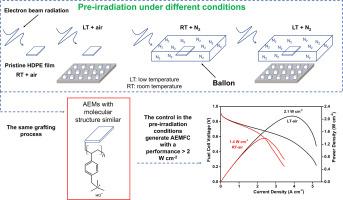
Manufacturing anion-exchange membranes (AEMs) with high durability is a current challenge for low-temperature alkaline fuel cells. In this work, a series of AEMs based on high-density polyethylene (HDPE) is synthetized by radiation-induced grafting (RIG) method considering various pre-irradiation conditions, such as temperature and atmosphere. The AEMs are extensively characterized, including assessments of the degree of grafting (DoG), ion-exchange capacity (IEC), water absorption properties, and hydroxide conductivity. Additionally, their molecular structure and thermal and mechanical properties are evaluated. Techniques, such as atomic force microscopy (AFM) and synchrotron small angle x-ray scattering (SAXS), are employed for analysis of AEMs morphology. Finally, the AEMs are applied in an H2-O2 anion-exchange membrane fuel cell (AEMFC) and subjected to a short-term stability test. Among the tested AEMs, the one pre-irradiated at low temperature (−10 °C) and air atmosphere exhibits excellent AEMFC performance of 2.1 W cm−2. This sample possesses high OH− conductivity of 208 mS cm−1 at 80 °C, and the stability test shows a conductivity loss of −0.06 % h−1 during 100 h under reduced relative humidity (80 %). Applying an accurate protocol for controlling pre-irradiation parameters can effectively reduce the irradiation degradation effects.
期刊介绍:
Reactive & Functional Polymers provides a forum to disseminate original ideas, concepts and developments in the science and technology of polymers with functional groups, which impart specific chemical reactivity or physical, chemical, structural, biological, and pharmacological functionality. The scope covers organic polymers, acting for instance as reagents, catalysts, templates, ion-exchangers, selective sorbents, chelating or antimicrobial agents, drug carriers, sensors, membranes, and hydrogels. This also includes reactive cross-linkable prepolymers and high-performance thermosetting polymers, natural or degradable polymers, conducting polymers, and porous polymers.
Original research articles must contain thorough molecular and material characterization data on synthesis of the above polymers in combination with their applications. Applications include but are not limited to catalysis, water or effluent treatment, separations and recovery, electronics and information storage, energy conversion, encapsulation, or adhesion.




 京公网安备 11010802042870号
京ICP备2023020795号-1
京公网安备 11010802042870号
京ICP备2023020795号-1

 分享
分享
 求助内容:
求助内容: 应助结果提醒方式:
 扫码关注我们
