Jesús Manuel Núñez-López , Juan Gabriel Segovia-Hernández , Eduardo Sánchez-Ramírez , José María Ponce-Ortega
{"title":"集成元启发式方法和确定性策略的过程工程供应链设备优化设计","authors":"Jesús Manuel Núñez-López , Juan Gabriel Segovia-Hernández , Eduardo Sánchez-Ramírez , José María Ponce-Ortega","doi":"10.1016/j.cherd.2024.12.021","DOIUrl":null,"url":null,"abstract":"<div><div>In recent years, the escalating use of supply chains in process engineering has highlighted the need for efficient regional resource distribution. Traditionally, supply chains are designed through deterministic optimization models. However, these models require significant simplifications to mathematically represent the equipment design in these supply chains because of the complexity and nonlinearity these formulations bring to the problem, often leading to suboptimal solutions. This work proposes a novel methodology integrating deterministic and metaheuristic optimization techniques to address this challenge comprehensively. By combining these methods, the approach optimizes supply chain logistics and equipment design, enhancing overall performance, cost-efficiency, and sustainability. A case study on the polystyrene supply chain in Mexico demonstrates the effectiveness of our strategy, showcasing significant economic, environmental, and operational benefits. Two different schemes were used, a direct separation sequence and an indirect separation sequence. The results show that the direct separation sequence is better both economically and environmentally, due to the high energy consumption of the indirect separation. This integrated approach offers a robust mathematical tool for decision-making, setting a new standard in supply chain optimization.</div></div>","PeriodicalId":10019,"journal":{"name":"Chemical Engineering Research & Design","volume":"214 ","pages":"Pages 93-104"},"PeriodicalIF":3.9000,"publicationDate":"2025-02-01","publicationTypes":"Journal Article","fieldsOfStudy":null,"isOpenAccess":false,"openAccessPdf":"","citationCount":"0","resultStr":"{\"title\":\"Integrating metaheuristic methods and deterministic strategies for optimizing supply chain equipment design in process engineering\",\"authors\":\"Jesús Manuel Núñez-López , Juan Gabriel Segovia-Hernández , Eduardo Sánchez-Ramírez , José María Ponce-Ortega\",\"doi\":\"10.1016/j.cherd.2024.12.021\",\"DOIUrl\":null,\"url\":null,\"abstract\":\"<div><div>In recent years, the escalating use of supply chains in process engineering has highlighted the need for efficient regional resource distribution. Traditionally, supply chains are designed through deterministic optimization models. However, these models require significant simplifications to mathematically represent the equipment design in these supply chains because of the complexity and nonlinearity these formulations bring to the problem, often leading to suboptimal solutions. This work proposes a novel methodology integrating deterministic and metaheuristic optimization techniques to address this challenge comprehensively. By combining these methods, the approach optimizes supply chain logistics and equipment design, enhancing overall performance, cost-efficiency, and sustainability. A case study on the polystyrene supply chain in Mexico demonstrates the effectiveness of our strategy, showcasing significant economic, environmental, and operational benefits. Two different schemes were used, a direct separation sequence and an indirect separation sequence. The results show that the direct separation sequence is better both economically and environmentally, due to the high energy consumption of the indirect separation. This integrated approach offers a robust mathematical tool for decision-making, setting a new standard in supply chain optimization.</div></div>\",\"PeriodicalId\":10019,\"journal\":{\"name\":\"Chemical Engineering Research & Design\",\"volume\":\"214 \",\"pages\":\"Pages 93-104\"},\"PeriodicalIF\":3.9000,\"publicationDate\":\"2025-02-01\",\"publicationTypes\":\"Journal Article\",\"fieldsOfStudy\":null,\"isOpenAccess\":false,\"openAccessPdf\":\"\",\"citationCount\":\"0\",\"resultStr\":null,\"platform\":\"Semanticscholar\",\"paperid\":null,\"PeriodicalName\":\"Chemical Engineering Research & Design\",\"FirstCategoryId\":\"5\",\"ListUrlMain\":\"https://www.sciencedirect.com/science/article/pii/S0263876224007007\",\"RegionNum\":3,\"RegionCategory\":\"工程技术\",\"ArticlePicture\":[],\"TitleCN\":null,\"AbstractTextCN\":null,\"PMCID\":null,\"EPubDate\":\"2024/12/26 0:00:00\",\"PubModel\":\"Epub\",\"JCR\":\"Q2\",\"JCRName\":\"ENGINEERING, CHEMICAL\",\"Score\":null,\"Total\":0}","platform":"Semanticscholar","paperid":null,"PeriodicalName":"Chemical Engineering Research & Design","FirstCategoryId":"5","ListUrlMain":"https://www.sciencedirect.com/science/article/pii/S0263876224007007","RegionNum":3,"RegionCategory":"工程技术","ArticlePicture":[],"TitleCN":null,"AbstractTextCN":null,"PMCID":null,"EPubDate":"2024/12/26 0:00:00","PubModel":"Epub","JCR":"Q2","JCRName":"ENGINEERING, CHEMICAL","Score":null,"Total":0}
Integrating metaheuristic methods and deterministic strategies for optimizing supply chain equipment design in process engineering
In recent years, the escalating use of supply chains in process engineering has highlighted the need for efficient regional resource distribution. Traditionally, supply chains are designed through deterministic optimization models. However, these models require significant simplifications to mathematically represent the equipment design in these supply chains because of the complexity and nonlinearity these formulations bring to the problem, often leading to suboptimal solutions. This work proposes a novel methodology integrating deterministic and metaheuristic optimization techniques to address this challenge comprehensively. By combining these methods, the approach optimizes supply chain logistics and equipment design, enhancing overall performance, cost-efficiency, and sustainability. A case study on the polystyrene supply chain in Mexico demonstrates the effectiveness of our strategy, showcasing significant economic, environmental, and operational benefits. Two different schemes were used, a direct separation sequence and an indirect separation sequence. The results show that the direct separation sequence is better both economically and environmentally, due to the high energy consumption of the indirect separation. This integrated approach offers a robust mathematical tool for decision-making, setting a new standard in supply chain optimization.
期刊介绍:
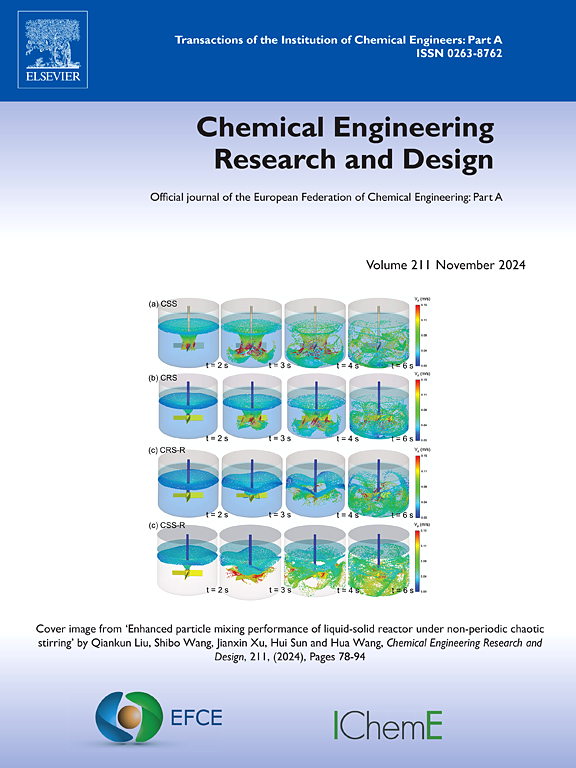
ChERD aims to be the principal international journal for publication of high quality, original papers in chemical engineering.
Papers showing how research results can be used in chemical engineering design, and accounts of experimental or theoretical research work bringing new perspectives to established principles, highlighting unsolved problems or indicating directions for future research, are particularly welcome. Contributions that deal with new developments in plant or processes and that can be given quantitative expression are encouraged. The journal is especially interested in papers that extend the boundaries of traditional chemical engineering.




 京公网安备 11010802042870号
京ICP备2023020795号-1
京公网安备 11010802042870号
京ICP备2023020795号-1

 分享
分享
 求助内容:
求助内容: 应助结果提醒方式:
 扫码关注我们
