G. Jovarauskaite , G. Monastyreckis , L. Mishnaevsky Jr. , D. Zeleniakiene
{"title":"基于三维碳纤维网格的自感知复合材料损伤映射","authors":"G. Jovarauskaite , G. Monastyreckis , L. Mishnaevsky Jr. , D. Zeleniakiene","doi":"10.1016/j.compositesb.2025.112182","DOIUrl":null,"url":null,"abstract":"<div><div>Self-sensing composites are becoming a technological breakthrough in structural health monitoring of aircraft structures and wind turbine blades. In this study, sandwich-structured composites are developed with intersecting and non-intersecting 3D carbon fibre grids. Damage sensing of the first type is based on the integrity of fibre-to-fibre contacts. The second type is based on the carbon nanotube-modified glass fibre plies, working as a conducting layer for the non-intersecting carbon fibre grid. The experimental section consists of indentation, impact and delamination tests. The damage area and size are determined from the local electrical resistance deviation. Sensitivity results are compared between samples with 0.1–0.5 wt% carbon nanotube concentrations. Additionally, the method is supported by numerical analysis of electric potential gradient using finite element modelling. This innovative approach demonstrates the feasibility of using self-sensing composites for potential remote SHM applications. While further work is required to validate the method's accuracy and effectiveness under real-world conditions, the results highlight its potential to identify core indentation, puncture damage, and interlaminar delamination without external sensors, offering significant safety and maintenance planning advancements.</div></div>","PeriodicalId":10660,"journal":{"name":"Composites Part B: Engineering","volume":"295 ","pages":"Article 112182"},"PeriodicalIF":14.0000,"publicationDate":"2025-04-15","publicationTypes":"Journal Article","fieldsOfStudy":null,"isOpenAccess":false,"openAccessPdf":"","citationCount":"0","resultStr":"{\"title\":\"Self-sensing composites with damage mapping using 3D carbon fibre grid\",\"authors\":\"G. Jovarauskaite , G. Monastyreckis , L. Mishnaevsky Jr. , D. Zeleniakiene\",\"doi\":\"10.1016/j.compositesb.2025.112182\",\"DOIUrl\":null,\"url\":null,\"abstract\":\"<div><div>Self-sensing composites are becoming a technological breakthrough in structural health monitoring of aircraft structures and wind turbine blades. In this study, sandwich-structured composites are developed with intersecting and non-intersecting 3D carbon fibre grids. Damage sensing of the first type is based on the integrity of fibre-to-fibre contacts. The second type is based on the carbon nanotube-modified glass fibre plies, working as a conducting layer for the non-intersecting carbon fibre grid. The experimental section consists of indentation, impact and delamination tests. The damage area and size are determined from the local electrical resistance deviation. Sensitivity results are compared between samples with 0.1–0.5 wt% carbon nanotube concentrations. Additionally, the method is supported by numerical analysis of electric potential gradient using finite element modelling. This innovative approach demonstrates the feasibility of using self-sensing composites for potential remote SHM applications. While further work is required to validate the method's accuracy and effectiveness under real-world conditions, the results highlight its potential to identify core indentation, puncture damage, and interlaminar delamination without external sensors, offering significant safety and maintenance planning advancements.</div></div>\",\"PeriodicalId\":10660,\"journal\":{\"name\":\"Composites Part B: Engineering\",\"volume\":\"295 \",\"pages\":\"Article 112182\"},\"PeriodicalIF\":14.0000,\"publicationDate\":\"2025-04-15\",\"publicationTypes\":\"Journal Article\",\"fieldsOfStudy\":null,\"isOpenAccess\":false,\"openAccessPdf\":\"\",\"citationCount\":\"0\",\"resultStr\":null,\"platform\":\"Semanticscholar\",\"paperid\":null,\"PeriodicalName\":\"Composites Part B: Engineering\",\"FirstCategoryId\":\"5\",\"ListUrlMain\":\"https://www.sciencedirect.com/science/article/pii/S1359836825000721\",\"RegionNum\":1,\"RegionCategory\":\"材料科学\",\"ArticlePicture\":[],\"TitleCN\":null,\"AbstractTextCN\":null,\"PMCID\":null,\"EPubDate\":\"2025/1/28 0:00:00\",\"PubModel\":\"Epub\",\"JCR\":\"Q1\",\"JCRName\":\"ENGINEERING, MULTIDISCIPLINARY\",\"Score\":null,\"Total\":0}","platform":"Semanticscholar","paperid":null,"PeriodicalName":"Composites Part B: Engineering","FirstCategoryId":"5","ListUrlMain":"https://www.sciencedirect.com/science/article/pii/S1359836825000721","RegionNum":1,"RegionCategory":"材料科学","ArticlePicture":[],"TitleCN":null,"AbstractTextCN":null,"PMCID":null,"EPubDate":"2025/1/28 0:00:00","PubModel":"Epub","JCR":"Q1","JCRName":"ENGINEERING, MULTIDISCIPLINARY","Score":null,"Total":0}
Self-sensing composites with damage mapping using 3D carbon fibre grid
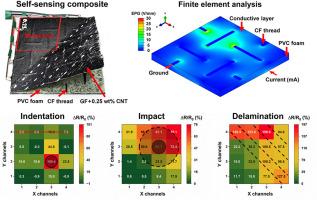
Self-sensing composites are becoming a technological breakthrough in structural health monitoring of aircraft structures and wind turbine blades. In this study, sandwich-structured composites are developed with intersecting and non-intersecting 3D carbon fibre grids. Damage sensing of the first type is based on the integrity of fibre-to-fibre contacts. The second type is based on the carbon nanotube-modified glass fibre plies, working as a conducting layer for the non-intersecting carbon fibre grid. The experimental section consists of indentation, impact and delamination tests. The damage area and size are determined from the local electrical resistance deviation. Sensitivity results are compared between samples with 0.1–0.5 wt% carbon nanotube concentrations. Additionally, the method is supported by numerical analysis of electric potential gradient using finite element modelling. This innovative approach demonstrates the feasibility of using self-sensing composites for potential remote SHM applications. While further work is required to validate the method's accuracy and effectiveness under real-world conditions, the results highlight its potential to identify core indentation, puncture damage, and interlaminar delamination without external sensors, offering significant safety and maintenance planning advancements.
期刊介绍:
Composites Part B: Engineering is a journal that publishes impactful research of high quality on composite materials. This research is supported by fundamental mechanics and materials science and engineering approaches. The targeted research can cover a wide range of length scales, ranging from nano to micro and meso, and even to the full product and structure level. The journal specifically focuses on engineering applications that involve high performance composites. These applications can range from low volume and high cost to high volume and low cost composite development.
The main goal of the journal is to provide a platform for the prompt publication of original and high quality research. The emphasis is on design, development, modeling, validation, and manufacturing of engineering details and concepts. The journal welcomes both basic research papers and proposals for review articles. Authors are encouraged to address challenges across various application areas. These areas include, but are not limited to, aerospace, automotive, and other surface transportation. The journal also covers energy-related applications, with a focus on renewable energy. Other application areas include infrastructure, off-shore and maritime projects, health care technology, and recreational products.





 京公网安备 11010802042870号
京ICP备2023020795号-1
京公网安备 11010802042870号
京ICP备2023020795号-1

 分享
分享
 求助内容:
求助内容: 应助结果提醒方式:
 扫码关注我们
