Saad Shaaban , Kamal Shalabi , Tarek A. Yousef , Ghayah M. Alsulaim , Mohamed Alaasar , Ahmed M. Abu-Dief , Ahmed S.M. Al-Janabi
{"title":"新型有机硒化物作为N80钢在3.5 wt%氯化钠溶液中的高效缓蚀剂","authors":"Saad Shaaban , Kamal Shalabi , Tarek A. Yousef , Ghayah M. Alsulaim , Mohamed Alaasar , Ahmed M. Abu-Dief , Ahmed S.M. Al-Janabi","doi":"10.1016/j.inoche.2024.113632","DOIUrl":null,"url":null,"abstract":"<div><div>New organoselenium-containing Schiff base (<strong>MSeOH</strong>) and its Ni (II) chelate <strong>[Ni(MSeO)<sub>2</sub>(H<sub>2</sub>O)<sub>2</sub>]</strong> were synthesized and characterized. Their corrosion inhibition was investigated toward N80 steel in a 3.5 % NaCl solution. Their corrosion inhibition mechanism was investigated for the N80 steel in 3.5 % NaCl solution using different techniques, including electrochemical impedance spectroscopy (EIS), X-ray photoelectron spectroscopy (XPS), scanning electron microscope (SEM), potentiodynamic polarization (PDP), density functional theory (DFT), and Monte Carlo (MC) simulations. The electrochemical studies demonstrated high protection efficiencies (up to 96.9 %) of 8.0 × 10<sup>−5</sup> M concentration. The <strong>[Ni(MSeO)<sub>2</sub>(H<sub>2</sub>O)<sub>2</sub>]</strong> exhibited superior corrosion inhibition efficiency compared to the ligand <strong>MSeOH</strong>. The additives on the corrosion solution manifested a significant influence, particularly on the anodic (βa) and cathodic (βc) Tafel slopes, proposing a mixed-type inhibition, reducing the anodic and cathodic reactions. The spontaneous adsorption of <strong>MSeOH</strong> and <strong>[Ni(MSeO)<sub>2</sub>(H<sub>2</sub>O)<sub>2</sub>]</strong> on the steel’s surface, conforming to the Langmuir adsorption isotherm, was substantiated by the increase in charge transfer resistance (R<sub>ct</sub>) and the decrease in the constant phase element (Y<sub>0</sub>) admittance values, evidencing the adsorption of <strong>MSeOH</strong> and <strong>[Ni(MSeO)<sub>2</sub>(H<sub>2</sub>O)<sub>2</sub>]</strong> molecules on the N80 steel surface, which was further corroborated by XPS and |SEM analysis. Moreover, DFT results showed that the <strong>[Ni(MSeO)<sub>2</sub>(H<sub>2</sub>O)<sub>2</sub>]</strong> complex has a high HOMO energy level, thus indicating high inhibition efficiency. On the other hand, a low LUMO energy level suggested the ease of electron acceptance by the vacant d-orbitals of the Ni(II) metal, promoting the formation of covalent bonds between the organic molecule and the metal center. Moreover, MC simulations substantiated the appropriate alignment of the inhibitor molecules in a flat orientation on the steel surface, thereby enhancing optimal surface coverage.</div></div>","PeriodicalId":13609,"journal":{"name":"Inorganic Chemistry Communications","volume":"172 ","pages":"Article 113632"},"PeriodicalIF":5.4000,"publicationDate":"2025-02-01","publicationTypes":"Journal Article","fieldsOfStudy":null,"isOpenAccess":false,"openAccessPdf":"","citationCount":"0","resultStr":"{\"title\":\"Novel organoselenides as efficient corrosion inhibitors for N80 steel in a 3.5 wt% sodium chloride solution\",\"authors\":\"Saad Shaaban , Kamal Shalabi , Tarek A. Yousef , Ghayah M. Alsulaim , Mohamed Alaasar , Ahmed M. Abu-Dief , Ahmed S.M. Al-Janabi\",\"doi\":\"10.1016/j.inoche.2024.113632\",\"DOIUrl\":null,\"url\":null,\"abstract\":\"<div><div>New organoselenium-containing Schiff base (<strong>MSeOH</strong>) and its Ni (II) chelate <strong>[Ni(MSeO)<sub>2</sub>(H<sub>2</sub>O)<sub>2</sub>]</strong> were synthesized and characterized. Their corrosion inhibition was investigated toward N80 steel in a 3.5 % NaCl solution. Their corrosion inhibition mechanism was investigated for the N80 steel in 3.5 % NaCl solution using different techniques, including electrochemical impedance spectroscopy (EIS), X-ray photoelectron spectroscopy (XPS), scanning electron microscope (SEM), potentiodynamic polarization (PDP), density functional theory (DFT), and Monte Carlo (MC) simulations. The electrochemical studies demonstrated high protection efficiencies (up to 96.9 %) of 8.0 × 10<sup>−5</sup> M concentration. The <strong>[Ni(MSeO)<sub>2</sub>(H<sub>2</sub>O)<sub>2</sub>]</strong> exhibited superior corrosion inhibition efficiency compared to the ligand <strong>MSeOH</strong>. The additives on the corrosion solution manifested a significant influence, particularly on the anodic (βa) and cathodic (βc) Tafel slopes, proposing a mixed-type inhibition, reducing the anodic and cathodic reactions. The spontaneous adsorption of <strong>MSeOH</strong> and <strong>[Ni(MSeO)<sub>2</sub>(H<sub>2</sub>O)<sub>2</sub>]</strong> on the steel’s surface, conforming to the Langmuir adsorption isotherm, was substantiated by the increase in charge transfer resistance (R<sub>ct</sub>) and the decrease in the constant phase element (Y<sub>0</sub>) admittance values, evidencing the adsorption of <strong>MSeOH</strong> and <strong>[Ni(MSeO)<sub>2</sub>(H<sub>2</sub>O)<sub>2</sub>]</strong> molecules on the N80 steel surface, which was further corroborated by XPS and |SEM analysis. Moreover, DFT results showed that the <strong>[Ni(MSeO)<sub>2</sub>(H<sub>2</sub>O)<sub>2</sub>]</strong> complex has a high HOMO energy level, thus indicating high inhibition efficiency. On the other hand, a low LUMO energy level suggested the ease of electron acceptance by the vacant d-orbitals of the Ni(II) metal, promoting the formation of covalent bonds between the organic molecule and the metal center. Moreover, MC simulations substantiated the appropriate alignment of the inhibitor molecules in a flat orientation on the steel surface, thereby enhancing optimal surface coverage.</div></div>\",\"PeriodicalId\":13609,\"journal\":{\"name\":\"Inorganic Chemistry Communications\",\"volume\":\"172 \",\"pages\":\"Article 113632\"},\"PeriodicalIF\":5.4000,\"publicationDate\":\"2025-02-01\",\"publicationTypes\":\"Journal Article\",\"fieldsOfStudy\":null,\"isOpenAccess\":false,\"openAccessPdf\":\"\",\"citationCount\":\"0\",\"resultStr\":null,\"platform\":\"Semanticscholar\",\"paperid\":null,\"PeriodicalName\":\"Inorganic Chemistry Communications\",\"FirstCategoryId\":\"92\",\"ListUrlMain\":\"https://www.sciencedirect.com/science/article/pii/S1387700324016228\",\"RegionNum\":3,\"RegionCategory\":\"化学\",\"ArticlePicture\":[],\"TitleCN\":null,\"AbstractTextCN\":null,\"PMCID\":null,\"EPubDate\":\"2024/11/30 0:00:00\",\"PubModel\":\"Epub\",\"JCR\":\"Q1\",\"JCRName\":\"CHEMISTRY, INORGANIC & NUCLEAR\",\"Score\":null,\"Total\":0}","platform":"Semanticscholar","paperid":null,"PeriodicalName":"Inorganic Chemistry Communications","FirstCategoryId":"92","ListUrlMain":"https://www.sciencedirect.com/science/article/pii/S1387700324016228","RegionNum":3,"RegionCategory":"化学","ArticlePicture":[],"TitleCN":null,"AbstractTextCN":null,"PMCID":null,"EPubDate":"2024/11/30 0:00:00","PubModel":"Epub","JCR":"Q1","JCRName":"CHEMISTRY, INORGANIC & NUCLEAR","Score":null,"Total":0}
Novel organoselenides as efficient corrosion inhibitors for N80 steel in a 3.5 wt% sodium chloride solution
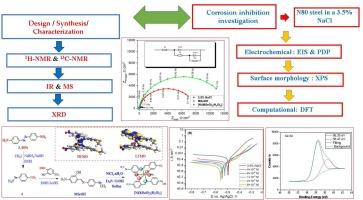
New organoselenium-containing Schiff base (MSeOH) and its Ni (II) chelate [Ni(MSeO)2(H2O)2] were synthesized and characterized. Their corrosion inhibition was investigated toward N80 steel in a 3.5 % NaCl solution. Their corrosion inhibition mechanism was investigated for the N80 steel in 3.5 % NaCl solution using different techniques, including electrochemical impedance spectroscopy (EIS), X-ray photoelectron spectroscopy (XPS), scanning electron microscope (SEM), potentiodynamic polarization (PDP), density functional theory (DFT), and Monte Carlo (MC) simulations. The electrochemical studies demonstrated high protection efficiencies (up to 96.9 %) of 8.0 × 10⁻⁵ M concentration. The [Ni(MSeO)2(H2O)2] exhibited superior corrosion inhibition efficiency compared to the ligand MSeOH. The additives on the corrosion solution manifested a significant influence, particularly on the anodic (βa) and cathodic (βc) Tafel slopes, proposing a mixed-type inhibition, reducing the anodic and cathodic reactions. The spontaneous adsorption of MSeOH and [Ni(MSeO)2(H2O)2] on the steel’s surface, conforming to the Langmuir adsorption isotherm, was substantiated by the increase in charge transfer resistance (Rct) and the decrease in the constant phase element (Y0) admittance values, evidencing the adsorption of MSeOH and [Ni(MSeO)2(H2O)2] molecules on the N80 steel surface, which was further corroborated by XPS and |SEM analysis. Moreover, DFT results showed that the [Ni(MSeO)2(H2O)2] complex has a high HOMO energy level, thus indicating high inhibition efficiency. On the other hand, a low LUMO energy level suggested the ease of electron acceptance by the vacant d-orbitals of the Ni(II) metal, promoting the formation of covalent bonds between the organic molecule and the metal center. Moreover, MC simulations substantiated the appropriate alignment of the inhibitor molecules in a flat orientation on the steel surface, thereby enhancing optimal surface coverage.
期刊介绍:
Launched in January 1998, Inorganic Chemistry Communications is an international journal dedicated to the rapid publication of short communications in the major areas of inorganic, organometallic and supramolecular chemistry. Topics include synthetic and reaction chemistry, kinetics and mechanisms of reactions, bioinorganic chemistry, photochemistry and the use of metal and organometallic compounds in stoichiometric and catalytic synthesis or organic compounds.




 京公网安备 11010802042870号
京ICP备2023020795号-1
京公网安备 11010802042870号
京ICP备2023020795号-1

 分享
分享
 求助内容:
求助内容: 应助结果提醒方式:
 扫码关注我们
