{"title":"水基炸药:一种基于MoSe2量子点的快速检测方法","authors":"Aneesha, Mohan Singh Mehata","doi":"10.1016/j.materresbull.2024.113287","DOIUrl":null,"url":null,"abstract":"<div><div>This study explores the synthesis of MoSe<sub>2</sub> quantum dots (QDs) via the hydrothermal method, followed by detailed characterization to determine their size and crystallinity. The MoSe<sub>2</sub> QDs exhibit a strong absorption peak at 260 nm and excitation-dependent photoluminescence (PL). These PL properties were utilized to develop a probe/sensor for detecting 2,4,6-trinitrophenol (2,4,6-TNP), a toxic nitroaromatic compound commonly found in contaminated water. As the concentration of 2,4,6-TNP increases, the PL intensity of QDs at 410 nm decreases in a monotonic fashion, showing a linear Stern-Volmer response within the concentration range of 3.3–99 nM, with a detection limit of 1.43 nM. The reduction in PL intensity is primarily driven by the inner filter effect. This study highlights the potential of MoSe<sub>2</sub> QDs for environmental monitoring and the detection of hazardous compounds like picric acid in water.</div></div>","PeriodicalId":18265,"journal":{"name":"Materials Research Bulletin","volume":"185 ","pages":"Article 113287"},"PeriodicalIF":5.8000,"publicationDate":"2025-05-01","publicationTypes":"Journal Article","fieldsOfStudy":null,"isOpenAccess":false,"openAccessPdf":"","citationCount":"0","resultStr":"{\"title\":\"Waterborne explosives: A rapid detection method using MoSe2 quantum dots\",\"authors\":\"Aneesha, Mohan Singh Mehata\",\"doi\":\"10.1016/j.materresbull.2024.113287\",\"DOIUrl\":null,\"url\":null,\"abstract\":\"<div><div>This study explores the synthesis of MoSe<sub>2</sub> quantum dots (QDs) via the hydrothermal method, followed by detailed characterization to determine their size and crystallinity. The MoSe<sub>2</sub> QDs exhibit a strong absorption peak at 260 nm and excitation-dependent photoluminescence (PL). These PL properties were utilized to develop a probe/sensor for detecting 2,4,6-trinitrophenol (2,4,6-TNP), a toxic nitroaromatic compound commonly found in contaminated water. As the concentration of 2,4,6-TNP increases, the PL intensity of QDs at 410 nm decreases in a monotonic fashion, showing a linear Stern-Volmer response within the concentration range of 3.3–99 nM, with a detection limit of 1.43 nM. The reduction in PL intensity is primarily driven by the inner filter effect. This study highlights the potential of MoSe<sub>2</sub> QDs for environmental monitoring and the detection of hazardous compounds like picric acid in water.</div></div>\",\"PeriodicalId\":18265,\"journal\":{\"name\":\"Materials Research Bulletin\",\"volume\":\"185 \",\"pages\":\"Article 113287\"},\"PeriodicalIF\":5.8000,\"publicationDate\":\"2025-05-01\",\"publicationTypes\":\"Journal Article\",\"fieldsOfStudy\":null,\"isOpenAccess\":false,\"openAccessPdf\":\"\",\"citationCount\":\"0\",\"resultStr\":null,\"platform\":\"Semanticscholar\",\"paperid\":null,\"PeriodicalName\":\"Materials Research Bulletin\",\"FirstCategoryId\":\"88\",\"ListUrlMain\":\"https://www.sciencedirect.com/science/article/pii/S0025540824006159\",\"RegionNum\":3,\"RegionCategory\":\"材料科学\",\"ArticlePicture\":[],\"TitleCN\":null,\"AbstractTextCN\":null,\"PMCID\":null,\"EPubDate\":\"2024/12/29 0:00:00\",\"PubModel\":\"Epub\",\"JCR\":\"Q2\",\"JCRName\":\"MATERIALS SCIENCE, MULTIDISCIPLINARY\",\"Score\":null,\"Total\":0}","platform":"Semanticscholar","paperid":null,"PeriodicalName":"Materials Research Bulletin","FirstCategoryId":"88","ListUrlMain":"https://www.sciencedirect.com/science/article/pii/S0025540824006159","RegionNum":3,"RegionCategory":"材料科学","ArticlePicture":[],"TitleCN":null,"AbstractTextCN":null,"PMCID":null,"EPubDate":"2024/12/29 0:00:00","PubModel":"Epub","JCR":"Q2","JCRName":"MATERIALS SCIENCE, MULTIDISCIPLINARY","Score":null,"Total":0}
Waterborne explosives: A rapid detection method using MoSe2 quantum dots
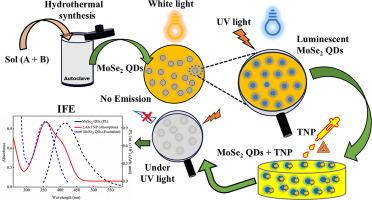
This study explores the synthesis of MoSe2 quantum dots (QDs) via the hydrothermal method, followed by detailed characterization to determine their size and crystallinity. The MoSe2 QDs exhibit a strong absorption peak at 260 nm and excitation-dependent photoluminescence (PL). These PL properties were utilized to develop a probe/sensor for detecting 2,4,6-trinitrophenol (2,4,6-TNP), a toxic nitroaromatic compound commonly found in contaminated water. As the concentration of 2,4,6-TNP increases, the PL intensity of QDs at 410 nm decreases in a monotonic fashion, showing a linear Stern-Volmer response within the concentration range of 3.3–99 nM, with a detection limit of 1.43 nM. The reduction in PL intensity is primarily driven by the inner filter effect. This study highlights the potential of MoSe2 QDs for environmental monitoring and the detection of hazardous compounds like picric acid in water.
期刊介绍:
Materials Research Bulletin is an international journal reporting high-impact research on processing-structure-property relationships in functional materials and nanomaterials with interesting electronic, magnetic, optical, thermal, mechanical or catalytic properties. Papers purely on thermodynamics or theoretical calculations (e.g., density functional theory) do not fall within the scope of the journal unless they also demonstrate a clear link to physical properties. Topics covered include functional materials (e.g., dielectrics, pyroelectrics, piezoelectrics, ferroelectrics, relaxors, thermoelectrics, etc.); electrochemistry and solid-state ionics (e.g., photovoltaics, batteries, sensors, and fuel cells); nanomaterials, graphene, and nanocomposites; luminescence and photocatalysis; crystal-structure and defect-structure analysis; novel electronics; non-crystalline solids; flexible electronics; protein-material interactions; and polymeric ion-exchange membranes.





 京公网安备 11010802042870号
京ICP备2023020795号-1
京公网安备 11010802042870号
京ICP备2023020795号-1

 分享
分享
 求助内容:
求助内容: 应助结果提醒方式:
 扫码关注我们
