{"title":"拓扑磁体ErMn6Sn6的临界行为和磁相图","authors":"Xiaojun Yang, Junxiao Pan, Shijiang Liu, Mao Yang","doi":"10.1016/j.materresbull.2025.113298","DOIUrl":null,"url":null,"abstract":"<div><div>The magnetic phase diagram as well as the magnetic critical behavior of a kagome magnet ErMn<span><math><msub><mrow></mrow><mrow><mn>6</mn></mrow></msub></math></span>Sn<span><math><msub><mrow></mrow><mrow><mn>6</mn></mrow></msub></math></span> is comprehensively studied. The Rhodes-Wolfarth ratio (RWR) is generated to be 2.17 (2.27) for <span><math><mrow><mi>H</mi><mo>/</mo><mo>/</mo><mi>a</mi><mi>b</mi></mrow></math></span> (<span><math><mrow><mi>H</mi><mo>/</mo><mo>/</mo><mi>c</mi></mrow></math></span>), demonstrating an itinerant magnetism. The Arrott plots suggest a first-order field-induced antiferromagnetic-ferromagnetic transition and a second-order temperature-induced paramagnetic-ferromagnetic magnetic transition. The obtained critical exponents <span><math><mi>β</mi></math></span> = 0.480(5) with <span><math><msub><mrow><mi>T</mi></mrow><mrow><mi>c</mi></mrow></msub></math></span> = 354.8(1) K, <span><math><mi>γ</mi></math></span> = 1.379(8) with <span><math><msub><mrow><mi>T</mi></mrow><mrow><mi>c</mi></mrow></msub></math></span> = 355.2(1) K, and <span><math><mi>δ</mi></math></span> = 3.87(2) at <span><math><msub><mrow><mi>T</mi></mrow><mrow><mi>c</mi></mrow></msub></math></span> = 355 K, which well obey the Widom relation and the scaling hypothesis, indicating self-consistency and accuracy of the yielded values. The exponents determined in this study suggest a three-dimensional critical behavior and a complex magnetic interaction which decays with distance as <span><math><mrow><mi>J</mi><mrow><mo>(</mo><mi>r</mi><mo>)</mo></mrow><mo>∼</mo><msup><mrow><mi>r</mi></mrow><mrow><mo>−</mo><mn>4</mn><mo>.</mo><mn>93</mn></mrow></msup></mrow></math></span>. An exhaustive <span><math><mrow><mi>H</mi><mo>−</mo><mi>T</mi></mrow></math></span> phase graph including paramagnetic, antiferromagnetic, ferromagnetic, and ferrimagnetic states is suggested with an exploration of the magnetic structures.</div></div>","PeriodicalId":18265,"journal":{"name":"Materials Research Bulletin","volume":"185 ","pages":"Article 113298"},"PeriodicalIF":5.8000,"publicationDate":"2025-05-01","publicationTypes":"Journal Article","fieldsOfStudy":null,"isOpenAccess":false,"openAccessPdf":"","citationCount":"0","resultStr":"{\"title\":\"Critical behavior and magnetic phase diagram of a topological kagome magnet ErMn6Sn6\",\"authors\":\"Xiaojun Yang, Junxiao Pan, Shijiang Liu, Mao Yang\",\"doi\":\"10.1016/j.materresbull.2025.113298\",\"DOIUrl\":null,\"url\":null,\"abstract\":\"<div><div>The magnetic phase diagram as well as the magnetic critical behavior of a kagome magnet ErMn<span><math><msub><mrow></mrow><mrow><mn>6</mn></mrow></msub></math></span>Sn<span><math><msub><mrow></mrow><mrow><mn>6</mn></mrow></msub></math></span> is comprehensively studied. The Rhodes-Wolfarth ratio (RWR) is generated to be 2.17 (2.27) for <span><math><mrow><mi>H</mi><mo>/</mo><mo>/</mo><mi>a</mi><mi>b</mi></mrow></math></span> (<span><math><mrow><mi>H</mi><mo>/</mo><mo>/</mo><mi>c</mi></mrow></math></span>), demonstrating an itinerant magnetism. The Arrott plots suggest a first-order field-induced antiferromagnetic-ferromagnetic transition and a second-order temperature-induced paramagnetic-ferromagnetic magnetic transition. The obtained critical exponents <span><math><mi>β</mi></math></span> = 0.480(5) with <span><math><msub><mrow><mi>T</mi></mrow><mrow><mi>c</mi></mrow></msub></math></span> = 354.8(1) K, <span><math><mi>γ</mi></math></span> = 1.379(8) with <span><math><msub><mrow><mi>T</mi></mrow><mrow><mi>c</mi></mrow></msub></math></span> = 355.2(1) K, and <span><math><mi>δ</mi></math></span> = 3.87(2) at <span><math><msub><mrow><mi>T</mi></mrow><mrow><mi>c</mi></mrow></msub></math></span> = 355 K, which well obey the Widom relation and the scaling hypothesis, indicating self-consistency and accuracy of the yielded values. The exponents determined in this study suggest a three-dimensional critical behavior and a complex magnetic interaction which decays with distance as <span><math><mrow><mi>J</mi><mrow><mo>(</mo><mi>r</mi><mo>)</mo></mrow><mo>∼</mo><msup><mrow><mi>r</mi></mrow><mrow><mo>−</mo><mn>4</mn><mo>.</mo><mn>93</mn></mrow></msup></mrow></math></span>. An exhaustive <span><math><mrow><mi>H</mi><mo>−</mo><mi>T</mi></mrow></math></span> phase graph including paramagnetic, antiferromagnetic, ferromagnetic, and ferrimagnetic states is suggested with an exploration of the magnetic structures.</div></div>\",\"PeriodicalId\":18265,\"journal\":{\"name\":\"Materials Research Bulletin\",\"volume\":\"185 \",\"pages\":\"Article 113298\"},\"PeriodicalIF\":5.8000,\"publicationDate\":\"2025-05-01\",\"publicationTypes\":\"Journal Article\",\"fieldsOfStudy\":null,\"isOpenAccess\":false,\"openAccessPdf\":\"\",\"citationCount\":\"0\",\"resultStr\":null,\"platform\":\"Semanticscholar\",\"paperid\":null,\"PeriodicalName\":\"Materials Research Bulletin\",\"FirstCategoryId\":\"88\",\"ListUrlMain\":\"https://www.sciencedirect.com/science/article/pii/S0025540825000066\",\"RegionNum\":3,\"RegionCategory\":\"材料科学\",\"ArticlePicture\":[],\"TitleCN\":null,\"AbstractTextCN\":null,\"PMCID\":null,\"EPubDate\":\"2025/1/14 0:00:00\",\"PubModel\":\"Epub\",\"JCR\":\"Q2\",\"JCRName\":\"MATERIALS SCIENCE, MULTIDISCIPLINARY\",\"Score\":null,\"Total\":0}","platform":"Semanticscholar","paperid":null,"PeriodicalName":"Materials Research Bulletin","FirstCategoryId":"88","ListUrlMain":"https://www.sciencedirect.com/science/article/pii/S0025540825000066","RegionNum":3,"RegionCategory":"材料科学","ArticlePicture":[],"TitleCN":null,"AbstractTextCN":null,"PMCID":null,"EPubDate":"2025/1/14 0:00:00","PubModel":"Epub","JCR":"Q2","JCRName":"MATERIALS SCIENCE, MULTIDISCIPLINARY","Score":null,"Total":0}
Critical behavior and magnetic phase diagram of a topological kagome magnet ErMn6Sn6
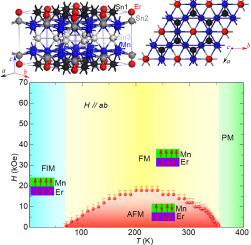
The magnetic phase diagram as well as the magnetic critical behavior of a kagome magnet ErMnSn is comprehensively studied. The Rhodes-Wolfarth ratio (RWR) is generated to be 2.17 (2.27) for (), demonstrating an itinerant magnetism. The Arrott plots suggest a first-order field-induced antiferromagnetic-ferromagnetic transition and a second-order temperature-induced paramagnetic-ferromagnetic magnetic transition. The obtained critical exponents = 0.480(5) with = 354.8(1) K, = 1.379(8) with = 355.2(1) K, and = 3.87(2) at = 355 K, which well obey the Widom relation and the scaling hypothesis, indicating self-consistency and accuracy of the yielded values. The exponents determined in this study suggest a three-dimensional critical behavior and a complex magnetic interaction which decays with distance as . An exhaustive phase graph including paramagnetic, antiferromagnetic, ferromagnetic, and ferrimagnetic states is suggested with an exploration of the magnetic structures.
期刊介绍:
Materials Research Bulletin is an international journal reporting high-impact research on processing-structure-property relationships in functional materials and nanomaterials with interesting electronic, magnetic, optical, thermal, mechanical or catalytic properties. Papers purely on thermodynamics or theoretical calculations (e.g., density functional theory) do not fall within the scope of the journal unless they also demonstrate a clear link to physical properties. Topics covered include functional materials (e.g., dielectrics, pyroelectrics, piezoelectrics, ferroelectrics, relaxors, thermoelectrics, etc.); electrochemistry and solid-state ionics (e.g., photovoltaics, batteries, sensors, and fuel cells); nanomaterials, graphene, and nanocomposites; luminescence and photocatalysis; crystal-structure and defect-structure analysis; novel electronics; non-crystalline solids; flexible electronics; protein-material interactions; and polymeric ion-exchange membranes.




 京公网安备 11010802042870号
京ICP备2023020795号-1
京公网安备 11010802042870号
京ICP备2023020795号-1

 分享
分享
 求助内容:
求助内容: 应助结果提醒方式:
 扫码关注我们
