Ke Chen , Ting Yao , Rui Qi , Sérgio D.N. Lourenço
{"title":"聚合物胶囊对碳酸盐砂一维压缩蠕变的影响","authors":"Ke Chen , Ting Yao , Rui Qi , Sérgio D.N. Lourenço","doi":"10.1016/j.powtec.2025.120705","DOIUrl":null,"url":null,"abstract":"<div><div>Carbonate sand, widely distributed in coastal regions, presents challenge due to its high stress-dependent and time-dependent (creep) compressibility. While soil stabilization techniques have traditionally focused on enhancing the strength of carbonate sand, the evaluation on the compressibility performance of cemented carbonate sand remains a critical aspect for most envisaged practical applications. In light of recent developments in self-healing approaches for soil stabilization, this study investigated the potential of calcium alginate/Tung oil capsules to mitigate compressibility in carbonate sand. The encapsulated Tung oil serves as a healing agent, gradually releasing within the sand matrix when subjected to void ratio changes during compaction, hardening and bonding sand grains after a 30-day drying. Long-term stepwise one-dimensional compression tests were conducted on both clean sand and sand-capsule composite with different initial relative density and particle size. The overall and stress-dependent compressibility was reduced for fine sand-capsule composite, while capsules had adverse effect on the compressibility of medium and coarse sand-capsule composite. Capsules could not reduce the creep but increase the elastic response of all sand-capsule composites. The Tung oil bonding could reduce the compressibility by preventing particle breakage of sand during loading. The stabilization mechanism of capsules in carbonate sand with different particle size was further investigated through thermal analysis, CT scan and microscopic analysis, revealing that the compressibility mitigation by capsules depended on the amount of Tung oil release from capsule, which was controlled by the pore structure of sand-capsule composite.</div></div>","PeriodicalId":407,"journal":{"name":"Powder Technology","volume":"454 ","pages":"Article 120705"},"PeriodicalIF":4.6000,"publicationDate":"2025-03-31","publicationTypes":"Journal Article","fieldsOfStudy":null,"isOpenAccess":false,"openAccessPdf":"","citationCount":"0","resultStr":"{\"title\":\"Effect of polymeric capsules on one-dimensional compression and creep of carbonate sand\",\"authors\":\"Ke Chen , Ting Yao , Rui Qi , Sérgio D.N. Lourenço\",\"doi\":\"10.1016/j.powtec.2025.120705\",\"DOIUrl\":null,\"url\":null,\"abstract\":\"<div><div>Carbonate sand, widely distributed in coastal regions, presents challenge due to its high stress-dependent and time-dependent (creep) compressibility. While soil stabilization techniques have traditionally focused on enhancing the strength of carbonate sand, the evaluation on the compressibility performance of cemented carbonate sand remains a critical aspect for most envisaged practical applications. In light of recent developments in self-healing approaches for soil stabilization, this study investigated the potential of calcium alginate/Tung oil capsules to mitigate compressibility in carbonate sand. The encapsulated Tung oil serves as a healing agent, gradually releasing within the sand matrix when subjected to void ratio changes during compaction, hardening and bonding sand grains after a 30-day drying. Long-term stepwise one-dimensional compression tests were conducted on both clean sand and sand-capsule composite with different initial relative density and particle size. The overall and stress-dependent compressibility was reduced for fine sand-capsule composite, while capsules had adverse effect on the compressibility of medium and coarse sand-capsule composite. Capsules could not reduce the creep but increase the elastic response of all sand-capsule composites. The Tung oil bonding could reduce the compressibility by preventing particle breakage of sand during loading. The stabilization mechanism of capsules in carbonate sand with different particle size was further investigated through thermal analysis, CT scan and microscopic analysis, revealing that the compressibility mitigation by capsules depended on the amount of Tung oil release from capsule, which was controlled by the pore structure of sand-capsule composite.</div></div>\",\"PeriodicalId\":407,\"journal\":{\"name\":\"Powder Technology\",\"volume\":\"454 \",\"pages\":\"Article 120705\"},\"PeriodicalIF\":4.6000,\"publicationDate\":\"2025-03-31\",\"publicationTypes\":\"Journal Article\",\"fieldsOfStudy\":null,\"isOpenAccess\":false,\"openAccessPdf\":\"\",\"citationCount\":\"0\",\"resultStr\":null,\"platform\":\"Semanticscholar\",\"paperid\":null,\"PeriodicalName\":\"Powder Technology\",\"FirstCategoryId\":\"5\",\"ListUrlMain\":\"https://www.sciencedirect.com/science/article/pii/S0032591025001007\",\"RegionNum\":2,\"RegionCategory\":\"工程技术\",\"ArticlePicture\":[],\"TitleCN\":null,\"AbstractTextCN\":null,\"PMCID\":null,\"EPubDate\":\"2025/1/25 0:00:00\",\"PubModel\":\"Epub\",\"JCR\":\"Q2\",\"JCRName\":\"ENGINEERING, CHEMICAL\",\"Score\":null,\"Total\":0}","platform":"Semanticscholar","paperid":null,"PeriodicalName":"Powder Technology","FirstCategoryId":"5","ListUrlMain":"https://www.sciencedirect.com/science/article/pii/S0032591025001007","RegionNum":2,"RegionCategory":"工程技术","ArticlePicture":[],"TitleCN":null,"AbstractTextCN":null,"PMCID":null,"EPubDate":"2025/1/25 0:00:00","PubModel":"Epub","JCR":"Q2","JCRName":"ENGINEERING, CHEMICAL","Score":null,"Total":0}
Effect of polymeric capsules on one-dimensional compression and creep of carbonate sand
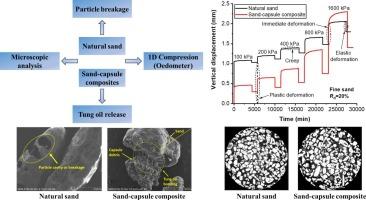
Carbonate sand, widely distributed in coastal regions, presents challenge due to its high stress-dependent and time-dependent (creep) compressibility. While soil stabilization techniques have traditionally focused on enhancing the strength of carbonate sand, the evaluation on the compressibility performance of cemented carbonate sand remains a critical aspect for most envisaged practical applications. In light of recent developments in self-healing approaches for soil stabilization, this study investigated the potential of calcium alginate/Tung oil capsules to mitigate compressibility in carbonate sand. The encapsulated Tung oil serves as a healing agent, gradually releasing within the sand matrix when subjected to void ratio changes during compaction, hardening and bonding sand grains after a 30-day drying. Long-term stepwise one-dimensional compression tests were conducted on both clean sand and sand-capsule composite with different initial relative density and particle size. The overall and stress-dependent compressibility was reduced for fine sand-capsule composite, while capsules had adverse effect on the compressibility of medium and coarse sand-capsule composite. Capsules could not reduce the creep but increase the elastic response of all sand-capsule composites. The Tung oil bonding could reduce the compressibility by preventing particle breakage of sand during loading. The stabilization mechanism of capsules in carbonate sand with different particle size was further investigated through thermal analysis, CT scan and microscopic analysis, revealing that the compressibility mitigation by capsules depended on the amount of Tung oil release from capsule, which was controlled by the pore structure of sand-capsule composite.
期刊介绍:
Powder Technology is an International Journal on the Science and Technology of Wet and Dry Particulate Systems. Powder Technology publishes papers on all aspects of the formation of particles and their characterisation and on the study of systems containing particulate solids. No limitation is imposed on the size of the particles, which may range from nanometre scale, as in pigments or aerosols, to that of mined or quarried materials. The following list of topics is not intended to be comprehensive, but rather to indicate typical subjects which fall within the scope of the journal's interests:
Formation and synthesis of particles by precipitation and other methods.
Modification of particles by agglomeration, coating, comminution and attrition.
Characterisation of the size, shape, surface area, pore structure and strength of particles and agglomerates (including the origins and effects of inter particle forces).
Packing, failure, flow and permeability of assemblies of particles.
Particle-particle interactions and suspension rheology.
Handling and processing operations such as slurry flow, fluidization, pneumatic conveying.
Interactions between particles and their environment, including delivery of particulate products to the body.
Applications of particle technology in production of pharmaceuticals, chemicals, foods, pigments, structural, and functional materials and in environmental and energy related matters.
For materials-oriented contributions we are looking for articles revealing the effect of particle/powder characteristics (size, morphology and composition, in that order) on material performance or functionality and, ideally, comparison to any industrial standard.




 京公网安备 11010802042870号
京ICP备2023020795号-1
京公网安备 11010802042870号
京ICP备2023020795号-1

 分享
分享
 求助内容:
求助内容: 应助结果提醒方式:
 扫码关注我们
