Kaiyuan Deng , Wenjin Li , Puxi An, Cheng Liu, Jiatao Wu, Rui Wang, Lei Yao, Guangliang Gary Liu
{"title":"高性能硫化物基全固态电池用超高富镍lini0.96 co0.02 mn0.020 o2阴极的表面-体协同重组","authors":"Kaiyuan Deng , Wenjin Li , Puxi An, Cheng Liu, Jiatao Wu, Rui Wang, Lei Yao, Guangliang Gary Liu","doi":"10.1016/j.powtec.2025.120691","DOIUrl":null,"url":null,"abstract":"<div><div>The all-solid-state lithium batteries (ASSLBs) based on sulfide solid electrolytes (SSE) and ultrahigh nickel-rich cathode (LiNi<sub>x</sub>Co<sub>y</sub>Mn<sub>1-x-y</sub>O<sub>2</sub>, where x > 0.9) encounter challenges at the electrolyte-cathode interface, such as oxygen escape and side reactions in a highly delithiated state, resulting in significant structural deterioration and rapid capacity decay. In this study, a novel surface modification strategy that serves multiple functions is proposed to achieve in-situ formation of a Li<sub>2</sub>MoO<sub>4</sub> coating layer and bulk doping with Mo element for enhancing the interface compatibility between LiNi<sub>0.96</sub>Co<sub>0.02</sub>Mn<sub>0.02</sub>O<sub>2</sub> (NCM96) and Li<sub>6</sub>PS<sub>5</sub>Cl (LPSCl) electrolyte. Using thermodynamic/density functional theory calculations, X-ray photoelectron spectroscopy, and in-situ distribution of relaxation times analysis, it is revealed that the incorporated strong Mo<img>O bonds in NCM96 and the surficial fast-ionic conductor layer help to stabilize lattice oxygen, and preventing further electrochemical oxidation of the sulfide electrolyte and the formation of oxygenated sulfur and phosphorus species. It is demonstrated that ASSLBs with Mo modified NCM96 as the cathode and LPSCl as the solid electrolyte (SE) exhibit a high discharge capacity of 174.4 mAh g<sup>−1</sup> and an excellent cycle retention of 78 % after 200 charge/discharge cycles. This surface-to-bulk synergistic modification strategy provides a new perspective for the design of high-performance sulfide-based ASSLBs.</div></div>","PeriodicalId":407,"journal":{"name":"Powder Technology","volume":"454 ","pages":"Article 120691"},"PeriodicalIF":5.5000,"publicationDate":"2025-03-31","publicationTypes":"Journal Article","fieldsOfStudy":null,"isOpenAccess":false,"openAccessPdf":"","citationCount":"0","resultStr":"{\"title\":\"Surface to bulk synergistic restructuring of ultrahigh nickel-rich LiNi0.96Co0.02Mn0.02O2 cathode for high-performance sulfide-based all-solid-state batteries\",\"authors\":\"Kaiyuan Deng , Wenjin Li , Puxi An, Cheng Liu, Jiatao Wu, Rui Wang, Lei Yao, Guangliang Gary Liu\",\"doi\":\"10.1016/j.powtec.2025.120691\",\"DOIUrl\":null,\"url\":null,\"abstract\":\"<div><div>The all-solid-state lithium batteries (ASSLBs) based on sulfide solid electrolytes (SSE) and ultrahigh nickel-rich cathode (LiNi<sub>x</sub>Co<sub>y</sub>Mn<sub>1-x-y</sub>O<sub>2</sub>, where x > 0.9) encounter challenges at the electrolyte-cathode interface, such as oxygen escape and side reactions in a highly delithiated state, resulting in significant structural deterioration and rapid capacity decay. In this study, a novel surface modification strategy that serves multiple functions is proposed to achieve in-situ formation of a Li<sub>2</sub>MoO<sub>4</sub> coating layer and bulk doping with Mo element for enhancing the interface compatibility between LiNi<sub>0.96</sub>Co<sub>0.02</sub>Mn<sub>0.02</sub>O<sub>2</sub> (NCM96) and Li<sub>6</sub>PS<sub>5</sub>Cl (LPSCl) electrolyte. Using thermodynamic/density functional theory calculations, X-ray photoelectron spectroscopy, and in-situ distribution of relaxation times analysis, it is revealed that the incorporated strong Mo<img>O bonds in NCM96 and the surficial fast-ionic conductor layer help to stabilize lattice oxygen, and preventing further electrochemical oxidation of the sulfide electrolyte and the formation of oxygenated sulfur and phosphorus species. It is demonstrated that ASSLBs with Mo modified NCM96 as the cathode and LPSCl as the solid electrolyte (SE) exhibit a high discharge capacity of 174.4 mAh g<sup>−1</sup> and an excellent cycle retention of 78 % after 200 charge/discharge cycles. This surface-to-bulk synergistic modification strategy provides a new perspective for the design of high-performance sulfide-based ASSLBs.</div></div>\",\"PeriodicalId\":407,\"journal\":{\"name\":\"Powder Technology\",\"volume\":\"454 \",\"pages\":\"Article 120691\"},\"PeriodicalIF\":5.5000,\"publicationDate\":\"2025-03-31\",\"publicationTypes\":\"Journal Article\",\"fieldsOfStudy\":null,\"isOpenAccess\":false,\"openAccessPdf\":\"\",\"citationCount\":\"0\",\"resultStr\":null,\"platform\":\"Semanticscholar\",\"paperid\":null,\"PeriodicalName\":\"Powder Technology\",\"FirstCategoryId\":\"5\",\"ListUrlMain\":\"https://www.sciencedirect.com/science/article/pii/S0032591025000865\",\"RegionNum\":2,\"RegionCategory\":\"工程技术\",\"ArticlePicture\":[],\"TitleCN\":null,\"AbstractTextCN\":null,\"PMCID\":null,\"EPubDate\":\"2025/1/25 0:00:00\",\"PubModel\":\"Epub\",\"JCR\":\"Q2\",\"JCRName\":\"ENGINEERING, CHEMICAL\",\"Score\":null,\"Total\":0}","platform":"Semanticscholar","paperid":null,"PeriodicalName":"Powder Technology","FirstCategoryId":"5","ListUrlMain":"https://www.sciencedirect.com/science/article/pii/S0032591025000865","RegionNum":2,"RegionCategory":"工程技术","ArticlePicture":[],"TitleCN":null,"AbstractTextCN":null,"PMCID":null,"EPubDate":"2025/1/25 0:00:00","PubModel":"Epub","JCR":"Q2","JCRName":"ENGINEERING, CHEMICAL","Score":null,"Total":0}
引用次数: 0
摘要
基于硫化物固体电解质(SSE)和超高富镍阴极(LiNixCoyMn1-x-yO2)的全固态锂电池(ASSLBs),其中x >;0.9)在电解-阴极界面遇到挑战,如氧逸出和副反应在高度稀薄状态下,导致显著的结构恶化和容量快速衰减。本研究提出了一种新的多功能表面修饰策略,实现原位形成Li2MoO4涂层并大量掺杂Mo元素,以增强lini0.96 co0.02 mn0.002 o2 (NCM96)与Li6PS5Cl (LPSCl)电解质之间的界面相容性。通过热力学/密度泛函理论计算、x射线光电子能谱和弛豫时间原位分布分析,揭示了NCM96和表面快离子导体层中加入的强MoO键有助于稳定晶格氧,防止硫化电解质进一步的电化学氧化和氧合硫和磷的形成。结果表明,以Mo修饰的NCM96为阴极,LPSCl为固体电解质(SE)的ASSLBs具有174.4 mAh g−1的高放电容量,并且在200次充放电循环后具有78%的优异循环保留率。这种表面-体协同改性策略为高性能硫化物基assb的设计提供了新的视角。
Surface to bulk synergistic restructuring of ultrahigh nickel-rich LiNi0.96Co0.02Mn0.02O2 cathode for high-performance sulfide-based all-solid-state batteries
The all-solid-state lithium batteries (ASSLBs) based on sulfide solid electrolytes (SSE) and ultrahigh nickel-rich cathode (LiNixCoyMn1-x-yO2, where x > 0.9) encounter challenges at the electrolyte-cathode interface, such as oxygen escape and side reactions in a highly delithiated state, resulting in significant structural deterioration and rapid capacity decay. In this study, a novel surface modification strategy that serves multiple functions is proposed to achieve in-situ formation of a Li2MoO4 coating layer and bulk doping with Mo element for enhancing the interface compatibility between LiNi0.96Co0.02Mn0.02O2 (NCM96) and Li6PS5Cl (LPSCl) electrolyte. Using thermodynamic/density functional theory calculations, X-ray photoelectron spectroscopy, and in-situ distribution of relaxation times analysis, it is revealed that the incorporated strong MoO bonds in NCM96 and the surficial fast-ionic conductor layer help to stabilize lattice oxygen, and preventing further electrochemical oxidation of the sulfide electrolyte and the formation of oxygenated sulfur and phosphorus species. It is demonstrated that ASSLBs with Mo modified NCM96 as the cathode and LPSCl as the solid electrolyte (SE) exhibit a high discharge capacity of 174.4 mAh g−1 and an excellent cycle retention of 78 % after 200 charge/discharge cycles. This surface-to-bulk synergistic modification strategy provides a new perspective for the design of high-performance sulfide-based ASSLBs.
期刊介绍:
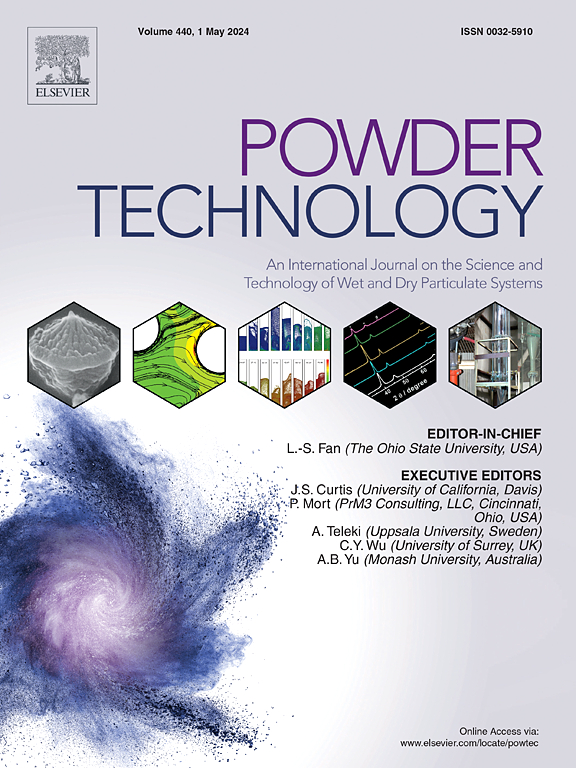
Powder Technology is an International Journal on the Science and Technology of Wet and Dry Particulate Systems. Powder Technology publishes papers on all aspects of the formation of particles and their characterisation and on the study of systems containing particulate solids. No limitation is imposed on the size of the particles, which may range from nanometre scale, as in pigments or aerosols, to that of mined or quarried materials. The following list of topics is not intended to be comprehensive, but rather to indicate typical subjects which fall within the scope of the journal's interests:
Formation and synthesis of particles by precipitation and other methods.
Modification of particles by agglomeration, coating, comminution and attrition.
Characterisation of the size, shape, surface area, pore structure and strength of particles and agglomerates (including the origins and effects of inter particle forces).
Packing, failure, flow and permeability of assemblies of particles.
Particle-particle interactions and suspension rheology.
Handling and processing operations such as slurry flow, fluidization, pneumatic conveying.
Interactions between particles and their environment, including delivery of particulate products to the body.
Applications of particle technology in production of pharmaceuticals, chemicals, foods, pigments, structural, and functional materials and in environmental and energy related matters.
For materials-oriented contributions we are looking for articles revealing the effect of particle/powder characteristics (size, morphology and composition, in that order) on material performance or functionality and, ideally, comparison to any industrial standard.





 京公网安备 11010802042870号
京ICP备2023020795号-1
京公网安备 11010802042870号
京ICP备2023020795号-1

 分享
分享
 求助内容:
求助内容: 应助结果提醒方式:
 扫码关注我们
