{"title":"草酸选择性抑制铜活化黄铁矿:对加强黄铜矿与黄铁矿分离的意义","authors":"Gde Pandhe Wisnu Suyantara , Akbarshokh Ulmaszoda , Hajime Miki , Doaa Ashraf Eladl , Keiko Sasaki , Naoko Okibe","doi":"10.1016/j.powtec.2025.120681","DOIUrl":null,"url":null,"abstract":"<div><div>The selective separation of pyrite (FeS<sub>2</sub>) and chalcopyrite (CuFeS<sub>2</sub>) in flotation processes poses significant challenges due to the activation of the pyrite surfaces by copper ions dissolved from associated copper sulfide minerals. This study proposes oxalic acid as an environment-friendly reagent to inhibit the copper-induced activation of pyrite. Chalcopyrite was used as a model mineral to evaluate the selectivity of oxalic acid treatment. The flotation experiments demonstrated that oxalic acid reduced the flotation recovery of copper-activated pyrite from 58 % to 16 % at pH 9 while exerting no discernible effect on chalcopyrite flotation. Further tests using artificial mixtures of chalcopyrite and pyrite confirmed the ability of oxalic acid to selectively separate chalcopyrite from copper-activated pyrite under mildly alkaline conditions, improving the separation efficiency from 30 % to 78 % with the addition of 15 kg/t (0.55 mM) oxalic acid at pH 9. The mechanism underlying this selectivity was investigated using infrared spectroscopy, X-ray photoelectron spectroscopy, and atomic force microscopy. The results revealed that oxalic acid reacts with copper ions to form copper oxalate, which effectively prevents copper deposition on the pyrite surface. This reaction inhibits pyrite activation and suppresses the adsorption of xanthate collectors. These findings highlight the potential of oxalic acid as a sustainable reagent for enhancing the selectivity and efficiency of chalcopyrite–pyrite separation in flotation processes.</div></div>","PeriodicalId":407,"journal":{"name":"Powder Technology","volume":"454 ","pages":"Article 120681"},"PeriodicalIF":5.5000,"publicationDate":"2025-03-31","publicationTypes":"Journal Article","fieldsOfStudy":null,"isOpenAccess":false,"openAccessPdf":"","citationCount":"0","resultStr":"{\"title\":\"Selective depression of copper-activated pyrite by oxalic acid: Implications for enhanced chalcopyrite–pyrite separation\",\"authors\":\"Gde Pandhe Wisnu Suyantara , Akbarshokh Ulmaszoda , Hajime Miki , Doaa Ashraf Eladl , Keiko Sasaki , Naoko Okibe\",\"doi\":\"10.1016/j.powtec.2025.120681\",\"DOIUrl\":null,\"url\":null,\"abstract\":\"<div><div>The selective separation of pyrite (FeS<sub>2</sub>) and chalcopyrite (CuFeS<sub>2</sub>) in flotation processes poses significant challenges due to the activation of the pyrite surfaces by copper ions dissolved from associated copper sulfide minerals. This study proposes oxalic acid as an environment-friendly reagent to inhibit the copper-induced activation of pyrite. Chalcopyrite was used as a model mineral to evaluate the selectivity of oxalic acid treatment. The flotation experiments demonstrated that oxalic acid reduced the flotation recovery of copper-activated pyrite from 58 % to 16 % at pH 9 while exerting no discernible effect on chalcopyrite flotation. Further tests using artificial mixtures of chalcopyrite and pyrite confirmed the ability of oxalic acid to selectively separate chalcopyrite from copper-activated pyrite under mildly alkaline conditions, improving the separation efficiency from 30 % to 78 % with the addition of 15 kg/t (0.55 mM) oxalic acid at pH 9. The mechanism underlying this selectivity was investigated using infrared spectroscopy, X-ray photoelectron spectroscopy, and atomic force microscopy. The results revealed that oxalic acid reacts with copper ions to form copper oxalate, which effectively prevents copper deposition on the pyrite surface. This reaction inhibits pyrite activation and suppresses the adsorption of xanthate collectors. These findings highlight the potential of oxalic acid as a sustainable reagent for enhancing the selectivity and efficiency of chalcopyrite–pyrite separation in flotation processes.</div></div>\",\"PeriodicalId\":407,\"journal\":{\"name\":\"Powder Technology\",\"volume\":\"454 \",\"pages\":\"Article 120681\"},\"PeriodicalIF\":5.5000,\"publicationDate\":\"2025-03-31\",\"publicationTypes\":\"Journal Article\",\"fieldsOfStudy\":null,\"isOpenAccess\":false,\"openAccessPdf\":\"\",\"citationCount\":\"0\",\"resultStr\":null,\"platform\":\"Semanticscholar\",\"paperid\":null,\"PeriodicalName\":\"Powder Technology\",\"FirstCategoryId\":\"5\",\"ListUrlMain\":\"https://www.sciencedirect.com/science/article/pii/S0032591025000762\",\"RegionNum\":2,\"RegionCategory\":\"工程技术\",\"ArticlePicture\":[],\"TitleCN\":null,\"AbstractTextCN\":null,\"PMCID\":null,\"EPubDate\":\"2025/1/22 0:00:00\",\"PubModel\":\"Epub\",\"JCR\":\"Q2\",\"JCRName\":\"ENGINEERING, CHEMICAL\",\"Score\":null,\"Total\":0}","platform":"Semanticscholar","paperid":null,"PeriodicalName":"Powder Technology","FirstCategoryId":"5","ListUrlMain":"https://www.sciencedirect.com/science/article/pii/S0032591025000762","RegionNum":2,"RegionCategory":"工程技术","ArticlePicture":[],"TitleCN":null,"AbstractTextCN":null,"PMCID":null,"EPubDate":"2025/1/22 0:00:00","PubModel":"Epub","JCR":"Q2","JCRName":"ENGINEERING, CHEMICAL","Score":null,"Total":0}
Selective depression of copper-activated pyrite by oxalic acid: Implications for enhanced chalcopyrite–pyrite separation
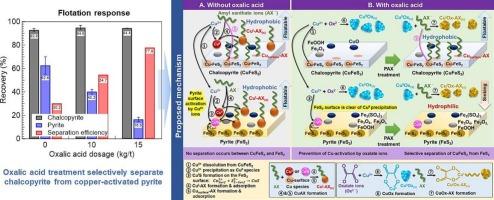
The selective separation of pyrite (FeS2) and chalcopyrite (CuFeS2) in flotation processes poses significant challenges due to the activation of the pyrite surfaces by copper ions dissolved from associated copper sulfide minerals. This study proposes oxalic acid as an environment-friendly reagent to inhibit the copper-induced activation of pyrite. Chalcopyrite was used as a model mineral to evaluate the selectivity of oxalic acid treatment. The flotation experiments demonstrated that oxalic acid reduced the flotation recovery of copper-activated pyrite from 58 % to 16 % at pH 9 while exerting no discernible effect on chalcopyrite flotation. Further tests using artificial mixtures of chalcopyrite and pyrite confirmed the ability of oxalic acid to selectively separate chalcopyrite from copper-activated pyrite under mildly alkaline conditions, improving the separation efficiency from 30 % to 78 % with the addition of 15 kg/t (0.55 mM) oxalic acid at pH 9. The mechanism underlying this selectivity was investigated using infrared spectroscopy, X-ray photoelectron spectroscopy, and atomic force microscopy. The results revealed that oxalic acid reacts with copper ions to form copper oxalate, which effectively prevents copper deposition on the pyrite surface. This reaction inhibits pyrite activation and suppresses the adsorption of xanthate collectors. These findings highlight the potential of oxalic acid as a sustainable reagent for enhancing the selectivity and efficiency of chalcopyrite–pyrite separation in flotation processes.
期刊介绍:
Powder Technology is an International Journal on the Science and Technology of Wet and Dry Particulate Systems. Powder Technology publishes papers on all aspects of the formation of particles and their characterisation and on the study of systems containing particulate solids. No limitation is imposed on the size of the particles, which may range from nanometre scale, as in pigments or aerosols, to that of mined or quarried materials. The following list of topics is not intended to be comprehensive, but rather to indicate typical subjects which fall within the scope of the journal's interests:
Formation and synthesis of particles by precipitation and other methods.
Modification of particles by agglomeration, coating, comminution and attrition.
Characterisation of the size, shape, surface area, pore structure and strength of particles and agglomerates (including the origins and effects of inter particle forces).
Packing, failure, flow and permeability of assemblies of particles.
Particle-particle interactions and suspension rheology.
Handling and processing operations such as slurry flow, fluidization, pneumatic conveying.
Interactions between particles and their environment, including delivery of particulate products to the body.
Applications of particle technology in production of pharmaceuticals, chemicals, foods, pigments, structural, and functional materials and in environmental and energy related matters.
For materials-oriented contributions we are looking for articles revealing the effect of particle/powder characteristics (size, morphology and composition, in that order) on material performance or functionality and, ideally, comparison to any industrial standard.




 京公网安备 11010802042870号
京ICP备2023020795号-1
京公网安备 11010802042870号
京ICP备2023020795号-1

 分享
分享
 求助内容:
求助内容: 应助结果提醒方式:
 扫码关注我们
