Wei Wang , Zheng Mao , Xinyue Lan, Duomei Tian, Juan Peng, Yong Chen
{"title":"使用带有丝网印刷电极的微流体装置对类器官培养基进行非酶监测","authors":"Wei Wang , Zheng Mao , Xinyue Lan, Duomei Tian, Juan Peng, Yong Chen","doi":"10.1016/j.materresbull.2025.113320","DOIUrl":null,"url":null,"abstract":"<div><div>Electrochemical monitoring of cell culture media holds significant promise for routine evaluation of cell culture conditions, making it invaluable for disease modeling, drug screening, cell therapy, and regenerative medicine. Despite its potential, the application of electrochemical sensing techniques faces challenges, including the requirement for large sample volumes and the complexity of device integration. In this study, we introduce a straightforward method to evaluate the concentration of lactic acid (LA) in culture media using screen-printed electrode (SPE) and a microfluidic device. Standard SPEs were modified via electrochemical reduction of graphene oxide (GO) and deposition of nickel oxide (NiO) nanoparticles within a microfluidic device. Then, they could be used for the LA monitoring on-a-chip over a broad range (0.1–30 mM) with a low detection limit (0.05 mM) as well as the Electrochemical Impedance Spectroscopy (EIS) of the system. The modified SPEs were characterized by Scanning Electron Microscopy (SEM) to show the morphological changes of the electrodes and clarify the mechanism of the quality improvement. Finally, the modified SPEs were used to measure LA concentrations of organoid suspension culture media. Our results showed significant differences in LA concentration, in the media with and without air infusion, proving the effectiveness of the present approach and the usefulness the integrated SPEs for biomedical applications.</div></div>","PeriodicalId":18265,"journal":{"name":"Materials Research Bulletin","volume":"185 ","pages":"Article 113320"},"PeriodicalIF":5.7000,"publicationDate":"2025-05-01","publicationTypes":"Journal Article","fieldsOfStudy":null,"isOpenAccess":false,"openAccessPdf":"","citationCount":"0","resultStr":"{\"title\":\"Non-enzymatic monitoring of organoid culture media using a microfluidic device with screen-printed electrodes\",\"authors\":\"Wei Wang , Zheng Mao , Xinyue Lan, Duomei Tian, Juan Peng, Yong Chen\",\"doi\":\"10.1016/j.materresbull.2025.113320\",\"DOIUrl\":null,\"url\":null,\"abstract\":\"<div><div>Electrochemical monitoring of cell culture media holds significant promise for routine evaluation of cell culture conditions, making it invaluable for disease modeling, drug screening, cell therapy, and regenerative medicine. Despite its potential, the application of electrochemical sensing techniques faces challenges, including the requirement for large sample volumes and the complexity of device integration. In this study, we introduce a straightforward method to evaluate the concentration of lactic acid (LA) in culture media using screen-printed electrode (SPE) and a microfluidic device. Standard SPEs were modified via electrochemical reduction of graphene oxide (GO) and deposition of nickel oxide (NiO) nanoparticles within a microfluidic device. Then, they could be used for the LA monitoring on-a-chip over a broad range (0.1–30 mM) with a low detection limit (0.05 mM) as well as the Electrochemical Impedance Spectroscopy (EIS) of the system. The modified SPEs were characterized by Scanning Electron Microscopy (SEM) to show the morphological changes of the electrodes and clarify the mechanism of the quality improvement. Finally, the modified SPEs were used to measure LA concentrations of organoid suspension culture media. Our results showed significant differences in LA concentration, in the media with and without air infusion, proving the effectiveness of the present approach and the usefulness the integrated SPEs for biomedical applications.</div></div>\",\"PeriodicalId\":18265,\"journal\":{\"name\":\"Materials Research Bulletin\",\"volume\":\"185 \",\"pages\":\"Article 113320\"},\"PeriodicalIF\":5.7000,\"publicationDate\":\"2025-05-01\",\"publicationTypes\":\"Journal Article\",\"fieldsOfStudy\":null,\"isOpenAccess\":false,\"openAccessPdf\":\"\",\"citationCount\":\"0\",\"resultStr\":null,\"platform\":\"Semanticscholar\",\"paperid\":null,\"PeriodicalName\":\"Materials Research Bulletin\",\"FirstCategoryId\":\"88\",\"ListUrlMain\":\"https://www.sciencedirect.com/science/article/pii/S0025540825000285\",\"RegionNum\":3,\"RegionCategory\":\"材料科学\",\"ArticlePicture\":[],\"TitleCN\":null,\"AbstractTextCN\":null,\"PMCID\":null,\"EPubDate\":\"2025/1/15 0:00:00\",\"PubModel\":\"Epub\",\"JCR\":\"Q2\",\"JCRName\":\"MATERIALS SCIENCE, MULTIDISCIPLINARY\",\"Score\":null,\"Total\":0}","platform":"Semanticscholar","paperid":null,"PeriodicalName":"Materials Research Bulletin","FirstCategoryId":"88","ListUrlMain":"https://www.sciencedirect.com/science/article/pii/S0025540825000285","RegionNum":3,"RegionCategory":"材料科学","ArticlePicture":[],"TitleCN":null,"AbstractTextCN":null,"PMCID":null,"EPubDate":"2025/1/15 0:00:00","PubModel":"Epub","JCR":"Q2","JCRName":"MATERIALS SCIENCE, MULTIDISCIPLINARY","Score":null,"Total":0}
Non-enzymatic monitoring of organoid culture media using a microfluidic device with screen-printed electrodes
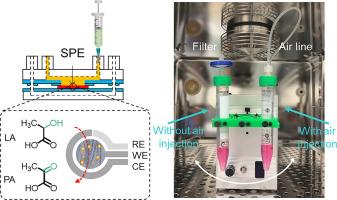
Electrochemical monitoring of cell culture media holds significant promise for routine evaluation of cell culture conditions, making it invaluable for disease modeling, drug screening, cell therapy, and regenerative medicine. Despite its potential, the application of electrochemical sensing techniques faces challenges, including the requirement for large sample volumes and the complexity of device integration. In this study, we introduce a straightforward method to evaluate the concentration of lactic acid (LA) in culture media using screen-printed electrode (SPE) and a microfluidic device. Standard SPEs were modified via electrochemical reduction of graphene oxide (GO) and deposition of nickel oxide (NiO) nanoparticles within a microfluidic device. Then, they could be used for the LA monitoring on-a-chip over a broad range (0.1–30 mM) with a low detection limit (0.05 mM) as well as the Electrochemical Impedance Spectroscopy (EIS) of the system. The modified SPEs were characterized by Scanning Electron Microscopy (SEM) to show the morphological changes of the electrodes and clarify the mechanism of the quality improvement. Finally, the modified SPEs were used to measure LA concentrations of organoid suspension culture media. Our results showed significant differences in LA concentration, in the media with and without air infusion, proving the effectiveness of the present approach and the usefulness the integrated SPEs for biomedical applications.
期刊介绍:
Materials Research Bulletin is an international journal reporting high-impact research on processing-structure-property relationships in functional materials and nanomaterials with interesting electronic, magnetic, optical, thermal, mechanical or catalytic properties. Papers purely on thermodynamics or theoretical calculations (e.g., density functional theory) do not fall within the scope of the journal unless they also demonstrate a clear link to physical properties. Topics covered include functional materials (e.g., dielectrics, pyroelectrics, piezoelectrics, ferroelectrics, relaxors, thermoelectrics, etc.); electrochemistry and solid-state ionics (e.g., photovoltaics, batteries, sensors, and fuel cells); nanomaterials, graphene, and nanocomposites; luminescence and photocatalysis; crystal-structure and defect-structure analysis; novel electronics; non-crystalline solids; flexible electronics; protein-material interactions; and polymeric ion-exchange membranes.




 京公网安备 11010802042870号
京ICP备2023020795号-1
京公网安备 11010802042870号
京ICP备2023020795号-1

 分享
分享
 求助内容:
求助内容: 应助结果提醒方式:
 扫码关注我们
