{"title":"基于位置标识符的分子通信网络寻址方案","authors":"Ankit","doi":"10.1016/j.phycom.2025.102599","DOIUrl":null,"url":null,"abstract":"<div><div>Networking over molecular signals is an important component of many new technologies, e.g., Internet of Bio-Nano Things (IoBNT) and Internet of Ingestible Things (IoIT). Assigning addresses to communicating nodes in a molecular communication (MC) network is an open problem in scientific literature due to challenges like probabilistic reception, undirected motion of molecular signals, and computational resource constraints. In this work, we propose a location identifier based addressing scheme that employs concentration gradient of molecular signals to assign addresses to stationary receiver nodes. Four different types of molecular signals are employed, which are emitted from four distinct addressing nodes. Interdependence between molecular receptivities at an addressed node is modeled using <span><math><mrow><mi>t</mi><mo>−</mo></mrow></math></span>copula. A bijective mapping between the addresses and receiver nodes’ locations is established to render mathematical validation to the proposed addressing scheme. Finally, an analytical expression of probability of addressing error (<span><math><msubsup><mrow><mi>P</mi></mrow><mrow><mtext>add</mtext></mrow><mrow><mtext>avg</mtext></mrow></msubsup></math></span>) averaged over several spatial configurations of addressed nodes is obtained, where the nodes are distributed as uniform binomial point process. It is shown that <span><math><msubsup><mrow><mi>P</mi></mrow><mrow><mtext>add</mtext></mrow><mrow><mtext>avg</mtext></mrow></msubsup></math></span> increases as <span><math><mrow><mi>O</mi><mrow><mo>(</mo><mi>n</mi><mo>)</mo></mrow></mrow></math></span> with increasing number of addressed nodes (<span><math><mi>n</mi></math></span>).</div></div>","PeriodicalId":48707,"journal":{"name":"Physical Communication","volume":"69 ","pages":"Article 102599"},"PeriodicalIF":2.2000,"publicationDate":"2025-04-01","publicationTypes":"Journal Article","fieldsOfStudy":null,"isOpenAccess":false,"openAccessPdf":"","citationCount":"0","resultStr":"{\"title\":\"Location identifier based addressing scheme for molecular communication networks\",\"authors\":\"Ankit\",\"doi\":\"10.1016/j.phycom.2025.102599\",\"DOIUrl\":null,\"url\":null,\"abstract\":\"<div><div>Networking over molecular signals is an important component of many new technologies, e.g., Internet of Bio-Nano Things (IoBNT) and Internet of Ingestible Things (IoIT). Assigning addresses to communicating nodes in a molecular communication (MC) network is an open problem in scientific literature due to challenges like probabilistic reception, undirected motion of molecular signals, and computational resource constraints. In this work, we propose a location identifier based addressing scheme that employs concentration gradient of molecular signals to assign addresses to stationary receiver nodes. Four different types of molecular signals are employed, which are emitted from four distinct addressing nodes. Interdependence between molecular receptivities at an addressed node is modeled using <span><math><mrow><mi>t</mi><mo>−</mo></mrow></math></span>copula. A bijective mapping between the addresses and receiver nodes’ locations is established to render mathematical validation to the proposed addressing scheme. Finally, an analytical expression of probability of addressing error (<span><math><msubsup><mrow><mi>P</mi></mrow><mrow><mtext>add</mtext></mrow><mrow><mtext>avg</mtext></mrow></msubsup></math></span>) averaged over several spatial configurations of addressed nodes is obtained, where the nodes are distributed as uniform binomial point process. It is shown that <span><math><msubsup><mrow><mi>P</mi></mrow><mrow><mtext>add</mtext></mrow><mrow><mtext>avg</mtext></mrow></msubsup></math></span> increases as <span><math><mrow><mi>O</mi><mrow><mo>(</mo><mi>n</mi><mo>)</mo></mrow></mrow></math></span> with increasing number of addressed nodes (<span><math><mi>n</mi></math></span>).</div></div>\",\"PeriodicalId\":48707,\"journal\":{\"name\":\"Physical Communication\",\"volume\":\"69 \",\"pages\":\"Article 102599\"},\"PeriodicalIF\":2.2000,\"publicationDate\":\"2025-04-01\",\"publicationTypes\":\"Journal Article\",\"fieldsOfStudy\":null,\"isOpenAccess\":false,\"openAccessPdf\":\"\",\"citationCount\":\"0\",\"resultStr\":null,\"platform\":\"Semanticscholar\",\"paperid\":null,\"PeriodicalName\":\"Physical Communication\",\"FirstCategoryId\":\"94\",\"ListUrlMain\":\"https://www.sciencedirect.com/science/article/pii/S1874490725000023\",\"RegionNum\":4,\"RegionCategory\":\"计算机科学\",\"ArticlePicture\":[],\"TitleCN\":null,\"AbstractTextCN\":null,\"PMCID\":null,\"EPubDate\":\"2025/1/8 0:00:00\",\"PubModel\":\"Epub\",\"JCR\":\"Q3\",\"JCRName\":\"ENGINEERING, ELECTRICAL & ELECTRONIC\",\"Score\":null,\"Total\":0}","platform":"Semanticscholar","paperid":null,"PeriodicalName":"Physical Communication","FirstCategoryId":"94","ListUrlMain":"https://www.sciencedirect.com/science/article/pii/S1874490725000023","RegionNum":4,"RegionCategory":"计算机科学","ArticlePicture":[],"TitleCN":null,"AbstractTextCN":null,"PMCID":null,"EPubDate":"2025/1/8 0:00:00","PubModel":"Epub","JCR":"Q3","JCRName":"ENGINEERING, ELECTRICAL & ELECTRONIC","Score":null,"Total":0}
Location identifier based addressing scheme for molecular communication networks
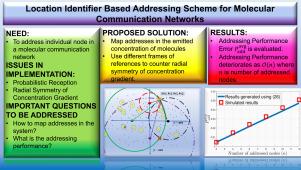
Networking over molecular signals is an important component of many new technologies, e.g., Internet of Bio-Nano Things (IoBNT) and Internet of Ingestible Things (IoIT). Assigning addresses to communicating nodes in a molecular communication (MC) network is an open problem in scientific literature due to challenges like probabilistic reception, undirected motion of molecular signals, and computational resource constraints. In this work, we propose a location identifier based addressing scheme that employs concentration gradient of molecular signals to assign addresses to stationary receiver nodes. Four different types of molecular signals are employed, which are emitted from four distinct addressing nodes. Interdependence between molecular receptivities at an addressed node is modeled using copula. A bijective mapping between the addresses and receiver nodes’ locations is established to render mathematical validation to the proposed addressing scheme. Finally, an analytical expression of probability of addressing error () averaged over several spatial configurations of addressed nodes is obtained, where the nodes are distributed as uniform binomial point process. It is shown that increases as with increasing number of addressed nodes ().
期刊介绍:
PHYCOM: Physical Communication is an international and archival journal providing complete coverage of all topics of interest to those involved in all aspects of physical layer communications. Theoretical research contributions presenting new techniques, concepts or analyses, applied contributions reporting on experiences and experiments, and tutorials are published.
Topics of interest include but are not limited to:
Physical layer issues of Wireless Local Area Networks, WiMAX, Wireless Mesh Networks, Sensor and Ad Hoc Networks, PCS Systems; Radio access protocols and algorithms for the physical layer; Spread Spectrum Communications; Channel Modeling; Detection and Estimation; Modulation and Coding; Multiplexing and Carrier Techniques; Broadband Wireless Communications; Wireless Personal Communications; Multi-user Detection; Signal Separation and Interference rejection: Multimedia Communications over Wireless; DSP Applications to Wireless Systems; Experimental and Prototype Results; Multiple Access Techniques; Space-time Processing; Synchronization Techniques; Error Control Techniques; Cryptography; Software Radios; Tracking; Resource Allocation and Inference Management; Multi-rate and Multi-carrier Communications; Cross layer Design and Optimization; Propagation and Channel Characterization; OFDM Systems; MIMO Systems; Ultra-Wideband Communications; Cognitive Radio System Architectures; Platforms and Hardware Implementations for the Support of Cognitive, Radio Systems; Cognitive Radio Resource Management and Dynamic Spectrum Sharing.




 京公网安备 11010802042870号
京ICP备2023020795号-1
京公网安备 11010802042870号
京ICP备2023020795号-1

 分享
分享
 求助内容:
求助内容: 应助结果提醒方式:
 扫码关注我们
