Francesca Petronella, Daniela De Biase, Carlo Santini, Arianna Avitabile, Maria Laura Sforza, Federica Zaccagnini, Antonio d’Alessandro and Luciano De Sio
{"title":"用于多病原体检测和光热消毒的逻辑或门金纳米棒等离子体生物传感器","authors":"Francesca Petronella, Daniela De Biase, Carlo Santini, Arianna Avitabile, Maria Laura Sforza, Federica Zaccagnini, Antonio d’Alessandro and Luciano De Sio","doi":"10.1039/D4MA00978A","DOIUrl":null,"url":null,"abstract":"<p >Climate and demographic changes necessitate new paradigms to ensure equitable access to safe drinking water, limiting health, economic, and social damage from poor water management. Nanomaterials present promising opportunities in this area. This work addresses two relevant issues for safe water access: potable water monitoring and disinfection by leveraging plasmonic nanoparticles' biorecognition and photothermal properties. Colloidal gold nanorods (AuNRs), known for their sensitivity to local refractive index changes and light-to-heat conversion ability, are used to create AuNR arrays with optimal morphological and optical characteristics. We demonstrate that these biofunctionalized AuNR arrays, mimicking a logic-OR gate, can detect multiple bacterial strains in water, specifically recognizing two bacterial strains often monitored to guarantee safe access to potable water: <em>Escherichia coli</em> and <em>Salmonella typhimurium</em> (10<small><sup>3</sup></small> CFU per mL). The two strains are recognized separately or simultaneously, highlighting the multiplexing capability of the AuNR array. Furthermore, the exceptional light-to-heat conversion of AuNR arrays in a ‘cascade-like’ configuration, validated by a custom theoretical model, is utilized for photothermal disinfection. In a customized thermo-optical setup, this system effectively reduces pathogen viability by five orders of magnitude within 30 minutes under NIR laser irradiation. The bioactivated AuNR arrays, with their selective pathogen recognition and robust disinfection capabilities, represent a powerful multifunctional technology for monitoring and purifying potable water.</p>","PeriodicalId":18242,"journal":{"name":"Materials Advances","volume":" 3","pages":" 1107-1118"},"PeriodicalIF":4.7000,"publicationDate":"2025-01-02","publicationTypes":"Journal Article","fieldsOfStudy":null,"isOpenAccess":false,"openAccessPdf":"https://pubs.rsc.org/en/content/articlepdf/2025/ma/d4ma00978a?page=search","citationCount":"0","resultStr":"{\"title\":\"Logic-OR gate gold nanorod-based plasmonic biosensor for multipathogen detection and photothermal disinfection†\",\"authors\":\"Francesca Petronella, Daniela De Biase, Carlo Santini, Arianna Avitabile, Maria Laura Sforza, Federica Zaccagnini, Antonio d’Alessandro and Luciano De Sio\",\"doi\":\"10.1039/D4MA00978A\",\"DOIUrl\":null,\"url\":null,\"abstract\":\"<p >Climate and demographic changes necessitate new paradigms to ensure equitable access to safe drinking water, limiting health, economic, and social damage from poor water management. Nanomaterials present promising opportunities in this area. This work addresses two relevant issues for safe water access: potable water monitoring and disinfection by leveraging plasmonic nanoparticles' biorecognition and photothermal properties. Colloidal gold nanorods (AuNRs), known for their sensitivity to local refractive index changes and light-to-heat conversion ability, are used to create AuNR arrays with optimal morphological and optical characteristics. We demonstrate that these biofunctionalized AuNR arrays, mimicking a logic-OR gate, can detect multiple bacterial strains in water, specifically recognizing two bacterial strains often monitored to guarantee safe access to potable water: <em>Escherichia coli</em> and <em>Salmonella typhimurium</em> (10<small><sup>3</sup></small> CFU per mL). The two strains are recognized separately or simultaneously, highlighting the multiplexing capability of the AuNR array. Furthermore, the exceptional light-to-heat conversion of AuNR arrays in a ‘cascade-like’ configuration, validated by a custom theoretical model, is utilized for photothermal disinfection. In a customized thermo-optical setup, this system effectively reduces pathogen viability by five orders of magnitude within 30 minutes under NIR laser irradiation. The bioactivated AuNR arrays, with their selective pathogen recognition and robust disinfection capabilities, represent a powerful multifunctional technology for monitoring and purifying potable water.</p>\",\"PeriodicalId\":18242,\"journal\":{\"name\":\"Materials Advances\",\"volume\":\" 3\",\"pages\":\" 1107-1118\"},\"PeriodicalIF\":4.7000,\"publicationDate\":\"2025-01-02\",\"publicationTypes\":\"Journal Article\",\"fieldsOfStudy\":null,\"isOpenAccess\":false,\"openAccessPdf\":\"https://pubs.rsc.org/en/content/articlepdf/2025/ma/d4ma00978a?page=search\",\"citationCount\":\"0\",\"resultStr\":null,\"platform\":\"Semanticscholar\",\"paperid\":null,\"PeriodicalName\":\"Materials Advances\",\"FirstCategoryId\":\"1085\",\"ListUrlMain\":\"https://pubs.rsc.org/en/content/articlelanding/2025/ma/d4ma00978a\",\"RegionNum\":0,\"RegionCategory\":null,\"ArticlePicture\":[],\"TitleCN\":null,\"AbstractTextCN\":null,\"PMCID\":null,\"EPubDate\":\"\",\"PubModel\":\"\",\"JCR\":\"Q2\",\"JCRName\":\"MATERIALS SCIENCE, MULTIDISCIPLINARY\",\"Score\":null,\"Total\":0}","platform":"Semanticscholar","paperid":null,"PeriodicalName":"Materials Advances","FirstCategoryId":"1085","ListUrlMain":"https://pubs.rsc.org/en/content/articlelanding/2025/ma/d4ma00978a","RegionNum":0,"RegionCategory":null,"ArticlePicture":[],"TitleCN":null,"AbstractTextCN":null,"PMCID":null,"EPubDate":"","PubModel":"","JCR":"Q2","JCRName":"MATERIALS SCIENCE, MULTIDISCIPLINARY","Score":null,"Total":0}
Logic-OR gate gold nanorod-based plasmonic biosensor for multipathogen detection and photothermal disinfection†
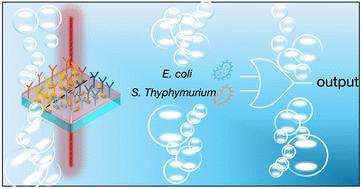
Climate and demographic changes necessitate new paradigms to ensure equitable access to safe drinking water, limiting health, economic, and social damage from poor water management. Nanomaterials present promising opportunities in this area. This work addresses two relevant issues for safe water access: potable water monitoring and disinfection by leveraging plasmonic nanoparticles' biorecognition and photothermal properties. Colloidal gold nanorods (AuNRs), known for their sensitivity to local refractive index changes and light-to-heat conversion ability, are used to create AuNR arrays with optimal morphological and optical characteristics. We demonstrate that these biofunctionalized AuNR arrays, mimicking a logic-OR gate, can detect multiple bacterial strains in water, specifically recognizing two bacterial strains often monitored to guarantee safe access to potable water: Escherichia coli and Salmonella typhimurium (103 CFU per mL). The two strains are recognized separately or simultaneously, highlighting the multiplexing capability of the AuNR array. Furthermore, the exceptional light-to-heat conversion of AuNR arrays in a ‘cascade-like’ configuration, validated by a custom theoretical model, is utilized for photothermal disinfection. In a customized thermo-optical setup, this system effectively reduces pathogen viability by five orders of magnitude within 30 minutes under NIR laser irradiation. The bioactivated AuNR arrays, with their selective pathogen recognition and robust disinfection capabilities, represent a powerful multifunctional technology for monitoring and purifying potable water.





 京公网安备 11010802042870号
京ICP备2023020795号-1
京公网安备 11010802042870号
京ICP备2023020795号-1

 分享
分享
 求助内容:
求助内容: 应助结果提醒方式:
 扫码关注我们
