{"title":"益生菌鸡基复合乳制品的研制与表征","authors":"Shweta Kumari, Priya Dhyani, Aayushi Mishra, Chhaya Goyal, Dinesh Chandra Rai, Baljeet Singh Saharan, Joginder Singh Duhan","doi":"10.1007/s11694-024-03040-5","DOIUrl":null,"url":null,"abstract":"<div><p>This study aimed to develop and optimize a ragi-based probiotic dairy beverage (RPDB) using two probiotic strains, <i>Limosilactobacillus fermentum</i> NCDC143 (LF) and <i>Lacticaseibacillus rhamnosus</i> NCDC347 (LGG). The ragi amount and fermentation duration were optimized through laboratory-scale trials based on sensory characteristics and antioxidant activity. The final optimized product, fermented with either strain, was acceptable to consumers, with average sensory scores above 7 on a 9-point hedonic scale. Proximate and physicochemical analyses were performed. Both fermented beverages (RPDB-LGG & RPDB-LF) showed significantly higher (<i>p</i> < 0.05) 2, 2-diphenyl-1-picryl-hydrazyl (DPPH) inhibition activity (44% & 46%), Total Phenolic Content (359.83 µg GAE/ml & 374.94 µg GAE/ml), and Total Flavonoid Content (14.58 mg QE/ml & 15.36 mg QE/ml) compared to the non-fermented control. Fourier transform infrared spectroscopy (FTIR) analysis characterized the functional groups in the samples. Ultra-high performance liquid chromatography-quadrupole high-resolution accurate mass spectroscopy (UHPLC-Q-Orbitrap-HRAMS)-based metabolomics revealed important biologically active metabolites in the probiotic beverage. Shelf-life analysis showed both beverages maintained recommended viable probiotic counts (at least 6–7 log CFU/ml) for 21 days at 4 °C. Notably, RPDB-LF exhibited better microbiological stability than RPDB-LGG during storage.</p></div>","PeriodicalId":631,"journal":{"name":"Journal of Food Measurement and Characterization","volume":"19 2","pages":"1288 - 1301"},"PeriodicalIF":3.3000,"publicationDate":"2024-12-18","publicationTypes":"Journal Article","fieldsOfStudy":null,"isOpenAccess":false,"openAccessPdf":"","citationCount":"0","resultStr":"{\"title\":\"Development and characterization of probiotic Ragi-based composite dairy product\",\"authors\":\"Shweta Kumari, Priya Dhyani, Aayushi Mishra, Chhaya Goyal, Dinesh Chandra Rai, Baljeet Singh Saharan, Joginder Singh Duhan\",\"doi\":\"10.1007/s11694-024-03040-5\",\"DOIUrl\":null,\"url\":null,\"abstract\":\"<div><p>This study aimed to develop and optimize a ragi-based probiotic dairy beverage (RPDB) using two probiotic strains, <i>Limosilactobacillus fermentum</i> NCDC143 (LF) and <i>Lacticaseibacillus rhamnosus</i> NCDC347 (LGG). The ragi amount and fermentation duration were optimized through laboratory-scale trials based on sensory characteristics and antioxidant activity. The final optimized product, fermented with either strain, was acceptable to consumers, with average sensory scores above 7 on a 9-point hedonic scale. Proximate and physicochemical analyses were performed. Both fermented beverages (RPDB-LGG & RPDB-LF) showed significantly higher (<i>p</i> < 0.05) 2, 2-diphenyl-1-picryl-hydrazyl (DPPH) inhibition activity (44% & 46%), Total Phenolic Content (359.83 µg GAE/ml & 374.94 µg GAE/ml), and Total Flavonoid Content (14.58 mg QE/ml & 15.36 mg QE/ml) compared to the non-fermented control. Fourier transform infrared spectroscopy (FTIR) analysis characterized the functional groups in the samples. Ultra-high performance liquid chromatography-quadrupole high-resolution accurate mass spectroscopy (UHPLC-Q-Orbitrap-HRAMS)-based metabolomics revealed important biologically active metabolites in the probiotic beverage. Shelf-life analysis showed both beverages maintained recommended viable probiotic counts (at least 6–7 log CFU/ml) for 21 days at 4 °C. Notably, RPDB-LF exhibited better microbiological stability than RPDB-LGG during storage.</p></div>\",\"PeriodicalId\":631,\"journal\":{\"name\":\"Journal of Food Measurement and Characterization\",\"volume\":\"19 2\",\"pages\":\"1288 - 1301\"},\"PeriodicalIF\":3.3000,\"publicationDate\":\"2024-12-18\",\"publicationTypes\":\"Journal Article\",\"fieldsOfStudy\":null,\"isOpenAccess\":false,\"openAccessPdf\":\"\",\"citationCount\":\"0\",\"resultStr\":null,\"platform\":\"Semanticscholar\",\"paperid\":null,\"PeriodicalName\":\"Journal of Food Measurement and Characterization\",\"FirstCategoryId\":\"97\",\"ListUrlMain\":\"https://link.springer.com/article/10.1007/s11694-024-03040-5\",\"RegionNum\":3,\"RegionCategory\":\"农林科学\",\"ArticlePicture\":[],\"TitleCN\":null,\"AbstractTextCN\":null,\"PMCID\":null,\"EPubDate\":\"\",\"PubModel\":\"\",\"JCR\":\"Q2\",\"JCRName\":\"FOOD SCIENCE & TECHNOLOGY\",\"Score\":null,\"Total\":0}","platform":"Semanticscholar","paperid":null,"PeriodicalName":"Journal of Food Measurement and Characterization","FirstCategoryId":"97","ListUrlMain":"https://link.springer.com/article/10.1007/s11694-024-03040-5","RegionNum":3,"RegionCategory":"农林科学","ArticlePicture":[],"TitleCN":null,"AbstractTextCN":null,"PMCID":null,"EPubDate":"","PubModel":"","JCR":"Q2","JCRName":"FOOD SCIENCE & TECHNOLOGY","Score":null,"Total":0}
Development and characterization of probiotic Ragi-based composite dairy product
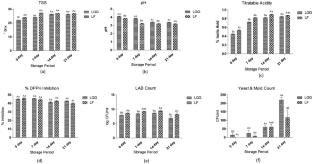
This study aimed to develop and optimize a ragi-based probiotic dairy beverage (RPDB) using two probiotic strains, Limosilactobacillus fermentum NCDC143 (LF) and Lacticaseibacillus rhamnosus NCDC347 (LGG). The ragi amount and fermentation duration were optimized through laboratory-scale trials based on sensory characteristics and antioxidant activity. The final optimized product, fermented with either strain, was acceptable to consumers, with average sensory scores above 7 on a 9-point hedonic scale. Proximate and physicochemical analyses were performed. Both fermented beverages (RPDB-LGG & RPDB-LF) showed significantly higher (p < 0.05) 2, 2-diphenyl-1-picryl-hydrazyl (DPPH) inhibition activity (44% & 46%), Total Phenolic Content (359.83 µg GAE/ml & 374.94 µg GAE/ml), and Total Flavonoid Content (14.58 mg QE/ml & 15.36 mg QE/ml) compared to the non-fermented control. Fourier transform infrared spectroscopy (FTIR) analysis characterized the functional groups in the samples. Ultra-high performance liquid chromatography-quadrupole high-resolution accurate mass spectroscopy (UHPLC-Q-Orbitrap-HRAMS)-based metabolomics revealed important biologically active metabolites in the probiotic beverage. Shelf-life analysis showed both beverages maintained recommended viable probiotic counts (at least 6–7 log CFU/ml) for 21 days at 4 °C. Notably, RPDB-LF exhibited better microbiological stability than RPDB-LGG during storage.
期刊介绍:
This interdisciplinary journal publishes new measurement results, characteristic properties, differentiating patterns, measurement methods and procedures for such purposes as food process innovation, product development, quality control, and safety assurance.
The journal encompasses all topics related to food property measurement and characterization, including all types of measured properties of food and food materials, features and patterns, measurement principles and techniques, development and evaluation of technologies, novel uses and applications, and industrial implementation of systems and procedures.




 京公网安备 11010802042870号
京ICP备2023020795号-1
京公网安备 11010802042870号
京ICP备2023020795号-1

 分享
分享
 求助内容:
求助内容: 应助结果提醒方式:
 扫码关注我们
