Wu Le, Zhen-shan Zhang, Xiao-dan Li, Peng-fei Xiang, Chunxin Li
{"title":"伽玛辐照虎坚果油理化性质及生物活性成分的研究","authors":"Wu Le, Zhen-shan Zhang, Xiao-dan Li, Peng-fei Xiang, Chunxin Li","doi":"10.1007/s11694-024-03042-3","DOIUrl":null,"url":null,"abstract":"<div><p>To explore the impact of gamma irradiation on the physicochemical properties and micronutrient contents of tiger nut oil (TNO), tiger nuts were irradiated at 0, 2, 4, 6 and 8 kGy and stored for 0 and 90 days. The physicochemical indexes, fatty acids, and the contents of tocopherols, sterols and phospholipids in TNO were identified and the structure was analyzed by FTIR. The results revealed that irradiation had no significant influence on the fatty acids of TNO, but increased its physicochemical indexes. Also, bioactive constituents, for instance, tocopherols and carotenoids, decreased with increasing irradiation dose. The phospholipid content increased with irradiation dose, but total sterols increased only at an irradiation dose of 2 kGy. FTIR confirmed that irradiation disrupted the structure of triacylglyceride, exhibiting a minor change in peaks at 3007, 2925, 2855, 1158, 1094 and 1032 cm<sup>− 1</sup>. After 90 days of storage, both irradiated and unirradiated samples showed similar deterioration in oil quality indices compared to the initial storage period. It is recommended that gamma irradiation of tiger nuts should be limited to less than 2 kGy.</p><h3>Graphical abstract</h3><div><figure><div><div><picture><source><img></source></picture></div></div></figure></div></div>","PeriodicalId":631,"journal":{"name":"Journal of Food Measurement and Characterization","volume":"19 2","pages":"1313 - 1324"},"PeriodicalIF":3.3000,"publicationDate":"2024-12-16","publicationTypes":"Journal Article","fieldsOfStudy":null,"isOpenAccess":false,"openAccessPdf":"","citationCount":"0","resultStr":"{\"title\":\"An investigation of the physicochemical properties and bioactive components of oil extracted from gamma-irradiated tiger nuts (Cyperus esculentus L.)\",\"authors\":\"Wu Le, Zhen-shan Zhang, Xiao-dan Li, Peng-fei Xiang, Chunxin Li\",\"doi\":\"10.1007/s11694-024-03042-3\",\"DOIUrl\":null,\"url\":null,\"abstract\":\"<div><p>To explore the impact of gamma irradiation on the physicochemical properties and micronutrient contents of tiger nut oil (TNO), tiger nuts were irradiated at 0, 2, 4, 6 and 8 kGy and stored for 0 and 90 days. The physicochemical indexes, fatty acids, and the contents of tocopherols, sterols and phospholipids in TNO were identified and the structure was analyzed by FTIR. The results revealed that irradiation had no significant influence on the fatty acids of TNO, but increased its physicochemical indexes. Also, bioactive constituents, for instance, tocopherols and carotenoids, decreased with increasing irradiation dose. The phospholipid content increased with irradiation dose, but total sterols increased only at an irradiation dose of 2 kGy. FTIR confirmed that irradiation disrupted the structure of triacylglyceride, exhibiting a minor change in peaks at 3007, 2925, 2855, 1158, 1094 and 1032 cm<sup>− 1</sup>. After 90 days of storage, both irradiated and unirradiated samples showed similar deterioration in oil quality indices compared to the initial storage period. It is recommended that gamma irradiation of tiger nuts should be limited to less than 2 kGy.</p><h3>Graphical abstract</h3><div><figure><div><div><picture><source><img></source></picture></div></div></figure></div></div>\",\"PeriodicalId\":631,\"journal\":{\"name\":\"Journal of Food Measurement and Characterization\",\"volume\":\"19 2\",\"pages\":\"1313 - 1324\"},\"PeriodicalIF\":3.3000,\"publicationDate\":\"2024-12-16\",\"publicationTypes\":\"Journal Article\",\"fieldsOfStudy\":null,\"isOpenAccess\":false,\"openAccessPdf\":\"\",\"citationCount\":\"0\",\"resultStr\":null,\"platform\":\"Semanticscholar\",\"paperid\":null,\"PeriodicalName\":\"Journal of Food Measurement and Characterization\",\"FirstCategoryId\":\"97\",\"ListUrlMain\":\"https://link.springer.com/article/10.1007/s11694-024-03042-3\",\"RegionNum\":3,\"RegionCategory\":\"农林科学\",\"ArticlePicture\":[],\"TitleCN\":null,\"AbstractTextCN\":null,\"PMCID\":null,\"EPubDate\":\"\",\"PubModel\":\"\",\"JCR\":\"Q2\",\"JCRName\":\"FOOD SCIENCE & TECHNOLOGY\",\"Score\":null,\"Total\":0}","platform":"Semanticscholar","paperid":null,"PeriodicalName":"Journal of Food Measurement and Characterization","FirstCategoryId":"97","ListUrlMain":"https://link.springer.com/article/10.1007/s11694-024-03042-3","RegionNum":3,"RegionCategory":"农林科学","ArticlePicture":[],"TitleCN":null,"AbstractTextCN":null,"PMCID":null,"EPubDate":"","PubModel":"","JCR":"Q2","JCRName":"FOOD SCIENCE & TECHNOLOGY","Score":null,"Total":0}
An investigation of the physicochemical properties and bioactive components of oil extracted from gamma-irradiated tiger nuts (Cyperus esculentus L.)
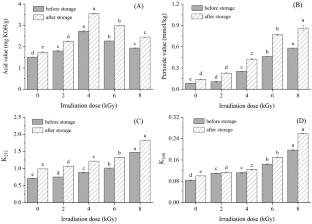
To explore the impact of gamma irradiation on the physicochemical properties and micronutrient contents of tiger nut oil (TNO), tiger nuts were irradiated at 0, 2, 4, 6 and 8 kGy and stored for 0 and 90 days. The physicochemical indexes, fatty acids, and the contents of tocopherols, sterols and phospholipids in TNO were identified and the structure was analyzed by FTIR. The results revealed that irradiation had no significant influence on the fatty acids of TNO, but increased its physicochemical indexes. Also, bioactive constituents, for instance, tocopherols and carotenoids, decreased with increasing irradiation dose. The phospholipid content increased with irradiation dose, but total sterols increased only at an irradiation dose of 2 kGy. FTIR confirmed that irradiation disrupted the structure of triacylglyceride, exhibiting a minor change in peaks at 3007, 2925, 2855, 1158, 1094 and 1032 cm− 1. After 90 days of storage, both irradiated and unirradiated samples showed similar deterioration in oil quality indices compared to the initial storage period. It is recommended that gamma irradiation of tiger nuts should be limited to less than 2 kGy.
期刊介绍:
This interdisciplinary journal publishes new measurement results, characteristic properties, differentiating patterns, measurement methods and procedures for such purposes as food process innovation, product development, quality control, and safety assurance.
The journal encompasses all topics related to food property measurement and characterization, including all types of measured properties of food and food materials, features and patterns, measurement principles and techniques, development and evaluation of technologies, novel uses and applications, and industrial implementation of systems and procedures.




 京公网安备 11010802042870号
京ICP备2023020795号-1
京公网安备 11010802042870号
京ICP备2023020795号-1

 分享
分享
 求助内容:
求助内容: 应助结果提醒方式:
 扫码关注我们
