Julie Morgane Guenat, Antoine Gander, Luca Fumagalli, Guillaume Lavanchy
{"title":"利用环境DNA研究连续湿地中两栖动物的精细繁殖栖息地利用","authors":"Julie Morgane Guenat, Antoine Gander, Luca Fumagalli, Guillaume Lavanchy","doi":"10.1002/edn3.70063","DOIUrl":null,"url":null,"abstract":"<p>Designing effective conservation plans to protect species from extinction requires a comprehensive understanding of their ecology. Conventional methods used to investigate habitat use are time-consuming, and the detectability of cryptic species is often insufficient. Environmental DNA (eDNA)-based approaches provide a complementary tool to traditional monitoring methods for ecosystem monitoring and assessment. Nevertheless, to our knowledge, such methods have rarely been applied to investigate habitat use at a fine scale in a continuous wetland environment. Here, we used an eDNA metabarcoding approach to characterize the breeding habitat use of local amphibian species in a wet meadow expanse along the southern shore of Lake Neuchâtel, Switzerland. We retrieved DNA from six out of the seven species expected to be present. We tested the influence of six abiotic environmental variables on overall species assemblages and individual species occurrences. We showed that the main factor structuring species assemblages was water temperature and that the distribution of three amphibian species was associated with several environmental variables. Our results indicate that the eDNA detection approaches are promising tools to study species' ecology at a small scale in continuous wetland habitats.</p>","PeriodicalId":52828,"journal":{"name":"Environmental DNA","volume":"7 1","pages":""},"PeriodicalIF":5.8000,"publicationDate":"2025-02-04","publicationTypes":"Journal Article","fieldsOfStudy":null,"isOpenAccess":false,"openAccessPdf":"https://onlinelibrary.wiley.com/doi/epdf/10.1002/edn3.70063","citationCount":"0","resultStr":"{\"title\":\"Investigating Fine-Scale Breeding Habitat Use by Amphibians in a Continuous Wetland Using Environmental DNA\",\"authors\":\"Julie Morgane Guenat, Antoine Gander, Luca Fumagalli, Guillaume Lavanchy\",\"doi\":\"10.1002/edn3.70063\",\"DOIUrl\":null,\"url\":null,\"abstract\":\"<p>Designing effective conservation plans to protect species from extinction requires a comprehensive understanding of their ecology. Conventional methods used to investigate habitat use are time-consuming, and the detectability of cryptic species is often insufficient. Environmental DNA (eDNA)-based approaches provide a complementary tool to traditional monitoring methods for ecosystem monitoring and assessment. Nevertheless, to our knowledge, such methods have rarely been applied to investigate habitat use at a fine scale in a continuous wetland environment. Here, we used an eDNA metabarcoding approach to characterize the breeding habitat use of local amphibian species in a wet meadow expanse along the southern shore of Lake Neuchâtel, Switzerland. We retrieved DNA from six out of the seven species expected to be present. We tested the influence of six abiotic environmental variables on overall species assemblages and individual species occurrences. We showed that the main factor structuring species assemblages was water temperature and that the distribution of three amphibian species was associated with several environmental variables. Our results indicate that the eDNA detection approaches are promising tools to study species' ecology at a small scale in continuous wetland habitats.</p>\",\"PeriodicalId\":52828,\"journal\":{\"name\":\"Environmental DNA\",\"volume\":\"7 1\",\"pages\":\"\"},\"PeriodicalIF\":5.8000,\"publicationDate\":\"2025-02-04\",\"publicationTypes\":\"Journal Article\",\"fieldsOfStudy\":null,\"isOpenAccess\":false,\"openAccessPdf\":\"https://onlinelibrary.wiley.com/doi/epdf/10.1002/edn3.70063\",\"citationCount\":\"0\",\"resultStr\":null,\"platform\":\"Semanticscholar\",\"paperid\":null,\"PeriodicalName\":\"Environmental DNA\",\"FirstCategoryId\":\"1085\",\"ListUrlMain\":\"https://onlinelibrary.wiley.com/doi/10.1002/edn3.70063\",\"RegionNum\":0,\"RegionCategory\":null,\"ArticlePicture\":[],\"TitleCN\":null,\"AbstractTextCN\":null,\"PMCID\":null,\"EPubDate\":\"\",\"PubModel\":\"\",\"JCR\":\"Q1\",\"JCRName\":\"Agricultural and Biological Sciences\",\"Score\":null,\"Total\":0}","platform":"Semanticscholar","paperid":null,"PeriodicalName":"Environmental DNA","FirstCategoryId":"1085","ListUrlMain":"https://onlinelibrary.wiley.com/doi/10.1002/edn3.70063","RegionNum":0,"RegionCategory":null,"ArticlePicture":[],"TitleCN":null,"AbstractTextCN":null,"PMCID":null,"EPubDate":"","PubModel":"","JCR":"Q1","JCRName":"Agricultural and Biological Sciences","Score":null,"Total":0}
Investigating Fine-Scale Breeding Habitat Use by Amphibians in a Continuous Wetland Using Environmental DNA
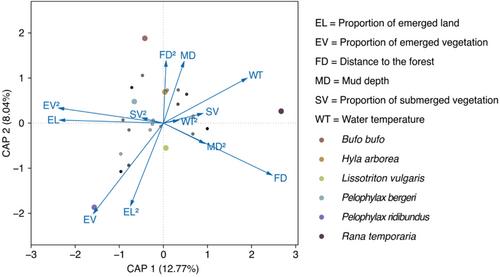
Designing effective conservation plans to protect species from extinction requires a comprehensive understanding of their ecology. Conventional methods used to investigate habitat use are time-consuming, and the detectability of cryptic species is often insufficient. Environmental DNA (eDNA)-based approaches provide a complementary tool to traditional monitoring methods for ecosystem monitoring and assessment. Nevertheless, to our knowledge, such methods have rarely been applied to investigate habitat use at a fine scale in a continuous wetland environment. Here, we used an eDNA metabarcoding approach to characterize the breeding habitat use of local amphibian species in a wet meadow expanse along the southern shore of Lake Neuchâtel, Switzerland. We retrieved DNA from six out of the seven species expected to be present. We tested the influence of six abiotic environmental variables on overall species assemblages and individual species occurrences. We showed that the main factor structuring species assemblages was water temperature and that the distribution of three amphibian species was associated with several environmental variables. Our results indicate that the eDNA detection approaches are promising tools to study species' ecology at a small scale in continuous wetland habitats.





 京公网安备 11010802042870号
京ICP备2023020795号-1
京公网安备 11010802042870号
京ICP备2023020795号-1

 分享
分享
 求助内容:
求助内容: 应助结果提醒方式:
 扫码关注我们
