T. Guo, V. G. Kouznetsova, M. G. D. Geers, K. Veroy, O. Rokoš
{"title":"二阶计算均匀化的降阶建模及其在几何参数化弹性超材料中的应用","authors":"T. Guo, V. G. Kouznetsova, M. G. D. Geers, K. Veroy, O. Rokoš","doi":"10.1002/nme.7604","DOIUrl":null,"url":null,"abstract":"<p>The structural properties of mechanical metamaterials are typically studied with two-scale methods based on computational homogenization. Because such materials have a complex microstructure, enriched schemes such as second-order computational homogenization are required to fully capture their nonlinear behavior, which arises from nonlocal interactions due to the buckling or patterning of the microstructure. In the two-scale formulation, the effective behavior of the microstructure is captured with a representative volume element (RVE), and a homogenized effective continuum is considered on the macroscale. Although an effective continuum formulation is introduced, solving such two-scale models concurrently is still computationally demanding due to the many repeated solutions for each RVE at the microscale level. In this work, we propose a reduced-order model for the microscopic problem arising in second-order computational homogenization, using proper orthogonal decomposition and a novel hyperreduction method that is specifically tailored for this problem and inspired by the empirical cubature method. Two numerical examples are considered, in which the performance of the reduced-order model is carefully assessed by comparing its solutions with direct numerical simulations (entirely resolving the underlying microstructure) and the full second-order computational homogenization model. The reduced-order model is able to approximate the result of the full computational homogenization well, provided that the training data is representative for the problem at hand. Any remaining errors, when compared with the direct numerical simulation, can be attributed to the inherent approximation errors in the computational homogenization scheme. Regarding run times for one thread, speed-ups on the order of 100 are achieved with the reduced-order model as compared to direct numerical simulations.</p>","PeriodicalId":13699,"journal":{"name":"International Journal for Numerical Methods in Engineering","volume":"126 1","pages":""},"PeriodicalIF":3.3000,"publicationDate":"2024-10-10","publicationTypes":"Journal Article","fieldsOfStudy":null,"isOpenAccess":false,"openAccessPdf":"https://onlinelibrary.wiley.com/doi/epdf/10.1002/nme.7604","citationCount":"0","resultStr":"{\"title\":\"Reduced-Order Modeling for Second-Order Computational Homogenization With Applications to Geometrically Parameterized Elastomeric Metamaterials\",\"authors\":\"T. Guo, V. G. Kouznetsova, M. G. D. Geers, K. Veroy, O. Rokoš\",\"doi\":\"10.1002/nme.7604\",\"DOIUrl\":null,\"url\":null,\"abstract\":\"<p>The structural properties of mechanical metamaterials are typically studied with two-scale methods based on computational homogenization. Because such materials have a complex microstructure, enriched schemes such as second-order computational homogenization are required to fully capture their nonlinear behavior, which arises from nonlocal interactions due to the buckling or patterning of the microstructure. In the two-scale formulation, the effective behavior of the microstructure is captured with a representative volume element (RVE), and a homogenized effective continuum is considered on the macroscale. Although an effective continuum formulation is introduced, solving such two-scale models concurrently is still computationally demanding due to the many repeated solutions for each RVE at the microscale level. In this work, we propose a reduced-order model for the microscopic problem arising in second-order computational homogenization, using proper orthogonal decomposition and a novel hyperreduction method that is specifically tailored for this problem and inspired by the empirical cubature method. Two numerical examples are considered, in which the performance of the reduced-order model is carefully assessed by comparing its solutions with direct numerical simulations (entirely resolving the underlying microstructure) and the full second-order computational homogenization model. The reduced-order model is able to approximate the result of the full computational homogenization well, provided that the training data is representative for the problem at hand. Any remaining errors, when compared with the direct numerical simulation, can be attributed to the inherent approximation errors in the computational homogenization scheme. Regarding run times for one thread, speed-ups on the order of 100 are achieved with the reduced-order model as compared to direct numerical simulations.</p>\",\"PeriodicalId\":13699,\"journal\":{\"name\":\"International Journal for Numerical Methods in Engineering\",\"volume\":\"126 1\",\"pages\":\"\"},\"PeriodicalIF\":3.3000,\"publicationDate\":\"2024-10-10\",\"publicationTypes\":\"Journal Article\",\"fieldsOfStudy\":null,\"isOpenAccess\":false,\"openAccessPdf\":\"https://onlinelibrary.wiley.com/doi/epdf/10.1002/nme.7604\",\"citationCount\":\"0\",\"resultStr\":null,\"platform\":\"Semanticscholar\",\"paperid\":null,\"PeriodicalName\":\"International Journal for Numerical Methods in Engineering\",\"FirstCategoryId\":\"5\",\"ListUrlMain\":\"https://onlinelibrary.wiley.com/doi/10.1002/nme.7604\",\"RegionNum\":3,\"RegionCategory\":\"工程技术\",\"ArticlePicture\":[],\"TitleCN\":null,\"AbstractTextCN\":null,\"PMCID\":null,\"EPubDate\":\"\",\"PubModel\":\"\",\"JCR\":\"Q1\",\"JCRName\":\"ENGINEERING, MULTIDISCIPLINARY\",\"Score\":null,\"Total\":0}","platform":"Semanticscholar","paperid":null,"PeriodicalName":"International Journal for Numerical Methods in Engineering","FirstCategoryId":"5","ListUrlMain":"https://onlinelibrary.wiley.com/doi/10.1002/nme.7604","RegionNum":3,"RegionCategory":"工程技术","ArticlePicture":[],"TitleCN":null,"AbstractTextCN":null,"PMCID":null,"EPubDate":"","PubModel":"","JCR":"Q1","JCRName":"ENGINEERING, MULTIDISCIPLINARY","Score":null,"Total":0}
Reduced-Order Modeling for Second-Order Computational Homogenization With Applications to Geometrically Parameterized Elastomeric Metamaterials
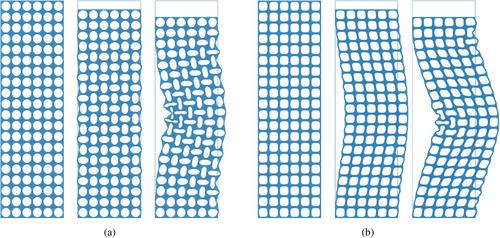
The structural properties of mechanical metamaterials are typically studied with two-scale methods based on computational homogenization. Because such materials have a complex microstructure, enriched schemes such as second-order computational homogenization are required to fully capture their nonlinear behavior, which arises from nonlocal interactions due to the buckling or patterning of the microstructure. In the two-scale formulation, the effective behavior of the microstructure is captured with a representative volume element (RVE), and a homogenized effective continuum is considered on the macroscale. Although an effective continuum formulation is introduced, solving such two-scale models concurrently is still computationally demanding due to the many repeated solutions for each RVE at the microscale level. In this work, we propose a reduced-order model for the microscopic problem arising in second-order computational homogenization, using proper orthogonal decomposition and a novel hyperreduction method that is specifically tailored for this problem and inspired by the empirical cubature method. Two numerical examples are considered, in which the performance of the reduced-order model is carefully assessed by comparing its solutions with direct numerical simulations (entirely resolving the underlying microstructure) and the full second-order computational homogenization model. The reduced-order model is able to approximate the result of the full computational homogenization well, provided that the training data is representative for the problem at hand. Any remaining errors, when compared with the direct numerical simulation, can be attributed to the inherent approximation errors in the computational homogenization scheme. Regarding run times for one thread, speed-ups on the order of 100 are achieved with the reduced-order model as compared to direct numerical simulations.
期刊介绍:
The International Journal for Numerical Methods in Engineering publishes original papers describing significant, novel developments in numerical methods that are applicable to engineering problems.
The Journal is known for welcoming contributions in a wide range of areas in computational engineering, including computational issues in model reduction, uncertainty quantification, verification and validation, inverse analysis and stochastic methods, optimisation, element technology, solution techniques and parallel computing, damage and fracture, mechanics at micro and nano-scales, low-speed fluid dynamics, fluid-structure interaction, electromagnetics, coupled diffusion phenomena, and error estimation and mesh generation. It is emphasized that this is by no means an exhaustive list, and particularly papers on multi-scale, multi-physics or multi-disciplinary problems, and on new, emerging topics are welcome.




 京公网安备 11010802042870号
京ICP备2023020795号-1
京公网安备 11010802042870号
京ICP备2023020795号-1

 分享
分享
 求助内容:
求助内容: 应助结果提醒方式:
 扫码关注我们
