Prof. Xiang-Ming Liang, Prof. Zhi-Jun Ruan, Dr. Gui-Quan Guo, Prof. Jun-Qi Lin, Prof. Di-Chang Zhong
{"title":"过渡金属配合物体系对CO2的还原:氢键对第二配位球的影响","authors":"Prof. Xiang-Ming Liang, Prof. Zhi-Jun Ruan, Dr. Gui-Quan Guo, Prof. Jun-Qi Lin, Prof. Di-Chang Zhong","doi":"10.1002/cctc.202401394","DOIUrl":null,"url":null,"abstract":"<p>Homogeneous electrocatalysts typified by transition-metal complex show transcendent potency in efficient energy catalysis through molecular design. For example, metal complexes with elaborate design performed wonderful activity and selectivity for electrocatalytic CO<sub>2</sub> reduction. Primary coordination sphere of metal complexes plays a key role in regulating its intrinsic redox properties and catalytic activity. However, the overall reduction efficiency of CO<sub>2</sub> is also bound up with the substrate activation process. Transition-metal complexes are hoped to exhibit reasonable redox potential, reactive activity, and stability, while binding and activating CO<sub>2</sub> molecules to achieve efficient CO<sub>2</sub> reduction. Construction of second coordination sphere, especially hydrogen-bonding network of transition-metal complexes, is reported to be the “kill two birds with one stone” strategy to realize efficient CO<sub>2</sub> reduction catalysis via systematic catalyst properties modulation and substrate activation. Herein, we present recent progress on the construction of hydrogen-bonding network in the second coordination sphere of metal complexes by ligand modification or the introduction of exogenous organic ligand, and the resulted productive enhancement of the catalytic performance of metal complexes by the improvement of adsorption capacity and activation of CO<sub>2</sub>, proton transfer rate, and stability of reaction intermediates, and so forth.</p>","PeriodicalId":141,"journal":{"name":"ChemCatChem","volume":"17 2","pages":""},"PeriodicalIF":3.9000,"publicationDate":"2024-10-21","publicationTypes":"Journal Article","fieldsOfStudy":null,"isOpenAccess":false,"openAccessPdf":"","citationCount":"0","resultStr":"{\"title\":\"CO2 Reduction by Transition-Metal Complex Systems: Effect of Hydrogen Bonding on the Second Coordination Sphere\",\"authors\":\"Prof. Xiang-Ming Liang, Prof. Zhi-Jun Ruan, Dr. Gui-Quan Guo, Prof. Jun-Qi Lin, Prof. Di-Chang Zhong\",\"doi\":\"10.1002/cctc.202401394\",\"DOIUrl\":null,\"url\":null,\"abstract\":\"<p>Homogeneous electrocatalysts typified by transition-metal complex show transcendent potency in efficient energy catalysis through molecular design. For example, metal complexes with elaborate design performed wonderful activity and selectivity for electrocatalytic CO<sub>2</sub> reduction. Primary coordination sphere of metal complexes plays a key role in regulating its intrinsic redox properties and catalytic activity. However, the overall reduction efficiency of CO<sub>2</sub> is also bound up with the substrate activation process. Transition-metal complexes are hoped to exhibit reasonable redox potential, reactive activity, and stability, while binding and activating CO<sub>2</sub> molecules to achieve efficient CO<sub>2</sub> reduction. Construction of second coordination sphere, especially hydrogen-bonding network of transition-metal complexes, is reported to be the “kill two birds with one stone” strategy to realize efficient CO<sub>2</sub> reduction catalysis via systematic catalyst properties modulation and substrate activation. Herein, we present recent progress on the construction of hydrogen-bonding network in the second coordination sphere of metal complexes by ligand modification or the introduction of exogenous organic ligand, and the resulted productive enhancement of the catalytic performance of metal complexes by the improvement of adsorption capacity and activation of CO<sub>2</sub>, proton transfer rate, and stability of reaction intermediates, and so forth.</p>\",\"PeriodicalId\":141,\"journal\":{\"name\":\"ChemCatChem\",\"volume\":\"17 2\",\"pages\":\"\"},\"PeriodicalIF\":3.9000,\"publicationDate\":\"2024-10-21\",\"publicationTypes\":\"Journal Article\",\"fieldsOfStudy\":null,\"isOpenAccess\":false,\"openAccessPdf\":\"\",\"citationCount\":\"0\",\"resultStr\":null,\"platform\":\"Semanticscholar\",\"paperid\":null,\"PeriodicalName\":\"ChemCatChem\",\"FirstCategoryId\":\"92\",\"ListUrlMain\":\"https://chemistry-europe.onlinelibrary.wiley.com/doi/10.1002/cctc.202401394\",\"RegionNum\":3,\"RegionCategory\":\"化学\",\"ArticlePicture\":[],\"TitleCN\":null,\"AbstractTextCN\":null,\"PMCID\":null,\"EPubDate\":\"\",\"PubModel\":\"\",\"JCR\":\"Q2\",\"JCRName\":\"CHEMISTRY, PHYSICAL\",\"Score\":null,\"Total\":0}","platform":"Semanticscholar","paperid":null,"PeriodicalName":"ChemCatChem","FirstCategoryId":"92","ListUrlMain":"https://chemistry-europe.onlinelibrary.wiley.com/doi/10.1002/cctc.202401394","RegionNum":3,"RegionCategory":"化学","ArticlePicture":[],"TitleCN":null,"AbstractTextCN":null,"PMCID":null,"EPubDate":"","PubModel":"","JCR":"Q2","JCRName":"CHEMISTRY, PHYSICAL","Score":null,"Total":0}
CO2 Reduction by Transition-Metal Complex Systems: Effect of Hydrogen Bonding on the Second Coordination Sphere
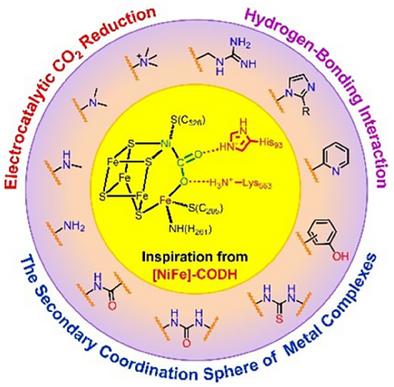
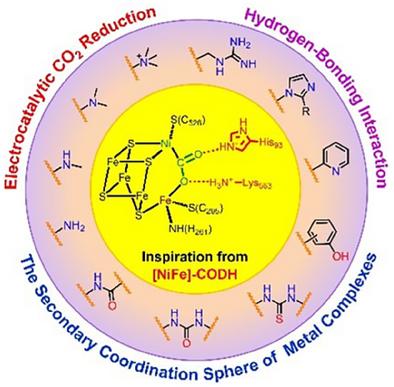
Homogeneous electrocatalysts typified by transition-metal complex show transcendent potency in efficient energy catalysis through molecular design. For example, metal complexes with elaborate design performed wonderful activity and selectivity for electrocatalytic CO2 reduction. Primary coordination sphere of metal complexes plays a key role in regulating its intrinsic redox properties and catalytic activity. However, the overall reduction efficiency of CO2 is also bound up with the substrate activation process. Transition-metal complexes are hoped to exhibit reasonable redox potential, reactive activity, and stability, while binding and activating CO2 molecules to achieve efficient CO2 reduction. Construction of second coordination sphere, especially hydrogen-bonding network of transition-metal complexes, is reported to be the “kill two birds with one stone” strategy to realize efficient CO2 reduction catalysis via systematic catalyst properties modulation and substrate activation. Herein, we present recent progress on the construction of hydrogen-bonding network in the second coordination sphere of metal complexes by ligand modification or the introduction of exogenous organic ligand, and the resulted productive enhancement of the catalytic performance of metal complexes by the improvement of adsorption capacity and activation of CO2, proton transfer rate, and stability of reaction intermediates, and so forth.
期刊介绍:
With an impact factor of 4.495 (2018), ChemCatChem is one of the premier journals in the field of catalysis. The journal provides primary research papers and critical secondary information on heterogeneous, homogeneous and bio- and nanocatalysis. The journal is well placed to strengthen cross-communication within between these communities. Its authors and readers come from academia, the chemical industry, and government laboratories across the world. It is published on behalf of Chemistry Europe, an association of 16 European chemical societies, and is supported by the German Catalysis Society.





 京公网安备 11010802042870号
京ICP备2023020795号-1
京公网安备 11010802042870号
京ICP备2023020795号-1

 分享
分享
 求助内容:
求助内容: 应助结果提醒方式:
 扫码关注我们
