{"title":"蒸发岩对湟水河流域微咸地下水水文地球化学过程的影响","authors":"Haofan Zheng, Xumei Mao, Hongming Peng, Wen Cai, Youjing Yuan, Xixi Zha, Zhen Zhao, Jiamin Liu","doi":"10.1002/hyp.70041","DOIUrl":null,"url":null,"abstract":"<div>\n \n <p>The Huangshui River is a major tributary of the upper Yellow River. Understanding the hydrogeochemical processes involved in the formation of brackish groundwater in the Huangshui River Basin is essential for the rational development and utilisation of water resources, as well as for the protection of water resources and aquatic ecosystems. The chemical composition of brackish groundwater can reveal the hydrogeochemical processes it has undergone, while isotopic tracing can indicate the sources and processes of groundwater formation. This study employs hydrochemical and isotopic analyses to elucidate the contribution of groundwater–rock interactions to the formation of brackish groundwater in the Huangshui River Basin. The groundwater is classified as HCO<sub>3</sub>–Ca·Mg type freshwater and SO<sub>4</sub>·Cl–Ca·Mg type brackish water. Based on ion ratio coefficients and <sup>87</sup>Sr/<sup>86</sup>Sr ratios, mineral dissolution, evaporation concentration and cation exchange are the dominant processes in the hydrochemical formation of brackish groundwater in the basin. The primary minerals undergoing dissolution in the basin include evaporites, carbonates and silicates. Discrimination using a hydrochemical component end-member mixing model identifies evaporites (73.6%) and carbonates (4.5%) as the main dissolved components in the brackish groundwater segment, while evaporites (67.5%) and carbonates (16.25%) are predominant in the partial dissolution of minerals in the freshwater segment. This suggests that the dissolution of evaporites plays a significant role in shaping the hydrogeochemistry of the Huangshui River Basin.</p>\n </div>","PeriodicalId":13189,"journal":{"name":"Hydrological Processes","volume":"38 12","pages":""},"PeriodicalIF":2.9000,"publicationDate":"2024-12-25","publicationTypes":"Journal Article","fieldsOfStudy":null,"isOpenAccess":false,"openAccessPdf":"","citationCount":"0","resultStr":"{\"title\":\"The Impacts of Evaporites on the Hydrogeochemical Processes of Brackish Groundwater in the Huangshui River Basin, Northwest China\",\"authors\":\"Haofan Zheng, Xumei Mao, Hongming Peng, Wen Cai, Youjing Yuan, Xixi Zha, Zhen Zhao, Jiamin Liu\",\"doi\":\"10.1002/hyp.70041\",\"DOIUrl\":null,\"url\":null,\"abstract\":\"<div>\\n \\n <p>The Huangshui River is a major tributary of the upper Yellow River. Understanding the hydrogeochemical processes involved in the formation of brackish groundwater in the Huangshui River Basin is essential for the rational development and utilisation of water resources, as well as for the protection of water resources and aquatic ecosystems. The chemical composition of brackish groundwater can reveal the hydrogeochemical processes it has undergone, while isotopic tracing can indicate the sources and processes of groundwater formation. This study employs hydrochemical and isotopic analyses to elucidate the contribution of groundwater–rock interactions to the formation of brackish groundwater in the Huangshui River Basin. The groundwater is classified as HCO<sub>3</sub>–Ca·Mg type freshwater and SO<sub>4</sub>·Cl–Ca·Mg type brackish water. Based on ion ratio coefficients and <sup>87</sup>Sr/<sup>86</sup>Sr ratios, mineral dissolution, evaporation concentration and cation exchange are the dominant processes in the hydrochemical formation of brackish groundwater in the basin. The primary minerals undergoing dissolution in the basin include evaporites, carbonates and silicates. Discrimination using a hydrochemical component end-member mixing model identifies evaporites (73.6%) and carbonates (4.5%) as the main dissolved components in the brackish groundwater segment, while evaporites (67.5%) and carbonates (16.25%) are predominant in the partial dissolution of minerals in the freshwater segment. This suggests that the dissolution of evaporites plays a significant role in shaping the hydrogeochemistry of the Huangshui River Basin.</p>\\n </div>\",\"PeriodicalId\":13189,\"journal\":{\"name\":\"Hydrological Processes\",\"volume\":\"38 12\",\"pages\":\"\"},\"PeriodicalIF\":2.9000,\"publicationDate\":\"2024-12-25\",\"publicationTypes\":\"Journal Article\",\"fieldsOfStudy\":null,\"isOpenAccess\":false,\"openAccessPdf\":\"\",\"citationCount\":\"0\",\"resultStr\":null,\"platform\":\"Semanticscholar\",\"paperid\":null,\"PeriodicalName\":\"Hydrological Processes\",\"FirstCategoryId\":\"89\",\"ListUrlMain\":\"https://onlinelibrary.wiley.com/doi/10.1002/hyp.70041\",\"RegionNum\":3,\"RegionCategory\":\"地球科学\",\"ArticlePicture\":[],\"TitleCN\":null,\"AbstractTextCN\":null,\"PMCID\":null,\"EPubDate\":\"\",\"PubModel\":\"\",\"JCR\":\"Q1\",\"JCRName\":\"Environmental Science\",\"Score\":null,\"Total\":0}","platform":"Semanticscholar","paperid":null,"PeriodicalName":"Hydrological Processes","FirstCategoryId":"89","ListUrlMain":"https://onlinelibrary.wiley.com/doi/10.1002/hyp.70041","RegionNum":3,"RegionCategory":"地球科学","ArticlePicture":[],"TitleCN":null,"AbstractTextCN":null,"PMCID":null,"EPubDate":"","PubModel":"","JCR":"Q1","JCRName":"Environmental Science","Score":null,"Total":0}
The Impacts of Evaporites on the Hydrogeochemical Processes of Brackish Groundwater in the Huangshui River Basin, Northwest China
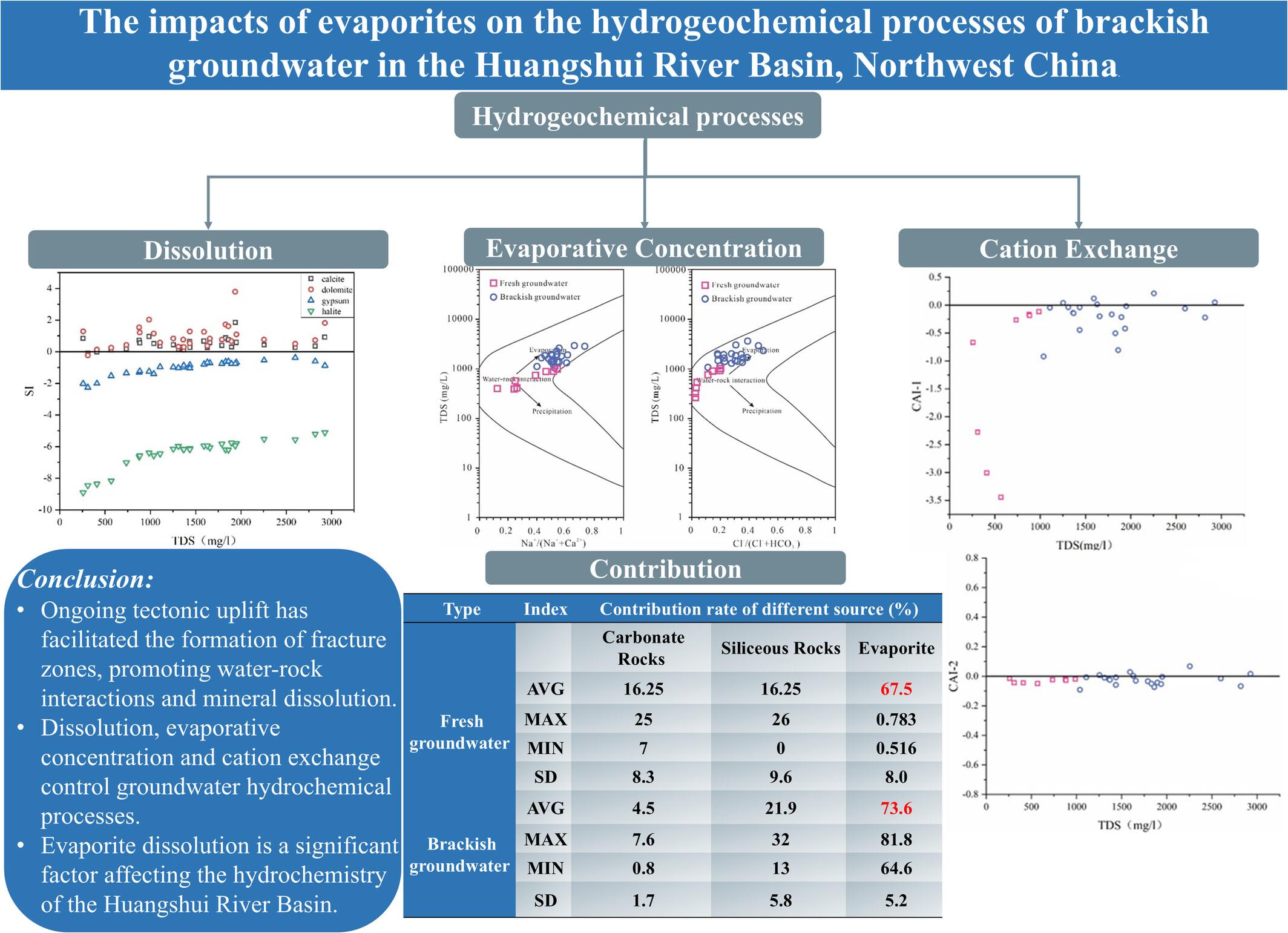
The Huangshui River is a major tributary of the upper Yellow River. Understanding the hydrogeochemical processes involved in the formation of brackish groundwater in the Huangshui River Basin is essential for the rational development and utilisation of water resources, as well as for the protection of water resources and aquatic ecosystems. The chemical composition of brackish groundwater can reveal the hydrogeochemical processes it has undergone, while isotopic tracing can indicate the sources and processes of groundwater formation. This study employs hydrochemical and isotopic analyses to elucidate the contribution of groundwater–rock interactions to the formation of brackish groundwater in the Huangshui River Basin. The groundwater is classified as HCO3–Ca·Mg type freshwater and SO4·Cl–Ca·Mg type brackish water. Based on ion ratio coefficients and 87Sr/86Sr ratios, mineral dissolution, evaporation concentration and cation exchange are the dominant processes in the hydrochemical formation of brackish groundwater in the basin. The primary minerals undergoing dissolution in the basin include evaporites, carbonates and silicates. Discrimination using a hydrochemical component end-member mixing model identifies evaporites (73.6%) and carbonates (4.5%) as the main dissolved components in the brackish groundwater segment, while evaporites (67.5%) and carbonates (16.25%) are predominant in the partial dissolution of minerals in the freshwater segment. This suggests that the dissolution of evaporites plays a significant role in shaping the hydrogeochemistry of the Huangshui River Basin.
期刊介绍:
Hydrological Processes is an international journal that publishes original scientific papers advancing understanding of the mechanisms underlying the movement and storage of water in the environment, and the interaction of water with geological, biogeochemical, atmospheric and ecological systems. Not all papers related to water resources are appropriate for submission to this journal; rather we seek papers that clearly articulate the role(s) of hydrological processes.




 京公网安备 11010802042870号
京ICP备2023020795号-1
京公网安备 11010802042870号
京ICP备2023020795号-1

 分享
分享
 求助内容:
求助内容: 应助结果提醒方式:
 扫码关注我们
