Jingwen Zhang, Zeyang He, Hao Fu, Wei Kong, Petr Senin, Arkadii Proskurin, Ting Bian, Shitan Yan
{"title":"基于多金属氧酸盐的金属-有机骨架制备的空心Mo掺杂CoS2多面体,用于高效整体水分解","authors":"Jingwen Zhang, Zeyang He, Hao Fu, Wei Kong, Petr Senin, Arkadii Proskurin, Ting Bian, Shitan Yan","doi":"10.1002/slct.202405183","DOIUrl":null,"url":null,"abstract":"<p>Nowadays, the sluggish hydrogen evolution reaction (HER) and oxygen evolution reaction (OER) kinetics are the key obstacles limiting the commercial application of water splitting. In this study, a size-matching strategy is proposed to construct the molybdenum-doped CoS<sub>2</sub> polyhedra (Mo-CoS<sub>2</sub>) by encapsulating polyoxometalate (POM, H<sub>3</sub>PMo<sub>12</sub>O<sub>40</sub>) guests into mesoporous zeolite imidazolium framework-67 (ZIF-67), with thioacetamide (TAA) serving as a gentle sulfur source. The catalyst exhibits a pronounced hollow structure due to the synergistic etching effects of POM and TAA, which can increase the number of active sites. Additionally, the incorporation of Mo optimizes the electronic structure, thereby improving both HER and OER performance. In alkaline electrolytes, Mo-CoS<sub>2</sub> delivers an overpotential of 330 mV and 269 mV for OER and HER, respectively, to produce a current density of 100 mA cm<sup>−2</sup>. Moreover, Mo-CoS<sub>2</sub> demonstrates exceptional performance in overall water splitting, achieving a cell voltage of 1.55 V at 10 mA cm<sup>−2</sup>, along with outstanding long-term stability. This study provides a promising avenue for the structural and component optimization of cobalt sulfide, which could significantly improve the efficiency of hydrogen production.</p>","PeriodicalId":146,"journal":{"name":"ChemistrySelect","volume":"10 4","pages":""},"PeriodicalIF":2.3000,"publicationDate":"2025-01-27","publicationTypes":"Journal Article","fieldsOfStudy":null,"isOpenAccess":false,"openAccessPdf":"","citationCount":"0","resultStr":"{\"title\":\"Hollow Mo Doped CoS2 Polyhedron Derived from Polyoxometalate-based Metal-Organic Frameworks for Efficient Overall Water Splitting\",\"authors\":\"Jingwen Zhang, Zeyang He, Hao Fu, Wei Kong, Petr Senin, Arkadii Proskurin, Ting Bian, Shitan Yan\",\"doi\":\"10.1002/slct.202405183\",\"DOIUrl\":null,\"url\":null,\"abstract\":\"<p>Nowadays, the sluggish hydrogen evolution reaction (HER) and oxygen evolution reaction (OER) kinetics are the key obstacles limiting the commercial application of water splitting. In this study, a size-matching strategy is proposed to construct the molybdenum-doped CoS<sub>2</sub> polyhedra (Mo-CoS<sub>2</sub>) by encapsulating polyoxometalate (POM, H<sub>3</sub>PMo<sub>12</sub>O<sub>40</sub>) guests into mesoporous zeolite imidazolium framework-67 (ZIF-67), with thioacetamide (TAA) serving as a gentle sulfur source. The catalyst exhibits a pronounced hollow structure due to the synergistic etching effects of POM and TAA, which can increase the number of active sites. Additionally, the incorporation of Mo optimizes the electronic structure, thereby improving both HER and OER performance. In alkaline electrolytes, Mo-CoS<sub>2</sub> delivers an overpotential of 330 mV and 269 mV for OER and HER, respectively, to produce a current density of 100 mA cm<sup>−2</sup>. Moreover, Mo-CoS<sub>2</sub> demonstrates exceptional performance in overall water splitting, achieving a cell voltage of 1.55 V at 10 mA cm<sup>−2</sup>, along with outstanding long-term stability. This study provides a promising avenue for the structural and component optimization of cobalt sulfide, which could significantly improve the efficiency of hydrogen production.</p>\",\"PeriodicalId\":146,\"journal\":{\"name\":\"ChemistrySelect\",\"volume\":\"10 4\",\"pages\":\"\"},\"PeriodicalIF\":2.3000,\"publicationDate\":\"2025-01-27\",\"publicationTypes\":\"Journal Article\",\"fieldsOfStudy\":null,\"isOpenAccess\":false,\"openAccessPdf\":\"\",\"citationCount\":\"0\",\"resultStr\":null,\"platform\":\"Semanticscholar\",\"paperid\":null,\"PeriodicalName\":\"ChemistrySelect\",\"FirstCategoryId\":\"92\",\"ListUrlMain\":\"https://chemistry-europe.onlinelibrary.wiley.com/doi/10.1002/slct.202405183\",\"RegionNum\":4,\"RegionCategory\":\"化学\",\"ArticlePicture\":[],\"TitleCN\":null,\"AbstractTextCN\":null,\"PMCID\":null,\"EPubDate\":\"\",\"PubModel\":\"\",\"JCR\":\"Q3\",\"JCRName\":\"CHEMISTRY, MULTIDISCIPLINARY\",\"Score\":null,\"Total\":0}","platform":"Semanticscholar","paperid":null,"PeriodicalName":"ChemistrySelect","FirstCategoryId":"92","ListUrlMain":"https://chemistry-europe.onlinelibrary.wiley.com/doi/10.1002/slct.202405183","RegionNum":4,"RegionCategory":"化学","ArticlePicture":[],"TitleCN":null,"AbstractTextCN":null,"PMCID":null,"EPubDate":"","PubModel":"","JCR":"Q3","JCRName":"CHEMISTRY, MULTIDISCIPLINARY","Score":null,"Total":0}
引用次数: 0
摘要
目前,析氢反应(HER)和析氧反应(OER)动力学滞后是制约裂解水商业化应用的主要障碍。在本研究中,提出了一种尺寸匹配策略,通过将聚金属氧酸盐(POM, H3PMo12O40)包裹在介孔分子筛咪唑框架-67 (ZIF-67)中,以硫乙酰胺(TAA)作为温和硫源,构建掺杂钼的CoS2多晶体(Mo-CoS2)。由于POM和TAA的协同蚀刻作用,催化剂呈现出明显的空心结构,从而增加了活性位点的数量。此外,Mo的加入优化了电子结构,从而提高了HER和OER性能。在碱性电解质中,Mo-CoS2分别为OER和HER提供330 mV和269 mV的过电位,产生100 mA cm−2的电流密度。此外,Mo-CoS2在整体水分解方面表现出优异的性能,在10 mA cm - 2时达到1.55 V的电池电压,并具有出色的长期稳定性。该研究为硫化钴的结构和成分优化提供了一条有希望的途径,可以显著提高制氢效率。
Hollow Mo Doped CoS2 Polyhedron Derived from Polyoxometalate-based Metal-Organic Frameworks for Efficient Overall Water Splitting
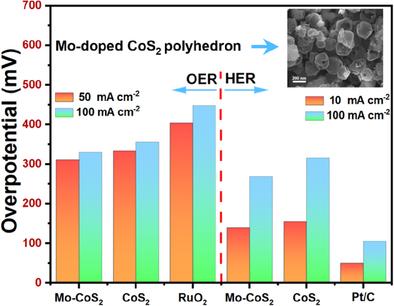
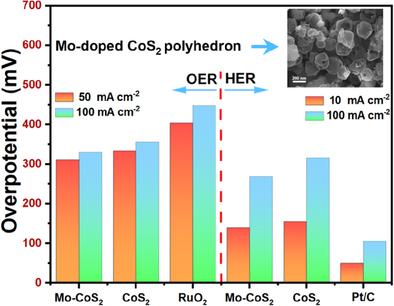
Nowadays, the sluggish hydrogen evolution reaction (HER) and oxygen evolution reaction (OER) kinetics are the key obstacles limiting the commercial application of water splitting. In this study, a size-matching strategy is proposed to construct the molybdenum-doped CoS2 polyhedra (Mo-CoS2) by encapsulating polyoxometalate (POM, H3PMo12O40) guests into mesoporous zeolite imidazolium framework-67 (ZIF-67), with thioacetamide (TAA) serving as a gentle sulfur source. The catalyst exhibits a pronounced hollow structure due to the synergistic etching effects of POM and TAA, which can increase the number of active sites. Additionally, the incorporation of Mo optimizes the electronic structure, thereby improving both HER and OER performance. In alkaline electrolytes, Mo-CoS2 delivers an overpotential of 330 mV and 269 mV for OER and HER, respectively, to produce a current density of 100 mA cm−2. Moreover, Mo-CoS2 demonstrates exceptional performance in overall water splitting, achieving a cell voltage of 1.55 V at 10 mA cm−2, along with outstanding long-term stability. This study provides a promising avenue for the structural and component optimization of cobalt sulfide, which could significantly improve the efficiency of hydrogen production.
期刊介绍:
ChemistrySelect is the latest journal from ChemPubSoc Europe and Wiley-VCH. It offers researchers a quality society-owned journal in which to publish their work in all areas of chemistry. Manuscripts are evaluated by active researchers to ensure they add meaningfully to the scientific literature, and those accepted are processed quickly to ensure rapid online publication.





 京公网安备 11010802042870号
京ICP备2023020795号-1
京公网安备 11010802042870号
京ICP备2023020795号-1

 分享
分享
 求助内容:
求助内容: 应助结果提醒方式:
 扫码关注我们
